Rich vs light moisturiser: which texture dry skin needs and when
ACTIVE INGREDIENTS
Rich vs light moisturiser is rarely a true either-or decision for dry skin. A light moisturiser mainly binds water, while a rich cream puts more lipids on the skin and slows down evaporation. Dry skin is usually short of lipids, so it is worth understanding what very dry skin on the face is really missing. If your skin feels tight even though your T-zone is shiny, it is more likely dehydrated than dry. The honest answer is usually: both, in two layers. In the evening and in winter, the top layer can be richer – more on that in the articles on whether you need a night cream and on winter face cream.
Rich vs light moisturiser: what is the difference?
The difference between a rich and a light moisturiser lies in the ratio of water to lipids and in which job the formula puts first. Neither term has a fixed definition. A review in Clinical Medicine & Research even states that there is no agreed definition of ‘moisturiser’ and that the term was coined by marketers. A review in the American Journal of Clinical Dermatology describes the same confusion from the other side: ‘moisturiser’ and ‘emollient’ are often used interchangeably, even though moisturisers usually also contain humectants, which are meant to supply the skin’s outermost layer with water.
In practice, this means that a light moisturiser contains a lot of water, humectants such as glycerin or hyaluronic acid and relatively little oil. It sinks in quickly and feels light. A rich cream has a much higher proportion of lipids, often from butters, waxes or petroleum jelly, and leaves a noticeable film. Almost every cream contains both, just in different proportions. So the better question is not which label is on the front, but which layer your skin is missing. The other criteria that matter when you buy are covered in the guide to choosing a moisturiser for dry skin.
What do humectants, emollients and occlusives do in a cream?
Humectants attract water, emollients make the skin soft and supple, and occlusives form a film that slows down evaporation. A review in the Indian Journal of Dermatology describes humectants as substances that draw water from deeper layers of the skin into the epidermis and, when the air is humid, from the surroundings as well. The catch comes straight after: this water is easily lost again at the surface, which is why humectants are usually combined with occlusives. According to the same paper, emollients are mainly lipids and oils that make the skin softer, more flexible and smoother. For occlusives, it points out a difference that explains texture: petroleum jelly at a concentration of at least 5% reduces water loss through the skin by more than 98 per cent, whereas lanolin, mineral oil and silicones only reduce it by 20 to 30 per cent. The paper also names the greasy feel on the skin as a drawback. The review in Clinical Medicine & Research adds that glycerin combined with occlusives relieves dryness more effectively than glycerin on its own.
| Group | What it does | Typical INCI names | How it feels |
|---|---|---|---|
| Humectants | Bind water in the skin’s outermost layer | Glycerin, Sodium Hyaluronate, Panthenol, Urea, Aloe Barbadensis Leaf Juice, polysaccharides | Light, fresh, no film |
| Emollients | Fill the gaps between skin cells, make skin supple | Squalane, Caprylic/Capric Triglyceride, Ceramide NP, plant oils such as Simmondsia Chinensis Seed Oil | Soft, nourished, hardly any shine |
| Occlusives | Form a film and slow down evaporation | Petrolatum, Paraffinum Liquidum, Cera Alba, Butyrospermum Parkii Butter, Lanolin | Rich, noticeable, often shiny |
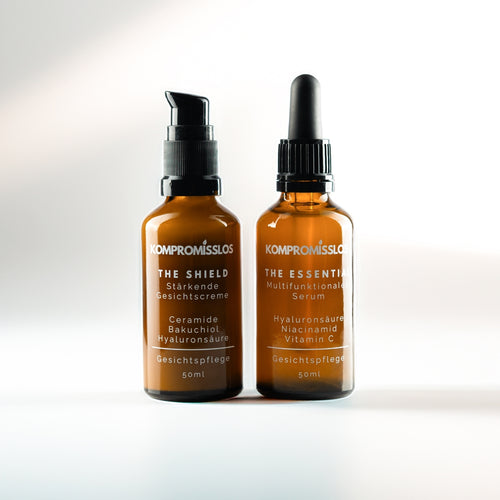
This leads to a simple rule: hydration and lipids belong in separate layers. A light serum with humectants goes on first, followed by a cream with lipids. Why this split works better than one product that is supposed to do everything is explained in the article on whether you really need both a serum and a cream. The Duo is built exactly this way: the serum provides hyaluronic acid in three molecular sizes, the cream ceramide NP, squalane and jojoba oil. Aloe juice and tamarind seed are further humectants in the Duo.
Oil-in-water or water-in-oil: how can you tell the texture?
In an oil-in-water emulsion, tiny droplets of oil are dispersed in water; in a water-in-oil emulsion, it is the other way round – and that is exactly what you feel when you apply it. If water is on the outside, the cream sinks in quickly, feels cool and is easy to thin with water. If oil is on the outside, a supple film remains, the cream takes longer to absorb and water tends to bead off it. The review in Clinical Medicine & Research classes lotions as oil-in-water emulsions; creams can be either, while ointments contain too little water to form a separate second phase. Classic rich creams and cold creams are usually water-in-oil, gel creams and most day creams oil-in-water. The emulsion type is rarely stated on the pack, but you can recognise it from a few signs:
- The name: ‘W/O’, ‘rich cream’ or ‘cold cream’ point to water-in-oil, ‘gel cream’, ‘fluid’ or ‘lotion’ to oil-in-water.
- The back-of-the-hand test: after one to two minutes, an oil-in-water cream can hardly be felt, while a water-in-oil cream stays shiny for longer.
- A drop of water: it blends into an oil-in-water cream but tends to sit on top of a water-in-oil cream.
- The cooling effect: water on the outside evaporates as you spread it and feels fresh, oil on the outside does not.
Which texture feels right is also a personal matter. In her review on Judge.me, Daniela B. writes: “As my skin is on the dry, mature side, I would like the face cream to be a little richer, so I add a facial oil from another brand” (review translated from German). That is a sensible solution: rather than switching cream, she adds an extra layer of lipids on top. When that is worth it and when it is not is covered in the article Serum or face oil: what your skin actually needs.
How can you tell from the INCI list whether a cream replenishes lipids or only binds moisture?
You can tell whether a cream replenishes lipids or mainly binds moisture from the first five to eight names on the INCI list. Ingredients are always listed in descending order of quantity; only very small amounts at the end may follow in any order. So whatever is near the top shapes the texture. How to read an ingredient list in general, including preservatives and fragrance, is explained in the guide on how to read an ingredient list. For the question of texture, three observations are enough:
- If Aqua is followed first by glycerin, hyaluronic acid (Sodium Hyaluronate), aloe juice or thickeners such as Xanthan Gum, and oils only appear further down, it is a light moisturiser or gel cream.
- If oils, Squalane, triglycerides or fatty alcohols such as Cetearyl Alcohol are among the first few ingredients, the cream noticeably replenishes lipids without being heavy.
- If Petrolatum, Paraffinum Liquidum, Butyrospermum Parkii Butter or waxes such as Cera Alba come right at the top, it is a rich cream that leaves a distinct film.
A special case is a list that does not start with Aqua. If a plant juice such as Aloe Barbadensis Leaf Juice comes first instead, that juice takes on the role of the water phase and brings humectants of its own. If there is no Aqua at all and the list contains only oils, butters and waxes, you are looking at a balm, not a cream.
Do not try a new texture on your whole face straight away. Apply it to one cheek only for a few evenings and compare the two sides in the morning: if that side feels less tight and is no shinier, the balance of moisture and oil is right.
How rich a moisturiser can combination or blemish-prone skin handle?
Combination and blemish-prone skin usually do not need oil-free skincare, but light protection against evaporation – and not equally thick everywhere. A paper in the Journal of Clinical and Aesthetic Dermatology examined 52 moisturisers marketed for skin with acne. The authors note that moisturisers have three basic properties – humectant, emollient and occlusive – and more than half of the products examined contain dimethicone and/or glycerin. The two usually appear together in a formula: the humectant glycerin and the silicone dimethicone, which according to the authors reduces water loss without feeling greasy. So even skincare for blemish-prone skin relies on protection against evaporation, just in a light form. What matters is the type of lipid and the right amount in the right place: a thin layer is often enough on the T-zone, while the cheeks and jawline can take more.
The worry that oil clogs pores is understandable, but often too sweeping. The usual lists rate individual raw materials on the basis of old tests, not the finished formula. What the rating really tells you is explained in the article Comedogenic: what it means. If your skin is dry and blemish-prone at the same time, you do not need completely oil-free skincare, but skincare that takes both into account, as the article on dry skin and breakouts shows. If you have inflamed acne, have it assessed by a dermatologist; skincare then only plays a supporting role.
I decided on two products instead of eight because that almost solves the texture question by itself. The serum provides moisture, the cream holds it in. In the INCI list of the Duo, aloe vera juice even comes before water; it is the base of both products. The cream contains ceramide NP, squalane and jojoba oil, but no petroleum jelly, no mineral oil and no shea butter. That means The Shield is not a classic rich cream, and it is not trying to be one. If your skin is very dry and needs more lipids in the evening, an extra layer of oil can make sense – I would rather say that openly than sell you a third cream. You can find every ingredient under ingredients from A to Z.
Frequently asked questions
Does hyaluronic acid add moisture or oil?
Hyaluronic acid is a humectant, not an oil. It binds water in the skin’s outermost layer, but does not leave a lipid film and does little to slow down evaporation. That is why it needs a cream on top; otherwise some of the water it binds is lost again. What else the ingredient does and where its limits lie is covered in the article on what hyaluronic acid really does for skin.
Is a rich cream too heavy in summer?
For the face, a classic rich cream is often too heavy in summer. When humidity is higher, less water evaporates through the skin, and humectants can then also draw water from the air. A lighter cream over your serum is usually enough. If certain areas stay dry, simply apply a little more of the same cream there rather than a second one.
Is a gel cream the same as a light moisturiser?
Not quite. ‘Gel cream’ describes the texture: plenty of water, a gelling agent and little oil. ‘Moisturiser’ describes the main job. A gel cream is almost always a light moisturiser, but not every light moisturiser is a gel. On its own, a gel cream usually provides too few lipids for dry skin.
Can I layer a light moisturiser and a rich cream?
Yes, as long as you apply the lighter texture first and the richer one on top. The other way round, the water-rich cream struggles to get through the film of oil. Two creams on top of each other are rarely necessary, though. A serum with humectants under a cream with lipids does the same job with clearly separated layers.
Is a balm the same as a rich cream?
No. A balm usually contains no water, only oils, butters and waxes. A rich cream, by contrast, is an emulsion, usually water-in-oil, and so still brings some water with it. A balm protects against evaporation but provides no moisture of its own. If you use one at all, it belongs on top of your skincare as the final layer.
Does mature skin automatically need a rich cream?
No. Mature skin produces fewer lipids, but it also loses moisture, so it usually needs both rather than simply more oil. A heavy cream on its own does nothing about the lack of water. How to build your skincare for dry skin with age is covered in a separate guide.
Is The Duo more of a light moisturiser or a rich cream?
Neither – The Duo splits the two jobs across two layers. The Essential serum provides humectants, including hyaluronic acid in three molecular sizes. The Shield cream adds lipids such as ceramide NP, squalane and jojoba oil on top, without petroleum jelly or mineral oil. If your skin is very dry, you can use a little more. You can see how the two work together on the page for The Duo of serum and cream.
Sources
- Sethi A, Kaur T, Malhotra SK, Gambhir ML. Moisturizers: The Slippery Road. Indian Journal of Dermatology, 2016. Source
- Purnamawati S, Indrastuti N, Danarti R, Saefudin T. The Role of Moisturizers in Addressing Various Kinds of Dermatitis: A Review. Clinical Medicine & Research, 2017. Source
- Lodén M. Role of topical emollients and moisturizers in the treatment of dry skin barrier disorders. American Journal of Clinical Dermatology, 2003. Source
- Chularojanamontri L, Tuchinda P, Kulthanan K, Pongparit K. Moisturizers for Acne: What are their Constituents? Journal of Clinical and Aesthetic Dermatology, 2014. Source