Serum and cream: do you really need both?
ROUTINE
A serum and a cream do two different jobs. The serum carries water-binding active ingredients into the outermost layer of your skin; the cream keeps that moisture there and protects the surface. Together they make a complete routine. One product on its own can be enough if your skin is stable and the air around you stays humid.
What is the difference between a serum and a cream?
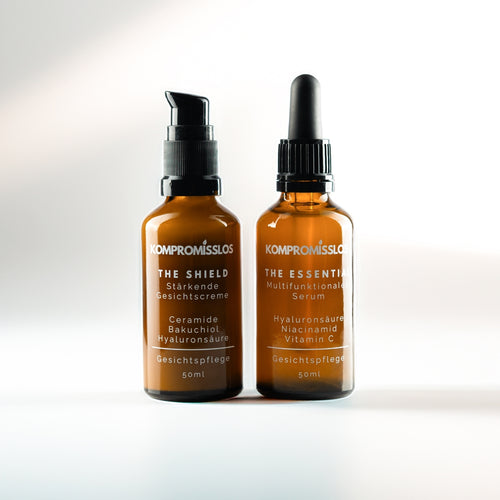
The difference lies in the formulation, not in the active ingredient. A serum is a light, mostly water-based preparation with a high proportion of dissolved actives and very little oil phase. A cream is an emulsion of water and lipids that also leaves a thin film on the surface of your skin. According to a review from the US National Library of Medicine, skincare products work with three groups of ingredients: water-binding humectants such as hyaluronic acid or glycerin, smoothing emollients such as ceramides, and film-forming occlusives that slow down water loss through the skin. A serum concentrates on the first group; a cream tends to cover the second and third. That is exactly why serum versus cream is not a matter of taste but a matter of function. In The Duo, made up of The Essential serum and The Shield cream, this division of labour is deliberate, rather than squeezing both steps into a single product.
Do you need both, or is one product enough?
Both make sense if your skin feels dry, tight or unsettled. One product is enough if your skin is stable, you live somewhere humid and your product already covers all three ingredient groups. This honest caveat belongs here: if you use a well-formulated, rich cream and are happy with it, you don’t necessarily need an extra serum. The same applies the other way round for very oily skin, where a light, fast-absorbing serum on its own may already be enough. The point at which two steps are clearly better is a weakened skin barrier: dry central-heating air, frequent cleansing, cold winter air or changes in your skin with age. In those cases, combining a concentration of actives with a protective layer does more than doubling the amount of a single product. How to dose both steps in practice is explained on the page on how to use the serum and cream.
In which order do you apply serum and cream?
Serum first, then cream. The rule behind it: from the lightest texture to the heaviest. A water-based serum cannot get through a lipid film, whereas a cream sits easily on top of a serum that has already absorbed. Apply the serum to skin that is still slightly damp, straight after cleansing. Water-binding ingredients need available water; otherwise they draw it from deeper layers of the skin. Then give the serum a moment to absorb, roughly half a minute to a minute, and apply the cream on top. Waiting longer brings no additional benefit, because absorption is complete after a short time. With Kompromisslos, that means 3 to 6 drops of serum and 3 to 6 pumps of cream, morning and evening. If you also want to combine individual actives, the overview of vitamin C or niacinamide will help you choose.
Serum and cream compared side by side
The overview below shows why the two steps don’t replace each other. A serum has a more visible, faster effect on moisture levels; a cream works more slowly but more lastingly on water loss. According to the National Library of Medicine review mentioned above, the water content of the skin rises quickly with water-binding products, but the loss through the skin’s surface does not automatically fall as a result. With film-forming products it is the other way round: it takes longer for the water content to rise, because the water first has to move up from deeper layers. Over the course of the day, these two curves together produce what you ultimately perceive as cared-for, calm skin. One important point: all concentrations stated by Kompromisslos apply to The Duo as a whole, meaning serum and cream together, never to a single product. You will find the full breakdown on the page about the ingredients in The Duo.
| Aspect | Serum | Cream | Together |
|---|---|---|---|
| Texture | Light and water-based. | Emulsion containing lipids. | Two layers, applied thinly. |
| Main job | Delivering actives and moisture. | Holding in moisture and protecting the surface. | Delivering and holding in one sequence. |
| When | Straight after cleansing. | Once the serum has absorbed. | Morning and evening. |
| Amount per application | 3 to 6 drops. | 3 to 6 pumps. | Lasts 2 to 4 months, depending on how often you use it. |
What happens if you use only one of the two?
A serum without a cream can backfire in dry air. Water-binding ingredients only attract water from their surroundings when the humidity is high enough. If it is lower, they draw water from the deeper layers of the epidermis, and without a sealing layer it evaporates at the surface. The National Library of Medicine review cited here warns explicitly and clearly about exactly this effect. In heated Swiss homes and offices, this is the norm rather than the exception in winter. Conversely, a cream without a serum delivers fewer actives into the skin, because, according to a review in the Journal of Cosmetic Dermatology, a cream functions mainly as a carrier system and its density of actives is limited. If your skin is prone to blemishes, the overview of blemish-prone skin gives you further pointers on texture.
How can you tell your combination is right?
The most reliable signal is how your skin feels 30 minutes after applying. If it still feels tight, the holding layer is missing – the cream, or a richer version of it. If your skin feels weighed down or shiny, the layer of cream is too thick or the serum is superfluous. A second signal is time: changes in moisture levels show within days, changes in the look of your skin take several weeks. If you judge after five days, you are judging over the wrong period and often switch products again too quickly. A third signal is how your skin reacts when the weather changes. A routine that works in summer and suddenly stops working in January isn’t wrong; it just hasn’t been adjusted. Often it is enough to apply the cream a little more generously in the evening. What others have noticed is collected in the reviews of The Duo.
Where skincare reaches its limits
Cosmetics care for the surface of the skin; they are no substitute for a medical assessment. A serum and cream can soften the look of dry, tight or unsettled skin and support the skin barrier. But they are not the answer to persistent redness, weeping or itchy patches, sudden changes in your skin, dark spots that change, or problems that persist for weeks despite adjusting your skincare. In those cases your skin needs a dermatological assessment, and before you try more products on your own. The same applies if you are already using a treatment prescribed by a doctor: discuss any additional skincare with your specialist rather than layering it up on your own. This limit isn’t a cautious formula; it is simply the point at which a cosmetic product is the wrong tool for your concern. For general background on active ingredients, see the article on gentian root extract and its effects.
I deliberately launched Kompromisslos with two products – not one, and not eight. A single all-in-one product would have meant either lowering the density of actives or leaving out the protective layer. I didn’t want either. So there is The Essential serum for the actives and The Shield cream to seal it all in, together as The Duo for CHF 109.90. All percentages, such as 5 per cent niacinamide and 2 per cent hyaluronic acid, refer to The Duo as a whole. I would rather put that uncomfortably precisely than make it sound pretty.
Frequently asked questions
Do I really need a serum and a cream?
Not necessarily. If your skin is stable, you live somewhere humid and your product contains humectants, lipids and film-formers, one step can be enough. With dry central-heating air, or with sensitive or mature skin, combining the two is usually the more reliable choice.
Does serum go before or after cream?
Serum first, then cream. The lighter, water-based texture always goes first, because it cannot penetrate a lipid film. Apply the serum to slightly damp skin, let it absorb for about a minute, then finish with the cream.
Can I use a serum without a cream?
Yes, but in dry air that is risky. Water-binding ingredients need a sealing layer; otherwise the water they bind evaporates at the surface. In summer or with oily skin, a serum on its own may well be enough; during the heating season that is rarely the case.
Is a cream without a serum enough?
For many skin types, yes. A cream does, however, deliver fewer actives per application, because a large part of the formulation is taken up by carrier ingredients. If you are relying on specific actives, a serum is the more effective way to get them into your skin.
How long should I wait between serum and cream?
Half a minute to a minute is enough. As soon as the serum no longer sits wet on your skin, you can apply the cream. Waiting longer brings no additional benefit and only lets your skin dry out unnecessarily before the protective layer even goes on.
Can I combine a serum and a cream from different brands?
In principle, yes. Make sure the actives don’t double up unnecessarily and that the textures work together – light before rich. Products designed to go together have the advantage that concentrations and tolerability were developed and tested together, rather than simply meeting by chance.
How much serum and cream do I need per application?
With Kompromisslos, it is 3 to 6 drops of serum and 3 to 6 pumps of cream, morning and evening. More product brings no additional benefit, because your skin can only absorb a limited amount. A bottle lasts 2 to 4 months, depending on how often you use it.