How long does 50 ml of moisturiser last? Usage, dosage and cost per month
SWISS BUYING GUIDE
How long 50 ml of moisturiser lasts comes down to three numbers: how much is in the pack, how much you use per application and how many times a day you apply it. Used twice a day, it lasts anywhere from just under four weeks (1 ml each time) to just under three months (0.3 ml each time), depending on the amount. In a usage study published in the journal Food and Chemical Toxicology, the median was 1.53 grams of face cream per day; at that rate, 50 ml would be empty after about 33 days. If you use less or only apply it in the evening, it lasts considerably longer.
How long does a 50 ml moisturiser last?
Used twice a day, a 50 ml moisturiser lasts between just under four weeks and just under three months, depending on whether you use closer to 1 ml or 0.3 ml each time. The maths behind it is simple: divide the contents of the pack by your daily usage and you get the number of days it will last. Daily usage is the amount per application multiplied by the number of applications. How much people actually use was measured in a study in the journal Food and Chemical Toxicology: up to 360 women in the US kept a two-week log of how they used test products supplied to them, which were weighed before and after. For face cream, the median was 0.84 grams per application and 1.53 grams per day, while the mean was 2.05 grams per day. On average, the participants applied face cream 1.77 times a day. If you simplify things and count one gram as one millilitre, 50 ml would be used up after about 33 days at the median and after about 24 days at the mean.
These figures are an average, not a guideline. How much you need varies with your skin type, the season and the texture of the product. In her review on Judge.me, Irène S. writes: ‘I need very little of the products in summer. Curious to see what it’s like in winter’ (review translated from German). That is exactly why it pays to look at the amount you actually use rather than at a blanket figure.
| Amount per application | Applications per day | Daily usage | 50 ml lasts about |
|---|---|---|---|
| 0.3 ml (sparing) | 2 | 0.6 ml | 83 days |
| 0.5 ml | 2 | 1.0 ml | 50 days |
| 0.84 g (study median) | 1.77 on average | 1.53 g (median) | 33 days |
| 1.0 ml (generous) | 2 | 2.0 ml | 25 days |
| 0.5 ml, evenings only | 1 | 0.5 ml | 100 days |
How much cream should you use per application: a pea-sized amount, a pump or millilitres?
For the face, an amount that leaves a thin, even film is usually enough, and a pea-sized amount is a useful rule of thumb for that. The problem is that nobody measures in millilitres, and a pea is not a unit of measurement. A pump is more precise, because the dispenser releases roughly the same amount every time you press it. How much that is, however, varies from one dispenser to the next, which is why many manufacturers give the dosage in pumps rather than in millilitres. Dermatology offers a measurable reference point. For ointments used in treatment, the fingertip unit was introduced: a strip of ointment squeezed from a tube with a 5 mm nozzle, reaching from the tip of the index finger to the first finger crease. According to a study in Clinical and Experimental Dermatology, 30 adult patients needed an average of 2.5 of these units for the face and neck. A follow-up paper in the Archives of Dermatology equates two fingertip units with one gram. For the face and neck, that comes to just over a gram of ointment.
This amount is meant for medicated ointments that are deliberately applied as a covering layer. The figure cannot be transferred one-to-one to a light face cream. But it does show that a tiny dab can easily fall short for the face and neck. The manufacturer’s instructions on the pack are the best starting point, because they are tailored to the texture and the dispenser.
How many drops of serum should you use?
The right number of drops is the one the manufacturer specifies for its serum, because it depends on the dropper, the consistency and the concentration and cannot be set across the board. A serum is more fluid than a cream and therefore covers the whole face with less volume. More drops do not automatically mean more effect: the concentration of active ingredients in the product stays the same, and whatever your skin does not absorb sits on top as a layer, stays tacky for longer and empties the bottle faster. Too few drops, on the other hand, will not reach every area – typically the neck and jawline miss out. You can check for yourself how much a single drop amounts to: count how many drops from your dropper it takes to fill one millilitre. Then you know your usage per application and can work out how long the bottle will last in exactly the same way as for a cream.
A small trick saves product: put the drops on your fingertips rather than in your palm, otherwise some of it stays on your hand. If you combine serum and cream, work out each one separately. If the two come in different sizes or have different dosages, they will rarely run out at the same time.
How do you work out the cost per month rather than per pot?
The cost per month is the price divided by the number of days the product lasts, multiplied by 30. Only this figure makes products comparable, because the price per pot tells you nothing about how long it will last. Here is a worked example with made-up figures: a cream costing CHF 40 that lasts 50 days costs CHF 24 a month. A cream costing CHF 25 that you need twice as much of, and that runs out after 25 days, costs CHF 30 a month. In this case, the cheaper pack is the more expensive skincare. What kind of formula you get for the price is a separate question, which we look at in expensive vs cheap face cream.
- Check how much is in the pack, for example 50 ml.
- Work out the amount per application: the manufacturer’s recommendation or your own measurement.
- Multiply it by the number of applications per day.
- Divide the contents of the pack by your daily usage – that is how many days it will last.
- Divide the price by that number of days and multiply by 30.
It helps when a manufacturer states how long a product lasts. With The Duo, for example, the serum and cream last around two months when both products are used twice a day. For a routine made up of several products, add up the monthly cost of every step. Knowing your monthly usage also lets you judge properly whether a skincare subscription or a one-off purchase makes more financial sense. One research finding helps with estimating: a large European usage study in the same journal found an inverse relationship between how often people apply facial skincare and how much they use each time. People who apply cream more often tend to use less per application. Multiplying the largest single amount by the highest frequency therefore overestimates usage.
Can you use too much or too little face cream?
Yes, both are possible, and both tend to show up in how your skin feels rather than as actual harm. Too much cream sits on the surface as a layer, looks shiny, feels heavy and ends up on your pillow, or pills under sunscreen and make-up. Your skin does not absorb an unlimited amount just because more of it is sitting there. With products containing stronger active ingredients such as acids or retinoids, overdoing it can also cause irritation. Too little cream, on the other hand, cannot be spread evenly: some areas stay dry, and your skin feels tight again after a short while. This happens easily when you try to make an expensive cream go further.
The right amount lies somewhere in between: enough for the cream to spread without dragging and to sink in within a few minutes. Consciously using the right amount and finishing the pack does more than save money: with a sustainable face cream, how much you use makes a bigger difference than the label.
When you open a new pack, write the date on it with a felt-tip pen. Once it is empty, you will know how long it really lasts and will not have to guess. The date also helps when you check the jar symbol that shows how long the product keeps after opening.
How can you tell that you are using too little?
You are using too little if your skin feels tight again shortly after you apply your cream, or if some areas feel rough, even though the cream suits your skin. Many people skimp because they want the pack to last longer. The result is skincare that lasts a long time but never quite does its job. These signs suggest you should increase the amount slightly:
- A tight feeling just one to two hours after applying.
- Rough or flaky patches on the cheeks, around the sides of the nose or on the chin.
- The cream only spreads if you press hard, and there is not enough to reach your neck.
- Fine dryness lines look more noticeable in the evening than in the morning.
- The pack lasts considerably longer than the manufacturer states.
If so, add one pump or a little extra and watch your skin for a week. If the signs persist even with a generous amount, the texture is more likely to be the problem than the dosage. In that case, a richer cream or a different product is a better answer than more and more of the same. If your skin stays irritated or keeps flaking, the cause should be looked into by a dermatologist.
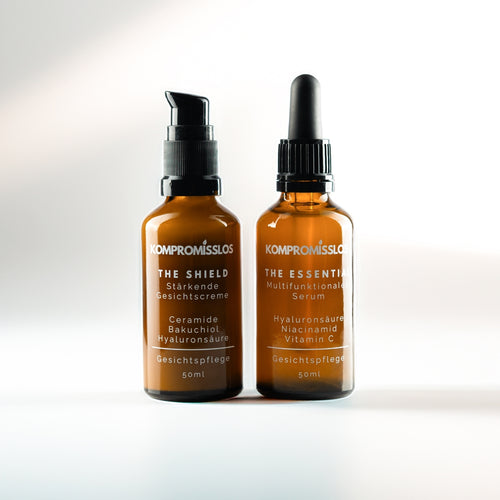
I chose 50 ml for both The Essential and The Shield, and I say openly how long they last: two to four months depending on use, and around two months when both products are used twice a day. It mattered to me that you should not have to wait until after you have bought them to find out what your skincare costs you each month. Even so, I cannot promise you an exact figure, because it depends on how generous you are, on your skin and on the time of year. What I can tell you is this: more pumps do not make the concentrations any higher, they just empty the bottle faster. If your skin stays calm and supple with the recommended amount, you do not need more. How much I recommend for each step is set out in the instructions for use.
Frequently asked questions
How long does a 30 ml serum last?
Used twice a day, a 30 ml serum lasts roughly one to two and a half months, depending on how much you use. If you use 0.2 ml per application, you get through 0.4 ml a day and the bottle lasts about 75 days. At 0.5 ml per application, it is empty after a month. To find out how much one drop from your dropper amounts to, count how many drops it takes to fill a millilitre.
Does dry skin need more moisturiser?
Yes, dry skin often needs a little more cream, especially in winter and on the cheeks and the sides of the nose. That noticeably shortens how long a pack lasts. If you constantly need much more than the recommended amount to stop your skin feeling tight, the texture is probably too light for you. A richer cream will then help more than a double helping.
How much cream do I need for my face and neck?
You need noticeably more for your face and neck than for your face alone, because the neck is an extra area that often gets forgotten. In one dermatological measurement, the face and neck took an average of 2.5 fingertip units of ointment, or just over a gram. For a light cream, the manufacturer’s recommendation is the better starting point, because it is tailored to the texture and the dispenser.
How much does good skincare cost per month?
There is no fixed figure, but there is a straightforward way to work it out: divide the price of each product by the number of days it lasts, multiply the result by 30 and add up every step of your routine. That shows you what cleanser, serum, cream and sunscreen really cost you together. Dropping one step often cuts your monthly costs more than a lower price on a single product.
How long does a cream keep once opened?
How long an opened cream keeps is shown by the jar symbol with a number of months on the pack, and if your cream will last longer than that, a smaller pack makes more sense. What exactly the symbol means and how to tell a cream has gone off is explained in our article on skincare shelf life after opening.
Is a bigger pack cheaper?
Per millilitre, a bigger pack is often cheaper, but only if you use it up within its shelf life after opening. So compare the price per millilitre and work out how long the pack will last at your rate of use. Even with a Swiss face cream, where it comes from tells you nothing about how long it lasts – only this calculation does.
How long does The Duo last?
The Duo lasts two to four months depending on use, and around two months when both products are used twice a day. The dosage per application is 3 to 6 drops of serum, followed by 3 to 6 pumps of cream, morning and evening, over the face and neck. If your skin is dry, you can use a little more, in which case The Duo will run out correspondingly sooner.
Sources
- Loretz LJ, Api AM, Barraj LM, Burdick J, Dressler WE, Gettings SD et al. Exposure data for cosmetic products: lipstick, body lotion, and face cream. Food and Chemical Toxicology, 2005. Source
- Hall B, Tozer S, Safford B, Coroama M, Steiling W, Leneveu-Duchemin MC et al. European consumer exposure to cosmetic products, a framework for conducting population exposure assessments. Food and Chemical Toxicology, 2007. Source
- Long CC, Finlay AY. The finger-tip unit – a new practical measure. Clinical and Experimental Dermatology, 1991. Source
- Long CC, Finlay AY, Averill RW. The rule of hand: 4 hand areas = 2 FTU = 1 g. Archives of Dermatology, 1992. Source