Swiss face cream: what really makes one and what to look for
SWISS SKINCARE
A Swiss face cream may only call itself Swiss if at least 60% of its manufacturing costs and 80% of its research, development and production costs are incurred in Switzerland. So the label tells you something about origin and production steps – nothing about the active ingredients. For your skin, it is the formula that decides, not the flag.
What makes a face cream Swiss in legal terms?
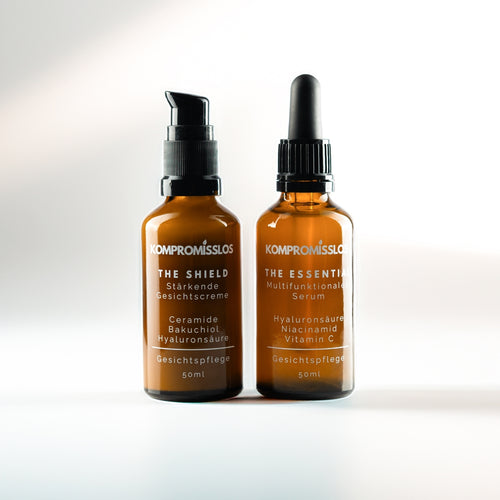
A Swiss face cream is a legally defined term, not a marketing image. Since 1 January 2017, Switzerland’s “Swissness” legislation has governed when a product may carry a Swiss indication of origin, and cosmetics are also subject to their own industry-specific ordinance. According to the Swiss Federal Institute of Intellectual Property, for cosmetic products at least 60% of the manufacturing costs must be incurred in Switzerland, plus at least 80% of the research, development and production costs. In addition, the ordinance lists activities that must take place in Switzerland because they have a particular influence on the quality of a cosmetic product. That is considerably stricter than the general rule for industrial products. So anyone who calls a cream a Swiss face cream is making a verifiable statement about its development and production. What the label does not tell you is which active ingredients it contains, at what concentration, and whether the formula suits your skin. Only the ingredient list answers those questions. You can read how we handle this with our Duo of serum and cream.
How can you tell if a face cream really comes from Switzerland?
You can tell from the exact wording on the packaging, not from the Alpine imagery. Watch for the difference between a genuine indication of origin and a mere company detail. Wording such as “made in Switzerland” or “Swiss Made” is bound by the Swissness criteria. Phrases such as “Swiss brand”, “developed in Switzerland” or a head office in Zurich on the back, on the other hand, only tell you where the company is based, not where the cream was made. Every cosmetics package also states the responsible person and their address. That address is a legal detail, not a statement about production. Since 2017, the Swiss cross may be used commercially, but only if the criteria are met. If origin really matters to you, ask the manufacturer directly where the bulk is mixed and filled. A brand that answers that openly gives you more certainty than any mountain panorama on the box.
A note about us: Kompromisslos is a Swiss company and sells exclusively in Switzerland and Liechtenstein. Where development and production take place: [OPEN: CHECK]. We are deliberately not stating an indication of origin here that we cannot back up.
Is a face cream from Switzerland better for your skin?
No, not automatically. Origin tells you nothing about how well a cream supports your skin barrier, or whether it contains enough active ingredient to do anything at all. A cream produced in Switzerland can have a thin formula in which the interesting active ingredients only appear at the end of the ingredient list. A cream produced abroad can be superbly formulated. What Swiss origin does bring is high standards of quality control and documentation, as well as short transport routes within the country. That is real value, but it does not answer the question you are actually asking: will this cream do anything for me? That is why looking at the declared concentrations is more worthwhile than looking at the flag. If a brand states the amounts of its active ingredients, you can compare. If it only argues with origin, you have nothing to compare. The table below separates the two clearly.
| Claim on the pack | What it proves | What it does not prove |
|---|---|---|
| Swiss Made or made in Switzerland | Production and share of costs meet the Swissness criteria | Which active ingredients it contains and in what amounts |
| Swiss brand or head office in Switzerland | The company is based in Switzerland | Where the cream was actually made |
| With Swiss Alpine plants | One raw material is of Alpine origin | At what concentration it is used |
| A concentration such as 5% niacinamide | A verifiable amount of active ingredient | Whether the texture suits your skin type |
What edelweiss and gentian do in a Swiss face cream
Alpine plant extracts are a worthwhile ingredient, but not a reason on their own. Edelweiss and gentian root grow under intense UV exposure and cold, and form protective substances as they do so. That is exactly what makes them interesting for skincare. Our Duo contains edelweiss extract at 2% and gentian root extract at 2%, each relative to the Duo as a whole. That is a figure you can compare. With many products that play on Alpine imagery, by contrast, you will find no figure at all, and the extract is so far down the list that it mainly serves the packaging. It is important to put this honestly: Alpine plants do not replace well-dosed core active ingredients such as niacinamide, hyaluronic acid or ceramides. They complement them. If you are interested in the ingredient in more detail, you will find it in our article on gentian root extract and what it does in skincare.
What to look for in a face cream from Switzerland instead of the flag
Look for declared concentrations, the position of the active ingredients in the ingredient list, and whether the brand tells you what a product cannot do. A cream with 5% niacinamide, 2% hyaluronic acid and 2% vitamin C as 3-O-ethyl ascorbic acid is verifiable. Also check whether the serum and cream are designed to work together, or whether you end up buying five products that overlap after all. And see whether the brand explains the order and amount to you, because even the best formula does little if you apply too little of it. With our products, it is 3 to 6 drops of serum and 3 to 6 pumps of cream, morning and evening. Exactly which active ingredients are included and in what amounts is set out in full on the page about ingredients and concentrations. Whether vitamin C or niacinamide is the more relevant ingredient for you is covered in our article on vitamin C or niacinamide in your routine.
When a Swiss face cream is not the right choice
If your skin has a medical problem, no face cream is the right answer, wherever it comes from. Skincare cares; it does not treat. With persistent redness, painful inflammation, sudden changes in moles, or skin that gets worse over weeks, you belong with a dermatologist, not in an online shop. The same applies if you are already using prescribed products, because then the specialist decides what else makes sense. It also pays to be honest about price: if your budget is tight and your skin is stable, you do not need expensive skincare, but a gentle cleanser, a simple moisturiser and consistent sun protection. And if your skin is mainly struggling with blemishes, the question of origin is secondary anyway. What really counts in that situation is covered in our article on blemish-prone skin and its causes. If, on the other hand, you opt for a lean routine with openly declared amounts of active ingredients, that is exactly what you will find in The Duo, serum and cream as a set.
I am often asked why we do not make more of Switzerland in our marketing. The honest answer: because I realised how little an indication of origin tells you about whether a product does anything for your skin. So I decided to disclose the concentrations rather than print a bigger flag. 5% niacinamide, 2% hyaluronic acid, 2% vitamin C, 0.3% bakuchiol. You can compare these figures with any other product; you cannot compare a mountain panorama. And I deliberately stopped at two products, because a third would not have brought any additional benefit for most skin types. You can read what others have made of it in the reviews from more than 125 customers.
Frequently asked questions
What legally counts as a Swiss face cream?
A Swiss face cream is a product for which at least 60% of the manufacturing costs and at least 80% of the research, development and production costs are incurred in Switzerland. In addition, certain quality-relevant production steps must take place in Switzerland. These rules have applied since 1 January 2017 through a dedicated industry ordinance for cosmetics.
Is a face cream from Switzerland better than one from abroad?
Not automatically. Origin tells you something about production standards and cost shares, nothing about the formula. A cream made abroad with well-dosed active ingredients can make more sense for your skin than a Swiss cream without any stated concentrations. What matters is what is declared and in what amounts.
Can any brand advertise with a Swiss cross?
No. Since 2017, the Swiss cross may be used commercially on products, but only if the Swissness criteria are met. For cosmetics, the requirements are stricter than for ordinary industrial products. An Alpine motif or a mountain name on the packaging, on the other hand, can be chosen freely and proves nothing at all.
What is the difference between a Swiss brand and Swiss Made?
“Swiss brand” only means that the company is based in Switzerland. “Swiss Made” or “made in Switzerland”, by contrast, are genuine indications of origin and are bound by fixed criteria. If production matters to you, look for the second kind of wording, and if in doubt, ask the manufacturer directly.
Do edelweiss and gentian make sense in a face cream?
They are a worthwhile addition, but no substitute for well-dosed core active ingredients. Under UV exposure and cold, Alpine plants form protective substances that are interesting for skincare. The amount remains what counts. Our Duo contains 2% edelweiss extract and 2% gentian root extract, relative to the Duo as a whole.
How long does a face cream last with daily use?
With our Duo, a bottle lasts 2 to 4 months, depending on how often you use it. We recommend 3 to 6 drops of serum and 3 to 6 pumps of cream, morning and evening. If you only use it once a day, it will last correspondingly longer. Applying too little is the most common reason why skincare seems to do nothing.
When should you see a professional instead of buying a cream?
With persistent redness, painful inflammation, changing moles, or skin that gets worse over weeks. Skincare cares for the skin; it is no substitute for a dermatological assessment. If you are already using prescribed products, it is also best to check with a dermatologist before adding any further skincare products.