Vitamin C or niacinamide: what does your skin actually need?
INGREDIENTS COMPARED
Vitamin C or niacinamide is not an either-or question. Vitamin C aims for a more even, fresher-looking complexion; niacinamide supports the skin barrier and can soften the look of redness and pores. Both can be used in the same routine. If you only want one, choose according to your skin goal, not according to an ingredient ranking.
Vitamin C or niacinamide: what’s the difference?
The difference lies in the goal, not in which is worth more. Vitamin C is an antioxidant and works mainly on the look of dark spots, on freshness and on a more even skin tone. Niacinamide – vitamin B3 – works on the barrier. It supports the skin’s own moisture balance, can soften the look of enlarged pores and is usually well tolerated even by sensitive skin. If your skin tends to look blotchy, dull and tired, vitamin C is the obvious place to start. If it feels tight easily, gets shiny in the T-zone or is quick to react with redness, niacinamide is the calmer route. Our Duo of serum and cream contains both ingredients, because in practice the two goals can hardly be separated neatly. Very few people want either an even complexion or a stable barrier. Most want both – without having to buy four products to get there.
| Criterion | Vitamin C | Niacinamide |
|---|---|---|
| Main goal | A more even, fresher-looking complexion | A stable skin barrier and less visible redness |
| Form used | 3-O-ethyl ascorbic acid, stable and water-soluble | Nicotinamide, highly water-soluble |
| Time of day | Particularly useful in the morning, possible in the evening | Equally good morning and evening |
| Sensitive skin | Can tingle briefly at high concentrations | Considered one of the best-tolerated options |
What does vitamin C do for your skin?
Vitamin C neutralises free radicals and so supports your skin against everything that acts on it from outside. This shows up most clearly with hyperpigmentation: over weeks, dark areas can look softer and your skin tone more even. What matters here is less the percentage than the form. Pure L-ascorbic acid is the best-researched variant, but also the most unstable. It oxidises in light and air, turns yellowish to brown and needs an acidic pH that not every skin likes. That is why we use 3-O-ethyl ascorbic acid at 2 %, a stable derivative that works in the pH-neutral range. You can see which other active ingredients are in the formula in the full overview of all ingredients. Incidentally, a vitamin C serum that has turned brown on the shelf is not a sign of quality – it is a sign that the active ingredient has already reacted.
What does niacinamide do for your skin?
Niacinamide is the all-rounder among active ingredients, which is why it turns up in so many formulas. It supports the skin barrier, helps the skin hold on to moisture and can soften the look of pores, shine and redness. It is precisely this breadth that makes it the better starting point if you are unsure or if your skin has reacted to lots of things in the past. In our skincare, niacinamide is at 5 %, accompanied by zinc PCA, which mainly helps with shiny, unsettled skin. It is important to keep this in perspective: niacinamide does not treat any skin condition. It works on the appearance of the skin and on the stability of the barrier, and that takes time. Expect four to eight weeks of consistent use before you can honestly judge whether the ingredient is doing anything for you. If you switch after ten days, you will never see a result.
Can you use vitamin C and niacinamide together?
Yes, in modern formulas the combination is not a problem. The concern comes from older laboratory observations in which, under high heat and in pure ingredient solutions, nicotinic acid could form, which triggers redness. Those conditions have little to do with a finished serum or cream on your face. In practice, the two ingredients have been used together in formulations for years, and the combination is considered sensible because their goals complement rather than compete with each other. If your skin does react, experience shows that the cause is more likely to be the formula as a whole, fragrance or too many new products at once than the interaction between these two substances. So introduce new products one at a time and give each two to three weeks. The guide to using the serum and cream shows step by step what a calm two-step routine looks like.
Vitamin C or niacinamide: which goes on first?
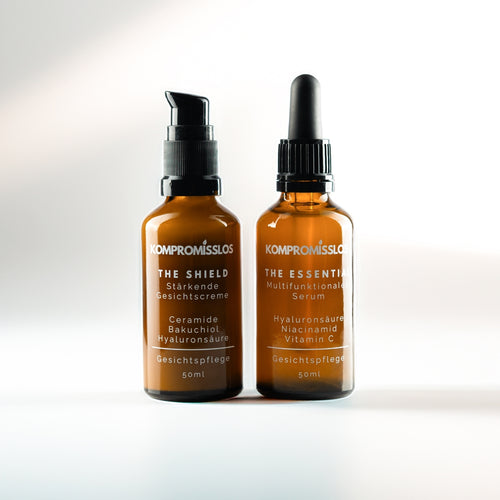
The order depends on the texture, not on the ingredient. Light comes before heavy, watery before rich. In practice, that means serum first, then cream. If your serum contains vitamin C and your cream contains niacinamide, the order takes care of itself and there is nothing more to think about. The question only really matters if you use two separate serums – and then the thinner one goes first. With our products, it is the same two steps morning and evening: three to six drops of serum and three to six pumps of cream – The Essential serum and The Shield cream – depending on how your skin feels and the time of year. Used like this, a bottle lasts two to four months. And yes, that is deliberately simple. The more steps a routine has, the more likely it is that you will stop following it after three weeks.
When is one active ingredient enough?
More often than advertising would have you believe. If your skin is currently irritated, flaky or feels rough, start with niacinamide alone and leave vitamin C out for now. A disrupted barrier needs rest, not a second active ingredient. If, on the other hand, you are only concerned about a few dark spots after the summer, vitamin C plus consistent sun protection is the more effective lever, and niacinamide is then a side issue. And if your skin is calm, even and happy, you do not need to buy either one in addition. Check the ingredient list of your current products before you order another serum. Very often one of the two ingredients is already in there without being prominently advertised on the packaging, and an extra product then mainly brings more steps, more cost and more potential for irritation. Less but consistently beats more but erratically, every time.
When to see a professional: Skincare works on the appearance of the skin, not on medical conditions. If your skin stays inflamed, hurts or weeps, or if a spot changes in shape or colour, that needs to be assessed by a dermatologist, not handled with a skincare routine.
For our formula, I deliberately chose 3-O-ethyl ascorbic acid rather than pure L-ascorbic acid, because I did not want to sell skincare that, after eight weeks on the bathroom shelf, is something different from what it was on the day you bought it. Pure vitamin C is impressive in the lab and tricky in everyday life. And I decided against splitting vitamin C and niacinamide into two additional products, even though that would sell more. Two products, the same steps morning and evening. That is the routine people actually stick with – and only a routine you stick with shows anything at all.
Dominic Bertschin
Frequently asked questions
Can you use vitamin C and niacinamide on the same day?
Yes, in finished formulas that is not a problem. You can use both ingredients morning and evening, either in one product or one after the other. The old warning against combining them comes from lab conditions with pure ingredients and high heat, which do not occur on your skin.
Which is better for dark spots, vitamin C or niacinamide?
For dark spots, vitamin C is the more direct route, because it targets the look of darker areas. Niacinamide additionally supports a more even complexion. The biggest difference, however, comes from daily sun protection – without it, new spots appear faster than existing ones fade.
Which is better for sensitive skin?
With sensitive skin, it is best to start with niacinamide. It is considered very well tolerated and supports the skin barrier rather than putting extra strain on it. You can add vitamin C later, once your skin feels stable – and then in a stable, pH-neutral form.
Do you need a separate vitamin C serum as well?
Only if your current skincare does not contain vitamin C. If the ingredient is already in your serum or cream, another product rarely makes a visible difference and mainly adds to the number of steps. So check your current ingredient list first.
How long does it take to see results?
Expect four to eight weeks of consistent use – longer for dark spots. The skin renews itself in cycles, and no active ingredient can speed that up at will. If you switch products after ten days, the main thing you achieve is never being able to judge a result.
Can niacinamide make vitamin C ineffective?
No, that is a stubborn myth. The two ingredients do not cancel each other out in a finished formula. They pursue different goals and complement each other in practice, which is why they are deliberately used together in many modern formulations. So there is no need to switch to separate application times.
When should you see a professional?
If your skin is persistently irritated, painful, weeping or has changed significantly, it needs to be assessed by a dermatologist. Skincare works on the appearance of the skin, not on medical conditions. This also applies to spots that change in shape, colour or size, and to reactions that do not subside within a few days of stopping a product.