Blemish-prone skin: causes, skincare and what actually helps
SKIN CONDITION
Blemish-prone skin is usually the result of several things working together: increased sebum production, clogged pores, hormonal fluctuations and stress. What helps is a calm, gentle routine rather than constantly switching products: cleanse gently, add moisture, support the skin barrier and use active ingredients such as niacinamide patiently. Visible changes take time, not a new product every week.
What actually helps blemish-prone skin?
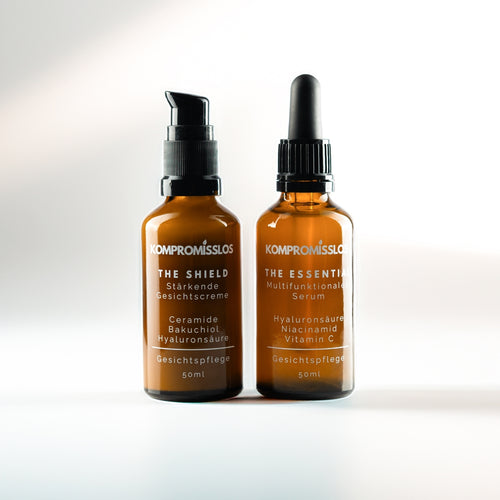
What helps blemish-prone skin above all is consistency: gentle cleansing, a light moisturiser and a few well-tolerated active ingredients that you stick with for weeks. The most common mistake is the opposite. As soon as something appears, the skin is aggressively stripped of oil, scrubbed, and a new product is tried every two weeks. Skin often responds with even more sebum, to make up for the oil it has lost, and with a weakened barrier that makes it more sensitive. A routine that you keep the same morning and evening, and that does not irritate your skin further, makes more sense. That is exactly why our range consists of only two products, a serum and a cream, which we deliberately put together as The Duo. Fewer products mean fewer variables. Only when you know what is on your skin can you judge what is actually making a difference. With blemish-prone skin, that is truer than with any other skin condition.
What causes blemish-prone skin?
Blemishes develop when sebum production is increased and dead skin cells build up at the opening of the pore, so that the sebum can no longer drain away. That is the mechanical part. It is triggered or made worse by factors you will not find in a cream: hormonal fluctuations during your cycle, in puberty or during menopause, ongoing stress, too little sleep, certain medications and sometimes diet. On top of that come external triggers such as occlusive skincare products, friction from a helmet or mask, and very drying cleansers. A weakened skin barrier also plays a part: if the skin loses too much moisture, it can compensate with more sebum, which makes things worse. So the honest answer to the question of causes is rarely a single reason. Usually two or three factors come together, and skincare only influences some of them. Which ones it influences decides what a routine can achieve at all.
Which skincare routine suits blemish-prone skin?
A skincare routine for blemish-prone skin has three steps: gentle cleansing, a light serum with moisture and barrier-strengthening active ingredients, then a cream that holds that moisture in without weighing the skin down. In most cases, you do not need more than that. It is important to keep the order the same morning and evening and to give your skin time to adjust. With our products, that means three to six drops of serum on skin that is still slightly damp, followed by three to six pumps of cream – the serum and cream in the Duo. If you have very oily skin, use the smaller amount in the evening and feel your way, rather than leaving out the cream altogether. Oily, blemish-prone skin needs moisture too; it just does not need much additional oil. You can read how we have thought through order and amounts in detail on our how-to-use page.
How to tell that a routine suits your skin:
- It has only a few steps, which you can manage even on a stressful evening.
- Your skin does not feel tight after cleansing.
- You introduce no more than one new product at a time.
- You judge the result after weeks, not days.
Which active ingredients support a more even complexion?
For blemish-prone skin, niacinamide, zinc and light hydrators have proved their worth, because they visibly calm the complexion without putting strain on the barrier. We use niacinamide at 5%. It supports the skin barrier, can soften the look of redness and uneven texture, and is usually well tolerated even by sensitive skin. Zinc PCA at 1% complements it and is considered a classic ingredient for a more balanced, more matte complexion. Hyaluronic acid at 1.5% hydrates the skin without weighing it down, while panthenol and ceramides give the barrier additional support. The cream contains bakuchiol at 0.3%, a gentler alternative to retinol. What you do not need, on the other hand, is a collection of active ingredients spread over eight products that get in each other’s way. You can see which ingredients we use, in what amounts and why, in the overview of our ingredients.
Which mistakes make blemishes worse?
The most common mistakes with blemishes are cleansing too aggressively, using too many products at once and not being patient enough. If you cleanse with a strongly degreasing product twice a day, you strip your skin of lipids, which it then produces again. If you introduce an exfoliant, serum, mask and spot treatment all at once, you will not know which one caused a reaction. If you switch after ten days because nothing is visible yet, you will never see the result of a complete skin renewal cycle. Then there are two classics: squeezing spots, which often makes things look worse for weeks, and leaving out moisturiser because your skin is oily anyway. Constantly checking your skin in a magnifying mirror belongs on the list too – it distorts your perception and leads to knee-jerk action. What actually works is unspectacular: a routine that you do not overhaul every two weeks. Others describe how this calmer approach feels over the weeks in our customer reviews.
When to see a professional about blemish-prone skin
If blemishes are painful, sit deep beneath the skin, leave scars or increase over months, that belongs in the hands of a dermatologist, not in a skincare routine. Skincare cares for the appearance of the skin; it is no substitute for a diagnosis or treatment. This is not a formality – it is the point at which many people wait too long and keep buying new products in the meantime. An assessment also makes sense for sudden changes with no obvious trigger, if you suspect a reaction to a medication, or with pronounced hormonal fluctuations. The same applies if the state of your skin is affecting you emotionally – that is a perfectly legitimate reason to get help. A professional can also judge whether something other than ordinary blemishes is behind the way your skin looks. Good skincare can accompany dermatological treatment. In that case, talk to your specialist beforehand about which products make sense alongside it.
I deliberately chose not to develop a separate product for blemish-prone skin. Instead, I built niacinamide at 5% and zinc PCA at 1% permanently into the routine, because I think it is more honest to make two well-tolerated products for many skin conditions than to sell a third jar. If you have blemish-prone skin, you usually already have enough products in your bathroom. What was missing was consistency. Dominic Bertschin, founder of Kompromisslos
Frequently asked questions
Can you get spots during menopause?
Yes, blemishes can appear during menopause, even though the skin becomes drier at the same time. The reason is the hormonal fluctuations of this phase, which shift the balance between the hormones. Typical are individual blemishes on the chin and jawline in otherwise rather dry skin. A gentle, hydrating routine usually makes more sense here than a degreasing one.
Can stress make your skin worse?
Ongoing stress can show in your complexion, partly via cortisol levels, which influence sebum production. Then there are indirect effects such as too little sleep, irregular meals and touching your face more often. Skincare can cushion this, but not resolve it. If stress is the main driver, addressing it will do more than any additional product.
What helps blemish-prone skin quickly?
With skin, quickly sadly does not mean overnight. What helps in the short term: do not squeeze, keep cleansing gentle, skip make-up on the affected area and keep using your moisturiser. Everything else takes weeks, because the complexion changes over a complete renewal cycle, not over days.
Does oily, blemish-prone skin need a moisturiser?
Yes, oily skin needs moisture too. Oil and moisture are two different things: the skin can produce a lot of sebum and at the same time bind too little water. If you leave out moisturiser, the skin can compensate with even more sebum. What makes sense is a light texture in a small amount, not going without.
How long does it take for blemish-prone skin to change?
Allow several weeks before you judge a routine. The skin renews itself over a cycle, and active ingredients such as niacinamide only show their effect over that period. In the first few days, what you mainly see is whether you tolerate a product well. Whether it suits you becomes clear much later.
Is a serum enough, or do I need a cream as well?
A serum brings active ingredients and moisture into the skin; the cream keeps both there. With blemish-prone skin, the combination usually makes more sense than a single product, because a stable barrier is part of the solution. If you have very oily skin, simply use the cream more sparingly in the evening.
Is The Duo suitable for blemish-prone skin?
The Duo is skincare for a more even, calmer complexion, not a treatment for acne. It is suitable for mild to moderate everyday blemishes, with niacinamide, zinc PCA and light hydration. For inflamed, painful or scarring breakouts, a dermatological assessment is the right way forward.