Gentian root extract for skin: when it belongs in your routine and when it doesn’t
SINGLE INGREDIENT
Gentian root extract has a calming, conditioning effect on the skin: the extract from the root of the gentian plant contains bitter compounds and secondary plant substances, and is used in skincare to visibly calm skin that looks stressed and to soften the look of redness. It is not a substitute for dosed active ingredients such as niacinamide or hyaluronic acid.
Gentian root extract: what it does on your skin
Gentian root extract is a plant extract taken from the root of the gentian, used in skincare as a calming supporting ingredient with antioxidant properties. The root contains bitter compounds and other secondary plant substances, which are used in formulations to make irritated-looking skin look calmer and the complexion appear more even. The key is to put it in context: the extract is a cosmetic ingredient, not a medicine. It does not change how your skin works, but how it feels and looks. That is exactly why, in a good formulation, it never stands alone. It accompanies the active ingredients that are dosed at a fixed concentration – in our case, for example, niacinamide at 5% and hyaluronic acid at 1.5%. You can check which ingredients we use and in what amounts in the full overview of all ingredients before you decide for or against a product.
Which skin types benefit from gentian root extract?
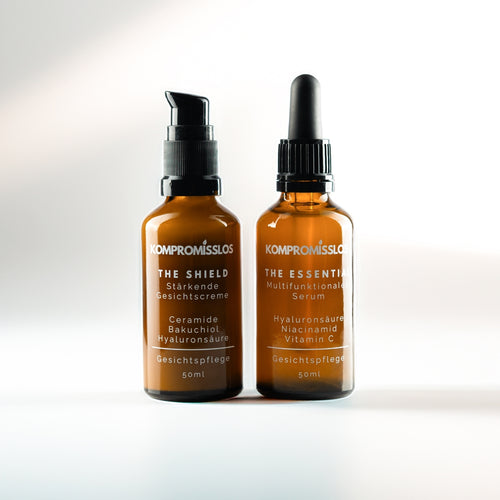
Gentian root extract is worthwhile above all for skin that quickly looks irritated, tends towards visible redness, or is stressed by cold, central heating and frequent washing. If, on the other hand, your skin is stable and the only things bothering you are hydration or an uneven skin tone, the extract is nice to have but not a reason to buy a product. In that case, humectants and active ingredients such as niacinamide or vitamin C determine the result. A simple rule of thumb: if your skin settles down quickly by itself after cleansing, you do not need an extra calming ingredient – what you mainly need is moisture and protection. To be honest, no plant extract can carry a skincare product on its own. It improves the skin feel and rounds off a formulation. It makes sense where it sits alongside adequately dosed active ingredients and the formula as a whole stays lean. That is exactly how we approached it in The Essential serum and The Shield cream, where plant extracts accompany the dosed active ingredients rather than replacing them.
Can you use gentian root extract on sensitive skin?
Yes, gentian root extract is considered well tolerated by sensitive skin, as long as it is used at a low dose and in a fragrance-free formulation. In practice, sensitive skin reacts less often to a single plant extract than to the sum of everything: lots of fragrance, high-strength acids, alcohol and too many steps at once. If you are prone to reactions, the order in which you introduce things matters more than any single ingredient. Introduce a new product on its own, wait a few days and watch how your skin reacts in the evening. It is also sensible to do a test on the inside of your elbow or along your jawline before applying it over a larger area. If you have already reacted to other plants of the daisy family or to herbal extracts, go especially slowly. And if your skin is currently broken, flaky or badly irritated, do not start a new product at all – calm it first with what you already know. You can see how other people with sensitive skin describe our skincare in the collected feedback from our customers.
What happens if your skin doesn’t tolerate gentian root extract?
In cosmetic terms, an intolerance to gentian root extract usually shows up as tightness, stinging, itching or redness that does not fade within a few minutes of application. In that case, stop using the product, keep your routine to the bare essentials for a few days and then reintroduce your products one at a time. That way you can tell whether it really was the plant extract or another component. An overloaded routine – too many active products sitting on already irritated skin at the same time – is in fact more common than a genuine intolerance. If the symptoms persist or spread, or if blisters, flaking and swelling appear, you need to see a dermatologist, not start another skincare experiment. This boundary matters to me: skincare cares for the skin and improves its appearance. Anything that needs to be diagnosed or treated belongs in the hands of a specialist.
How often should you use gentian root extract?
You can use gentian root extract every day; like the rest of your skincare, it makes sense morning and evening. As part of a formulation, you do not need to cycle it like an acid or a retinoid, because it does not work through irritation. The amount matters more than the frequency: for our products, we recommend 3 to 6 drops of serum and 3 to 6 pumps of cream per application, depending on how your skin feels and the time of year. Depending on how often you use it, a bottle then lasts 2 to 4 months. Applying more does not help, because your skin only absorbs as much as it can, and the rest sits on the surface or ends up on your collar. When your skin is very irritated, less is often more: a calm routine of cleansing, moisture and protection, followed consistently over several weeks. We have described the exact routine in the step-by-step guide to using the serum and cream.
How much gentian root extract should a product contain?
There is no universal percentage for gentian root extract, because plant extracts vary greatly in strength depending on how they are made, the solvent used and the concentrate. Two products with the same percentage can therefore be composed completely differently. More telling than the figure is its position in the INCI list, and whether there is room alongside it for the dosed active ingredients at all. If a plant extract is right at the end of the list, it is more decoration than a real part of the formula, even if it features prominently on the front. In our case, those active ingredients are hyaluronic acid at 1.5%, niacinamide at 5%, vitamin C as 3-O-ethyl ascorbic acid at 2%, zinc PCA at 1% and bakuchiol at 0.3% in the cream. Gentian root extract is in the Duo at 2%, based on the serum and cream together. Be sceptical when a brand puts a plant extract in large letters on the front while the measurable active ingredients disappear into the small print.
I deliberately chose gentian root extract and edelweiss extract as supporting ingredients rather than the main selling point, because I did not want to build a brand that lives off an Alpine plant on the label. Swiss origin sells well, but it does not care for anyone’s skin. Our formulation is carried by the active ingredients whose fixed concentrations I can state. The gentian root extract makes the result more rounded, calmer and more pleasant on the skin. That is exactly the role it is allowed to play – I never expected more of it. For the same reason, we have only two products rather than a range of eight. I would rather be able to explain something twice than ask for trust eight times. If this approach seems too sober to you, our Duo of serum and cream is probably not the right choice for you – and that is absolutely fine.
Frequently asked questions
What does gentian root extract do for the skin?
Gentian root extract is used in skincare to visibly calm stressed skin and soften the look of redness. It contains bitter compounds and other secondary plant substances. As a supporting ingredient, it improves the skin feel but does not replace dosed active ingredients such as niacinamide, hyaluronic acid or vitamin C.
Is gentian root extract suitable for sensitive skin?
At a low dose and in a fragrance-free formulation, gentian root extract is considered well tolerated by sensitive skin. Even so, introduce the product on its own and test it first along your jawline or on the inside of your elbow. If you often react to herbal extracts, go especially slowly.
How can you tell if you’re intolerant to gentian root extract?
Typical signs are stinging, tightness, itching or redness that does not fade quickly after application. Stop using the product, then reintroduce your products one at a time. If the symptoms persist or get worse, have them checked by a dermatologist.
How often can you use gentian root extract?
Every day, morning and evening, as part of your normal skincare. Unlike acids or retinoids, you do not need to cycle it. For our products, we recommend 3 to 6 drops of serum and 3 to 6 pumps of cream per application. A bottle then lasts 2 to 4 months.
What percentage of gentian root extract makes sense?
A sensible percentage cannot be given in general terms, because plant extracts are concentrated to different degrees depending on how they are made. Look instead at its position in the INCI list and at whether the dosed active ingredients are adequately represented alongside it. In our Duo, it is 2%, based on both products together.
Is gentian root extract the same as gentian extract?
Both refer to the same plant extract; only the name varies. Gentian root extract states more precisely which part of the plant is used, namely the root. On the packaging, you will find the ingredient under its INCI name, which gives the botanical species. In our formula, it is listed as Gentiana Lutea Root Extract.
Is gentian root extract in your skincare?
Yes, gentian root extract is one of our supporting ingredients, alongside edelweiss extract, ceramides, squalane and panthenol. It is in both products, The Essential serum and The Shield cream, at 2% based on the Duo as a whole. You can find the full list of all ingredients with their concentrations on our ingredients page, so you can check for yourself what is in them.