Sustainable face cream: the five checks that really matter
SUSTAINABLE SKINCARE
You can recognise a sustainable face cream by four things: a fully declared formula without synthetic polymers, packaging you can dispose of as a single material or refill, traceable production with short supply routes, and a rate of use that suits your skin. Seals help you find your way, but they don’t replace a look at the ingredient list.
What actually makes a face cream sustainable?
With a face cream, sustainability isn’t a single feature but the sum of four levels that you can assess separately. The first is the formula: which raw materials it contains, how they are obtained and what happens to them when they end up in waste water. The second is the packaging: material, weight, whether it is a single material and whether you can dispose of it properly in Switzerland. The third is production, including the transport route: where the raw materials come from, where the product is filled and how far the finished product travels to reach you. The fourth level is almost always forgotten, yet it is the most effective: how much you use. A cream of which you need twice as much has twice the impact, with an identical formula. You can see what such a check looks like from a full declaration, for example in our overview of all ingredients with percentages.
These four levels sometimes conflict with one another. Anyone who sells you sustainability as a simple yes-or-no answer is glossing over those trade-offs.
How relevant is microplastic in face cream really?
Microplastic from cosmetics is a real issue, but it isn’t the biggest lever. The Federal Office for the Environment estimates that around 14,000 tonnes of macro- and microplastic enter soils, surface waters and their sediments in Switzerland every year. Tyre abrasion accounts for the largest share, at around 8,900 tonnes, followed by littering at around 2,700 tonnes. Intentionally added microplastic from products such as cosmetics is small in relation to the total input, but according to the FOEN it still leads to significant inputs into surface waters. Two things follow from this for you. First, anyone who sells you a cream as a way to save our rivers and lakes is greatly exaggerating. Second, avoiding synthetic polymers still makes sense, because it targets exactly the point where cosmetics can make any contribution at all. You can only check this on the ingredient list, never from the claim on the front of the pack.
In concrete terms, look on the back for terms such as Polyethylene, Nylon or Acrylates Copolymer. If you find none of them, the formula is clean in this respect. It says nothing, however, about the other three levels.
Glass, plastic or refill: which packaging is better?
There is no packaging that wins on every count, and anyone who says otherwise is doing selective maths. Glass recycles well and can be disposed of in Switzerland through an established collection system, but it weighs many times more than plastic, which makes every journey more costly. Lightweight plastic saves transport weight, but it only goes back into the loop properly if it is a single material and not a composite of three. That is often exactly the problem with airless dispensers and pump systems: they dispense economically and protect delicate active ingredients, but they consist of several components you can barely separate. Refill systems are mathematically the best solution, but only if you actually use them for years and don’t switch to another brand after two rounds. So the honest answer is this: what matters is less the material than how often you replace the packaging.
What does Swiss production say about sustainability?
Swiss production is an argument for quality and control, but only a weak environmental argument. For a product as small and light as a face cream, transport within Switzerland accounts for only a small part of the overall impact. The raw materials themselves weigh far more heavily, and even with Swiss manufacturers they rarely come entirely from Switzerland. What Swiss production does genuinely offer: short distances between formulation, filling and quality control, a direct line to the manufacturer if you have a complaint, and the option of keeping batches small rather than producing for stock. When you read the label, pay attention to the difference between a statement about production and a mere company address. If the pack only gives the distributor’s registered office, that tells you nothing about where it was filled. Alpine raw materials such as edelweiss or gentian root extract don’t automatically come from Swiss cultivation either, just because the brand is Swiss.
For transparency about our own products: the serum and cream are filled in Herznach, Aargau.
How to spot a sustainable face cream in two minutes
Five checks are enough to give you a rough idea of where a cream stands, and you can carry out all five directly on the product or its product page. You don’t need any specialist knowledge, just the willingness to read the back of the pack rather than the front. The order matters: start with the ingredient list, because it leaves the least room for interpretation, and work your way towards the softer criteria. Seals come last on purpose, because a seal only ever checks the criteria of its own standard, not sustainability as a whole. If a brand communicates openly on the first three points, you usually won’t need the seal to help you decide. If, on the other hand, it starts floundering on all five, even the prettiest label won’t help. The table below sums up what to look for and what each answer tells you.
| Check | What to look for | What it tells you |
|---|---|---|
| Ingredient list | Look for Polyethylene, Nylon or Acrylates Copolymer. | Shows whether the formula contains synthetic polymers. |
| Information on active ingredients | Check whether concentrations are given or only names. | Openly stated percentages are a sign of transparency. |
| Packaging | See whether it is a single material and does without an outer carton. | Single-material packaging is easier to recycle. |
| Origin | Look for a place of production, not just an address. | “Distributed by” is not the same as “made in”. |
| Consumption | Work out how long a pack lasts with the way you use it. | Using a lot cancels out any good formula. |
The underrated lever is the amount, not the label
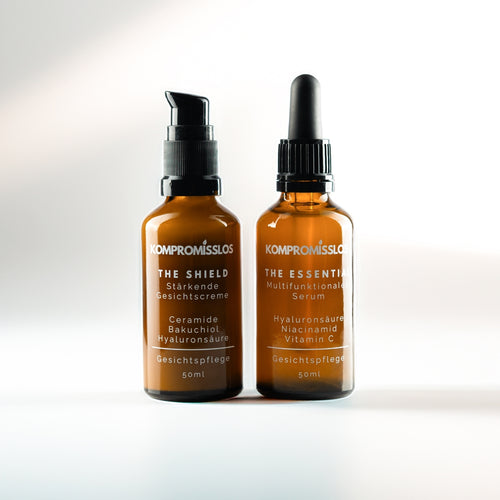
The most sustainable cream is the one you need little of and use up to the very end. This is where most bathrooms fall short: half-used jars, opened serums and a night cream that didn’t suit you. Each of these products has used raw materials, packaging and transport without ever serving a purpose. That is why the most honest sustainability measure is inconvenient and costs nothing: only buy more when something is genuinely empty, and reduce the number of steps in your routine rather than adding to them. For us, that means two products rather than eight. For our Duo of serum and cream, you need three to six drops of serum and three to six pumps of cream, morning and evening, which means a bottle lasts two to four months, depending on how often you use it. How to apply both correctly, and in which order, is explained in our how-to-use guide.
And the honest counter-argument: if your skincare is working, switching isn’t a sustainable decision, just new packaging. Use up what you have first. If, on the other hand, you use several products in parallel to cover different active ingredients, it is worth asking whether that’s necessary. In the Duo, we have combined 5% niacinamide and 2% hyaluronic acid rather than spreading them across two serums. We show whether that makes sense using the example of vitamin C and niacinamide. The same principle applies to blemish-prone skin: fewer products, used consistently.
I’m often asked why we don’t offer a larger range if we are serious about sustainability. The answer is an uncomfortable one: every additional product would have increased sales and worsened our environmental footprint. So I decided on two products that work together, and on stating all concentrations openly. That costs me marketing arguments, because I can’t advertise a secret formula. In return, you can work out for yourself what you are getting. For me, sustainability begins with that kind of transparency, not with a colour on the label. You can read what customers think of it in their reviews.
Frequently asked questions
Is a sustainable face cream automatically natural skincare?
No. Sustainability relates to how raw materials are obtained, packaging, production and consumption, whereas natural skincare relates to where the ingredients come from. Certified natural skincare can come in composite packaging that is hard to recycle, and a cream with a few synthetic auxiliary ingredients can have the better overall balance across its entire life cycle.
Is glass always better than plastic?
No. Glass is very easy to recycle, but it weighs considerably more and makes transport more of a burden. Lightweight, single-material plastic can come out better overall. What matters is less the material than how often you replace the packaging and whether you dispose of it properly.
How can I tell whether a face cream contains microplastic?
From the ingredient list on the back. Look out for terms such as Polyethylene, Nylon or Acrylates Copolymer, as these indicate synthetic polymers. Advertising claims on the front are no proof. A brand that doesn’t also show the full list online makes checking needlessly difficult for you.
Is a vegan face cream automatically more sustainable?
Not necessarily. Vegan means that no animal-derived raw materials are included, which is an ethical and often also an environmental plus. But the claim says nothing about packaging, transport routes or the growing conditions of the plant-based raw materials. You need to check the two questions separately.
How much does a seal really tell you about sustainability?
A seal checks the criteria of its own standard, not sustainability as a whole. Some standards only regulate the ingredients; others also cover packaging or cultivation. A seal is useful as a first filter, but it doesn’t replace a look at the declaration and the question of where the product is made.
How long should a face cream last?
That depends on the dose and how often you apply it. With our Duo, a bottle lasts two to four months when used morning and evening. A much shorter lifespan suggests that you are applying too much or that the texture doesn’t go far enough.
Is it worth switching to a sustainable cream straight away?
Only if your current skincare doesn’t suit you. Throwing away an opened product makes the balance worse, not better. Use up what you have first and make the more sustainable choice next time you buy. That applies even if you currently feel very drawn to a particular brand.
Sources
- Federal Office for the Environment (FOEN), Kunststoffe in der Umwelt, 2025. Source