Refillable skincare: how many refills it takes to be genuinely more sustainable
NATURAL SKINCARE
Refillable skincare is only more sustainable than a new pack if you refill the permanent container often enough and the refill itself is light. There is no fixed number, because it depends on the material: in a life cycle assessment of take-away containers, fewer than five uses were enough for plastic, while steel needed 13 to 33. If you stop before that point or switch brands, you end up worse off than with a simple pack. A more reliable lever lies elsewhere: buy fewer products and use them up.
Is refillable skincare really more sustainable than a new pack?
Refillable skincare is more sustainable than a new pack once the permanent container is actually used often enough – and it is not if the container ends up in a drawer after it has been emptied for the first time. A refill system shifts the environmental burden to the start: the container is built heavier and sturdier than single-use packaging so that it can survive many rounds. That extra burden first has to be earned back through the refills. A life cycle assessment in the journal Resources, Conservation & Recycling Advances examined this using a blusher compact whose inner pan is replaced. As a reference, the researchers assumed the compact would be used four times. Compared with a single-use compact that was 17 per cent lighter, the reusable version performed clearly better on the indicator for human health impacts: the authors put the advantage of reuse over the material saving at 171 per cent. At the same time, they point out that the environmental impact rises significantly if a reusable pack is not actually reused.
A second finding from the same study concerns the refill itself: the aluminium refill pan accounted for the largest share of the environmental burden on the human health indicator. So a refill solution is only as good as the part you buy new each time. Whether glass or plastic is the better choice in principle depends on further factors. For an overview, see the five checks that really matter for a sustainable face cream.
How many refills does it take for a refill system to pay off for the environment?
A refill system pays off from the point at which the permanent container plus all the refills cause less environmental burden than the same number of single-use packs. This break-even point varies widely depending on material and weight. There are hardly any independent figures for cosmetics, but the principle has been well studied for other types of reusable packaging. A study in Sustainable Production and Consumption compared single-use take-away boxes with reusable containers: plastic containers came out ahead on global warming potential after fewer than five uses, while a heavy steel container needed 13 to 33 uses. These figures cannot be transferred one-to-one to skincare, but the logic can: the heavier and more elaborate the permanent container, the longer you have to stick with it.
The study also names the catch that no advert mentions. If a container has to be used five times to pay off, but already seems too worn to its users after three rounds, the system is no longer environmentally viable. For skincare, that means in practice: a refill system only pays off if you still like the product when the next refill pouch is due. The researchers behind the compact study assumed that the likelihood of no longer buying refills or of switching brands rises significantly after one year. These factors decide your personal break-even point:
- Weight and material of the permanent container: a heavy glass or metal jar needs more rounds than a light plastic dispenser.
- Weight and material of the refill: a thin pouch saves more than a cartridge with its own pump and metal parts.
- Your loyalty to the product: only the refills you actually buy count.
- Cleaning and journeys: rinsing with hot water and extra trips to the refill station cost energy too.
- Disposal: what happens to the pouch, cartridge and container at the end also shapes the overall balance.
What refill systems are there: refill pouches, replaceable cartridges, refill stations?
In facial skincare, you will essentially come across four refill systems, and they differ mainly in what you reuse and what still ends up as waste each time. With a refill pouch, the dispenser stays put and you decant the contents of a flexible pouch into it. With a replaceable cartridge, an outer shell such as a jar or bottle remains, and you swap a sealed inner container. At a refill station, you fill your own container or one you buy there. With take-back schemes, you send or bring the empty container back, and the manufacturer cleans and refills it. No system is the best across the board. What matters is which one fits your household routine and which part ends up in the bin at the end.
| System | What you reuse | What still ends up as waste | What to look out for |
|---|---|---|---|
| Refill pouch | Dispenser or bottle | The pouch, often made of several layers | Decanting is an open process, so mind hygiene |
| Replaceable cartridge | Outer shell, jar or bottle | Inner container, sometimes with a pump | Sealed and hygienic, but more material per round |
| Refill station | Your own container | Hardly any packaging, but journeys instead | Keep the container clean and dry, use the contents up soon |
| Take-back and refilling | The whole container | Shipping and industrial cleaning | Only worth it if you really do return the container |
What happens to empty refill pouches and cartridges in Switzerland?
In Switzerland, empty refill pouches and cartridges mostly end up in general waste and are incinerated with energy recovery, unless your municipality offers a mixed plastics collection. According to the Federal Office for the Environment (FOEN), around 83 per cent of plastic waste went to waste incineration plants and around 9 per cent was processed into recyclates, reference year 2017. Collection of PET drinks bottles is well established, and retailers also collect plastic bottles with lids – the FOEN gives milk and shampoo bottles as examples. Mixed plastics collections from households are spreading steadily; they are run by private providers and have to be approved by the canton or municipality. A refill pouch is a difficult candidate for them: according to the FOEN, the wide variety of plastics and additives, along with contamination, makes recycling harder.
For you, this means checking your municipality’s waste calendar to see whether there is a plastics collection and what is allowed in it. Squeeze pouches and cartridges as empty as you can before throwing them away, because product residue lowers the quality of the collected material. And do not assume that a refill automatically stays in the loop just because it says ‘refill’ on it.
Is it hygienic to refill a face cream or serum yourself?
Refilling a face cream or serum yourself becomes a hygiene risk as soon as you open the container, decant the product or mix leftovers with fresh product. Water-based skincare relies on preservatives, and every time it is opened, microbes from the air, your hands or the bathroom can get in. How much the closure matters is shown by an older but frequently cited study in Applied and Environmental Microbiology: volunteers used an unpreserved skin lotion in everyday life for two weeks. Afterwards, 71 per cent of the containers with a screw cap were microbially contaminated, compared with 39 per cent with a flip-top cap and 10 per cent with a pump dispenser. Applied to refills, this means that closed systems, such as a cartridge that is replaced as a whole, are the safer choice in terms of hygiene than an open dispenser you decant into from a pouch.
If you do decant, then only into a completely emptied, cleaned and dry container, and never on top of old leftovers. What the PAO symbol means is explained in the article on skincare shelf life after opening, and why some formulas are more sensitive than others is covered in the article on preservatives in natural skincare.
Dropper bottles are particularly unsuitable for refilling yourself: the pipette dips into the product every time you use it and often comes into contact with your fingers. It is better to use the product up and then throw the empty bottle away or find another use for it.
When is a refill offer just marketing, and what achieves more than any refill pack?
A refill offer is mainly marketing when a brand advertises percentage savings without disclosing how often you need to refill to achieve them and what they are being compared with. Claims such as a certain percentage less packaging or CO2 usually come from the manufacturer itself and apply to a scenario you can rarely check. So ask about the reference point: per refill, after five rounds or over the entire lifespan. There is more on how to recognise sustainable natural skincare and well-founded environmental claims in a separate article. A second warning sign is lock-in: if the refill only fits the dispenser of a single brand, the system is also selling loyalty. And loyalty is precisely what many people lack. In the UK online survey from the take-away container study, recycling was the most common choice for the packaging of various supermarket products (53 per cent), followed by the bin (34 per cent); only 13 per cent chose reuse.
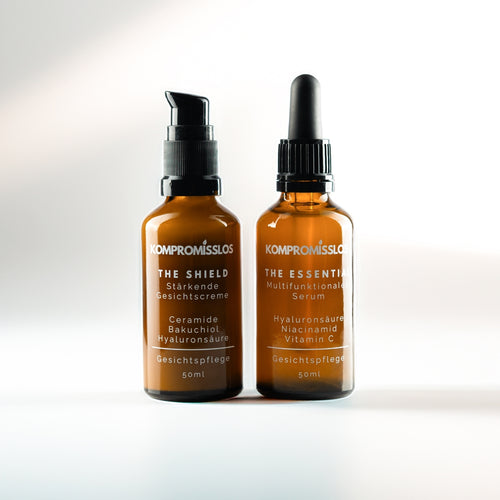
That is why the packaging you never buy in the first place achieves more than any refill pack. Fewer products mean fewer containers, and a product you use up completely only needs replacing once it is really empty. What this looks like in practice is shown in a minimalist skincare routine with just a few products, and you can work out how many packs that adds up to per year once you know how long 50 ml of face cream lasts. In her review on Judge.me, Simone writes: “I think it’s really great that you only need 2 products […]” (review translated from German). That is exactly the idea behind The Duo, a serum and face cream: two products instead of eight, which last around two months when used twice a day.
I deliberately limited The Duo to two products and did not add a toner or an exfoliant to the range. It was a decision about the routine rather than the packaging, but it has a side effect: the packaging you never buy is the only packaging that is guaranteed to cost nothing. With 3 to 6 drops of serum and 3 to 6 pumps of cream, both last two to four months depending on use, as the step-by-step application guide shows. That does not make a bottle climate-neutral, and it is no substitute for a life cycle assessment. It simply means fewer containers pile up in your bathroom that someone will have to dispose of at some point.
Frequently asked questions
Are refills cheaper than the original product?
Often, but not always. Refills frequently cost slightly less per millilitre because there is no elaborate container to pay for. So compare the price per millilitre rather than per pack, and factor in the permanent container on your first purchase. If what you mainly want is a predictable supply, the more relevant question is whether a skincare subscription is really worth it.
Can I refill pump dispensers and dropper bottles myself?
Technically it is often possible, but hygienically it is tricky. Pumps can hardly be cleaned and dried thoroughly at home, and pipettes come into contact with the product and your fingers every time you use them. If at all, then only with the same product, into a completely emptied, clean and dry container, and never on top of leftovers.
Is a plastic refill pouch better than a new glass jar?
It can be, if the pouch is light and you reuse the jar many times in return. A light pouch usually takes less to produce and transport than a new glass jar. But the advantage disappears if you only refill once or twice, or if the pouch ends up in general waste anyway.
How long do I need to use a refill system for it to pay off?
There is no universally valid number. What counts is how much more material goes into the permanent container than into a single-use pack, and what the refill is made of: a light plastic dispenser recovers its extra footprint faster than a heavy glass or metal jar. So only buy a refill system once you already know the product and are sure you want to keep using it.
Are there refill stations for facial skincare in Switzerland?
In Switzerland, you are most likely to find refill stations in zero-waste shops. Whether they also sell facial skincare loose varies from shop to shop, so ask directly. With facial skincare, what matters most is how the station is cleaned, that you fill a clean, dry container and that you use the product up promptly.
How can I tell whether a refill claim is backed up?
A refill claim that is backed up states its reference point: how many refills it assumes and what it is being compared with. Without that information, a percentage is worth little. It is also a good sign if the brand says what the refill is made of and how to dispose of it. An independently verified life cycle assessment is the strongest form of evidence.
Do I need a refill system if I use The Duo?
No. With The Duo, the bigger lever is quantity: two products instead of eight, which last two to four months depending on use, or around two months when used twice a day. If you use both up before buying more, you save packaging without having to rely on a refill system. You can find out more about the routine on the page for The Duo.
Sources
- Gatt IJ, Refalo P. Reusability and recyclability of plastic cosmetic packaging: A life cycle assessment. Resources, Conservation & Recycling Advances, 2022. Source
- Greenwood SC, Walker S, Baird HM, Parsons R, Mehl S, Webb TL et al. Many happy returns: Combining insights from the environmental and behavioural sciences to understand what is required to make reusable packaging mainstream. Sustainable Production and Consumption, 2021. Source
- Brannan DK, Dille JC. Type of closure prevents microbial contamination of cosmetics during consumer use. Applied and Environmental Microbiology, 1990. Source
- Bundesamt für Umwelt BAFU. Kunststoffe. Source