Natural preservatives in skincare: which are allowed and how well tolerated they really are
NATURAL SKINCARE
Preservatives in natural skincare come from a short positive list: the COSMOS standard only allows benzoic acid, sorbic acid, dehydroacetic acid, salicylic acid and their salts, plus benzyl alcohol. All of them also appear in Annex V of the EU Cosmetics Regulation, whose list applies in Switzerland too, each with a fixed maximum level. Most people tolerate them well, but contact allergies do occur. Ingredients such as Sodium Levulinate or Sodium Anisate do not count as preservatives in legal terms, but they support preservation in many formulas.
Which preservatives are allowed in certified natural skincare?
Natural skincare with the COSMOS label may only use five groups of preservatives: benzoic acid and its salts, benzyl alcohol, dehydroacetic acid and its salts, salicylic acid and its salts, and sorbic acid and its salts. That is what Appendix V of the COSMOS standard, version 4.2 from September 2025, sets out. The small print is telling: these substances are only allowed temporarily and are reviewed at every revision of the standard, with the aim of removing them as soon as compliant alternatives exist. NATRUE keeps its own list covering essentially the same groups of substances. What the various natural skincare certifications check beyond that is a topic of its own. When it comes to preservation, what matters most is what is missing: parabens are not on any of these lists, and neither is the widely used preservative phenoxyethanol. One point matters for everyday shopping: without a certification label, ‘natural skincare’ is not a protected term. A brand without certification may use any preservative from Annex V and still market its products as natural. The only reliable guide is therefore the INCI list on the pack.
Sodium Benzoate, Potassium Sorbate, Sodium Levulinate: what does each one do?
Sodium Benzoate and Potassium Sorbate are genuine preservatives listed in Annex V, whereas Sodium Levulinate is not a preservative in legal terms but an ingredient that supports preservation. Sodium Benzoate is the sodium salt of benzoic acid, Potassium Sorbate the potassium salt of sorbic acid. Both are organic acids, and how well they work depends heavily on the pH of the formula. Sodium Levulinate, the salt of levulinic acid, and Sodium Anisate, the salt of anisic acid, are not listed in Annex V. In legal terms they therefore do not count as preservatives, but in many natural skincare formulas they sit alongside a genuine preservative. A study in Scientific Reports counts anisic acid and glycols such as Pentylene Glycol among the multifunctional ingredients with antimicrobial properties that complement conventional preservatives or partly replace them. Alcohol can also have a preserving effect if the dose is high enough. Why that makes it such a common ingredient in natural skincare is explained in the article on alcohol in skincare.
Incidentally, a preservative appearing in the INCI list does not mean the system actually works. In the same study, 14 products were put through a challenge test with microbes. A combination of 0.084% Sodium Benzoate and 0.079% Potassium Sorbate met neither the criterion for bacteria nor the one for fungi. Dose, pH and formula decide together.
How much preservative is allowed in cosmetics?
The maximum permitted level is set by Annex V of the EU Cosmetics Regulation, separately for each substance and measured in the ready-to-use product. Switzerland adopts this list through its Ordinance on Foodstuffs and Utility Articles, so the same limits apply to products sold here. For benzoic acid, the regulation distinguishes by product type: 2.5% in rinse-off products, 1.7% in oral care products and 0.5% in leave-on products, each calculated as the acid. For a serum or a face cream, the lowest value therefore applies. The table shows the limits for leave-on products, meaning products that stay on the skin. The actual concentration is not stated on any pack; the INCI list only shows the order. That is why preservatives usually appear near the end of the list: they are used in small amounts.
| INCI name | Maximum level in leave-on products | On the COSMOS list |
|---|---|---|
| Sodium Benzoate, Benzoic Acid | 0.5% (as acid) | Yes |
| Potassium Sorbate, Sorbic Acid | 0.6% (as acid) | Yes |
| Benzyl Alcohol | 1.0% | Yes |
| Sodium Dehydroacetate, Dehydroacetic Acid | 0.6% (as acid), not in sprays | Yes |
| Salicylic Acid and its salts | 0.5% (as acid), not for children under 3 | Yes |
| Sodium Levulinate, Sodium Anisate | Not in Annex V, not a preservative in the legal sense | Not listed as a preservative |
How long a product keeps once opened is a different question from what it is preserved with. That is covered in a separate article on skincare shelf life after opening.
Is Sodium Benzoate safe in skincare?
At the permitted concentration, Sodium Benzoate is unproblematic for the vast majority of people, but it can trigger a contact allergy in a small group. Recent figures come from an analysis in the journal Contact Dermatitis: between 2008 and 2023, a dermatology clinic in Sheffield patch tested a total of 3,198 patients with 5% Sodium Benzoate. Of these, 57, or 1.8 per cent, had an allergic reaction, and in two thirds of these cases it was clinically relevant. To put this in context: the people tested had come to the clinic with suspected contact eczema, so they were not a cross-section of the general population. The authors describe Sodium Benzoate as an important allergen that is tricky to test, because doubtful and irritant reactions were more than three times as common as clearly allergic ones.
What this means for you: if you have no known reaction to benzoates, there is no reason to avoid Sodium Benzoate across the board. If you do, read the INCI list every time. Sodium Benzoate is also on the list in The Duo of serum and cream, openly declared. Whether an individual ingredient is an ‘additive’ you should avoid on principle is discussed in the article on Swiss skincare without additives.
How well tolerated are benzyl alcohol and dehydroacetic acid?
Most people tolerate benzyl alcohol well, but it is considered an underrated contact allergen – which is precisely why the American Contact Dermatitis Society named it Allergen of the Year 2026. The accompanying review in the journal Dermatitis describes how benzyl alcohol can cause allergic contact dermatitis, particularly with prolonged or repeated exposure. Because it is missing from many standard patch test series, it is easily overlooked as the culprit. Benzyl alcohol is also a fragrance component. If it is used for scent rather than as a preservative, it must be listed individually in the ingredient list of leave-on products from as little as 0.001%, instead of disappearing under the catch-all term Parfum. For dehydroacetic acid, the evidence is thinner. The EU limits it to 0.6% and bans it in sprays, but the available data do not allow any reliable conclusion about how often it causes allergies. As with benzoates, the same holds for both substances: no reason for concern if you have no history of reactions, but a clear suspect if your skin keeps reacting to skincare products.
If your skin reacts to several products with redness, itching or eczema, switching brands will not get you far. A patch test with a dermatologist shows which substance is behind it and saves you a lot of wasted purchases.
What does ‘nature-identical’ mean for preservatives?
Nature-identical means that a preservative is chemically identical to a substance that also occurs in nature, but is usually made in a laboratory or on an industrial scale. The COSMOS standard is unusually frank about this: the approved preservatives are mostly of petrochemical origin, but all or most of their structure is found in nature. That is why the standard explicitly classes them as non-natural ingredients that are only allowed as an exception. Sorbic acid is named after the rowan berry, benzoic acid after benzoin resin. Even so, there is no berry extract in the product, just the synthetically produced, identical substance. For your skin, the origin makes no difference; the molecule is the same. The underlying question of whether natural is automatically better is covered in the article on natural Swiss cosmetics. For preservation, the sober conclusion is this: a label such as ‘naturally preserved’ tells you little, whereas the INCI list tells you everything.
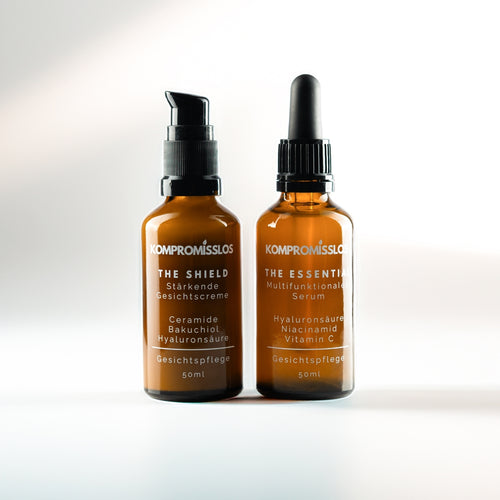
The Duo is based on aloe vera juice, with water added. Anything that contains water has to be preserved, otherwise microbes will grow in it sooner or later. In our case, Sodium Benzoate and Sodium Levulinate do that job, supported by Pentylene Glycol and Glycerin. On our page listing all ingredients from A to Z, Sodium Benzoate is explicitly described as synthetic. So I promise neither ‘preservative-free’ nor ‘naturally preserved’, because neither would be honest for a formula that contains water. What I can tell you is this: no phenoxyethanol, no parabens, no fragrance. And if you know you react to benzoates, our Duo is not the right product for you. To me, saying so is just as much part of full disclosure as stating the percentages of the active ingredients.
Frequently asked questions
Why do preservatives in natural skincare need an acidic pH?
Because most of the permitted preservatives are organic acids, such as benzoic and sorbic acid. With these, the pH of the formula determines how much of the active, undissociated acid is present. A study in Scientific Reports describes this using anisic acid as an example and names a pH below 5.5 as a requirement for it to work. That is why pH adjusters such as Citric Acid often appear in the INCI list of such formulas.
Are essential oils preservatives?
No, essential oils are not listed in Annex V and do not count as preservatives in legal terms. Some do have antimicrobial properties, but a manufacturer may only use substances from Annex V as preservatives. On top of that, they can irritate sensitive skin, as the article on essential oils in skincare shows.
Is Sodium Levulinate natural?
Sodium Levulinate is made from natural raw materials, but it is chemically processed. That is why NATRUE lists it among its derived natural substances rather than among the preservatives. In legal terms it is not a preservative, because it is not in Annex V. In a formula, it therefore usually sits alongside a preservative from Annex V and supports it.
What is Sodium Anisate?
Sodium Anisate is the sodium salt of anisic acid, an organic acid of plant origin. Like Sodium Levulinate, it is not listed in Annex V and is therefore not a preservative in the legal sense. According to a study in Scientific Reports, anisic acid only works in the acidic range and should be combined with preservatives such as benzyl alcohol, because it is weak against bacteria.
Can I be allergic to preservatives?
Yes, contact allergies to preservatives do exist, including to those permitted in natural skincare, such as Sodium Benzoate or benzyl alcohol. They are rare, but real. Typical signs are redness, itching or eczema where you apply the product, often only after repeated use. A patch test with a dermatologist gives you a clear answer – trying one new product after another does not.
Why does water-free skincare contain no preservatives?
Microbes need water to grow. Pure oils, balms and water-free serums offer them hardly anywhere to live and therefore often manage without preservatives. Their problem is rather that the oils go rancid, which antioxidants such as vitamin E can slow down. Whether skincare that contains water can do entirely without preservation is discussed in the article on parabens in cosmetics and their alternatives.
How is The Duo preserved?
The Duo is preserved with Sodium Benzoate and Sodium Levulinate, supported by Pentylene Glycol and Glycerin. Sodium Benzoate is a preservative from Annex V and is also on the COSMOS list; Sodium Levulinate supports the system. The Duo contains no phenoxyethanol, parabens or fragrance. If you are allergic to benzoates, it is not the right choice for you.
Sources
- Europäisches Parlament und Rat. Verordnung (EG) Nr. 1223/2009 über kosmetische Mittel, Anhang III und Anhang V (Liste der zugelassenen Konservierungsstoffe), konsolidierte Fassung vom 1.9.2025. Amtsblatt der Europäischen Union, 2009. Source
- COSMOS-standard AISBL. COSMOS Standard: Cosmetics Organic and Natural Standard, Version 4.2, Appendix V. COSMOS-standard AISBL, 2025. Source
- Chen T, Chang H. Deciphering trends in replacing preservatives in cosmetics intended for infants and sensitive population. Scientific Reports, 2024. Source
- Lawrance NJ, Holden CR, Gawkrodger DJ. Sodium Benzoate as an Emerging but Problematic Allergen: Retrospective Analysis of Patch Test Results in 3198 Cases Underlines the Need for an Improved Test Preparation, as Even Dubious Reactions May Be Clinically Relevant. Contact Dermatitis, 2025. Source
- Le NT, Wu PA. Benzyl Alcohol: Allergen of the Year 2026. Dermatitis, 2026. Source