Is phenoxyethanol safe? How concerning this cosmetic preservative really is
NATURAL SKINCARE
Based on current evidence, phenoxyethanol is safe and not harmful at the permitted levels. The EU’s Scientific Committee on Consumer Safety (SCCS) re-evaluated the preservative in 2016 and judged it safe at up to 1%, explicitly including children up to the age of three. Contact allergies do occur, but they are rare. Phenoxyethanol’s poor reputation comes mainly from warning lists and from the fact that certified natural cosmetics do not allow it. That is a rule about which groups of substances are permitted, not a toxicological verdict.
Is phenoxyethanol safe?
Yes – at concentrations of up to 1%, phenoxyethanol is considered safe for use in cosmetics, according to the assessment of the responsible EU expert committee. The re-evaluation was triggered in 2012 by the French medicines agency ANSM, which had raised concerns, mainly about young children. The SCCS then reviewed animal studies, data on absorption through the skin and model calculations of how the body metabolises the substance. In animal studies, the main effects were on the blood, but at doses far above anything consumers absorb from cosmetics. The rabbit was the most sensitive species, and according to the SCCS, humans break down phenoxyethanol much more efficiently than rabbits do. The main breakdown product is phenoxyacetic acid. The committee itself points out one limitation: its assessment only considers exposure from cosmetics, not from any other sources.
Why such a well-studied substance still ends up on so many lists has more to do with the logic of those lists than with any new data. How to tell evidence-based warnings from scaremongering is covered in the article on harmful ingredients in skincare and the warning lists behind them.
What is phenoxyethanol and why is it in cosmetics?
Phenoxyethanol is a synthetically produced preservative – chemically a glycol ether – that protects water-based cosmetics from microbes. According to the SCCS, it is effective against a broad spectrum of Gram-negative and Gram-positive bacteria as well as yeasts and moulds. A substance like this is needed because every cream, serum and lotion that contains water becomes a breeding ground as soon as you open it and dip your fingers in. Without a preservative, such a product would go off within a short time. Phenoxyethanol also acts as a solvent, which is why it often comes in ready-made blends with other preservatives. The SCCS also notes that it is used as a component of fragrance mixtures. Just how widespread it is can be seen from a sample analysed in the journal Contact Dermatitis: of 3,541 leave-on products – skincare that stays on the skin – 1,111 contained phenoxyethanol. And for a preservative, widely used does not mean suspicious. Above all, it means well studied.
What is the maximum concentration of phenoxyethanol allowed?
Phenoxyethanol is limited to a maximum concentration of 1% in the finished cosmetic product. The limit is set out in Annex V of the EU Cosmetics Regulation 1223/2009, the list of approved preservatives. Switzerland adopts this list: according to the Federal Food Safety and Veterinary Office (FSVO), Article 54 of the Swiss Foodstuffs and Utility Articles Ordinance refers to the current version of the EU Cosmetics Regulation. In Switzerland, then, only substances listed in Annex V may be used as preservatives, and only under the conditions stated there. What is interesting is how the SCCS arrives at the 1%. It works with a safety buffer, known in technical terms as the margin of safety: how far daily exposure lies below the dose that caused no harm in animal studies. For phenoxyethanol, the committee requires a margin of at least 25. For adults, the result was 130 when all cosmetics containing the preservative were added together.
| Figure | Value | What it means |
|---|---|---|
| Maximum concentration in the EU and Switzerland | 1% | Applies to every cosmetic product, including baby care |
| ANSM proposal, 2012 | 0.4% for children under three, not in the nappy area | Prompted the re-evaluation; in 2016 the SCCS considered 1% safe for this age group too |
| Required margin of safety | at least 25 | Minimum the SCCS sets for this substance |
| Margin of safety for adults | 130 | All cosmetics containing phenoxyethanol combined |
| Margin of safety for children up to three | 41 to 53 | Unfavourable but realistic scenario with a low body weight |
How common are allergies to phenoxyethanol?
Allergies to phenoxyethanol are rare. The SCCS summarises data from the IVDK, a network of dermatology clinics in Germany, Switzerland and Austria: of 6,932 patients tested, 0.24 per cent had a positive patch test reaction to 1% phenoxyethanol. The context matters here. The people tested had already come to the clinic with suspected contact eczema – they were not the general population. The study in Contact Dermatitis went a step further and set the frequency of allergies against how widely each preservative is used in products. After all, a substance found in one in three products has more opportunity to trigger allergies than a rare one. The resulting ratio for phenoxyethanol was 0.06, the lowest of all the preservatives studied. Parabens came in at 0.35, benzoates at 1.35 and the combination of methylchloroisothiazolinone and methylisothiazolinone at 9.0. The SCCS reaches the same conclusion: contact allergies in humans have been documented but are rare, and the risk of becoming sensitised is very low.
Rare does not mean never. If you develop redness, itching or small blisters after using a new product, stop using it. Only a patch test with a dermatologist can tell you which ingredient is behind the reaction – guessing from the ingredient list cannot.
Why is phenoxyethanol in baby products so debated?
Phenoxyethanol in baby products is debated because young children can be more exposed to a cosmetic ingredient than adults. That was exactly the concern of the French ANSM when, in 2012, it proposed lowering the maximum level in products for children under three to 0.4% and not using phenoxyethanol at all in products for the nappy area. The SCCS therefore ran separate calculations for this age group. In an unfavourable but realistic scenario, it added up all age-appropriate products and assumed a low body weight. At 9 kilograms, this gave a margin of safety of 53; at 7 kilograms, a margin of 41. The required minimum is 25. The committee concluded that, although children up to the age of three may be more exposed than adults, the margins of safety are sufficient. Its conclusion contains no separate restriction for the nappy area. For parents, this means that, based on this assessment, a baby product containing phenoxyethanol is no cause for concern. If your child’s skin is sore or inflamed, though, that question belongs with your paediatrician, not the internet.
Why is phenoxyethanol not allowed in certified natural cosmetics?
Phenoxyethanol is not allowed in certified natural cosmetics because the major standards only permit a short positive list of preservatives, and phenoxyethanol is not on it. Version 4.2 of the COSMOS standard allows only five groups of preservatives of petrochemical origin, including benzoic acid and sorbic acid, and excludes all other substances with a petrochemical component. NATRUE only allows the preservatives listed in its Annex 4. Phenoxyethanol appears on neither list. The exclusion is a decision about origin and principle. It contains no verdict that phenoxyethanol is more harmful than the permitted alternatives – and if anything, the allergy data above suggest the opposite. Which alternatives exist and how well they are tolerated is covered in the profile of preservatives in natural skincare. The same applies there too: swapping one preservative for another does not automatically make a product gentler.
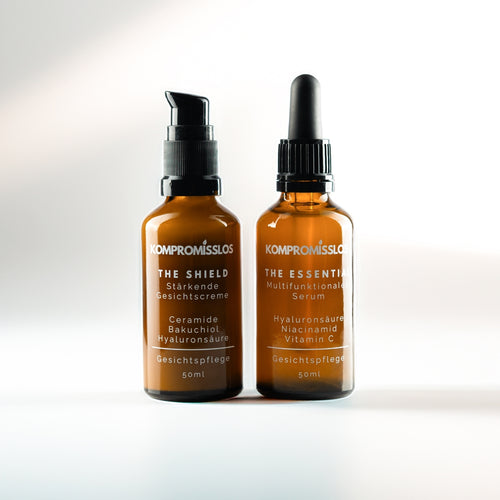
One example without phenoxyethanol is The Duo of serum and face cream. Here, Sodium Benzoate and Sodium Levulinate do the preserving, supported by Pentylene Glycol and Glycerin. What the word ‘natural’ on a pack actually tells you is a separate question, which the article on natural Swiss cosmetics takes apart.
On our page with the full ingredient list for the Duo, the preservatives are listed too – and classified accurately. Sodium Benzoate is marked as synthetic there, even though it would be more convenient to talk only about natural preservation. I see no point in hiding preservatives or treating them as a flaw. Water-based skincare like the Duo, whose base is aloe vera juice, needs protection from microbes, or it will spoil once you have opened it. The fact that the Duo contains no phenoxyethanol is a formulation decision, not a safety argument. If you are happy with a product, you do not need to throw it away just because phenoxyethanol is on the label. Read the whole list rather than fixating on a single word in it.
Frequently asked questions
Is phenoxyethanol an alcohol?
Chemically, phenoxyethanol is a glycol ether that carries an alcohol group; its technical name is 2-phenoxyethanol. But it has nothing to do with ethanol or Alcohol Denat., which can be drying in high amounts, and it is only used in cosmetics at up to 1%. Which alcohols dry out your skin and which care for it is explained in the article on alcohol in skincare.
Is phenoxyethanol safe during pregnancy?
The SCCS assessment does not include a separate conclusion on pregnancy, but it did take into account animal studies on fertility and the development of offspring. In those studies, harm to the offspring only appeared at doses that were already harming the mothers, and the classification as safe up to 1% applies to consumers in general. If you are unsure, discuss your skincare with your gynaecologist or midwife rather than cutting out individual ingredients on your own.
How do I spot phenoxyethanol in the INCI list?
Phenoxyethanol appears in the INCI list under exactly that name. Because it may make up no more than 1%, you will usually find it towards the end of the list, often next to a second preservative. Its chemical name is 2-phenoxyethanol, and in technical documents you may also come across the synonym phenoxytol.
Is phenoxyethanol better than parabens?
In terms of allergy risk, phenoxyethanol comes out ahead in the Contact Dermatitis analysis, with a ratio of 0.06 compared with 0.35 for parabens. But both are approved, well-studied preservatives whose safety depends on the concentration. Which parabens are allowed and which have been banned is covered in the article on parabens in cosmetics.
Can phenoxyethanol irritate the skin?
It rarely does. In a test evaluated by the SCCS, even undiluted phenoxyethanol did not irritate rabbit skin, and in cosmetics it is limited to 1%. Contact allergies have been described, but they are rare. If a product stings or reddens your skin, fragrances, acids or an already stressed skin barrier may also be to blame.
Are preservative-free cosmetics safer?
Not automatically. Water-based cosmetics without preservatives can become contaminated with microbes once opened, and that is a bigger problem for your skin than an approved preservative. Products with no declared preservative are often water-free, come in special packaging or rely on ingredients that do double duty. What lies behind such claims is explained in the article on Swiss skincare without additives.
Does The Duo contain phenoxyethanol?
No. The Duo is preserved with Sodium Benzoate and Sodium Levulinate, supported by Pentylene Glycol and Glycerin, and it contains no parabens either. Sodium Benzoate is a synthetic preservative. That does not make the Duo inherently better tolerated than a product with phenoxyethanol – it is simply a different preservative system, and one that is fully declared.
Sources
- SCCS (Scientific Committee on Consumer Safety). Opinion on Phenoxyethanol, SCCS/1575/16, final version of 6 October 2016. Europäische Kommission, 2016. Source
- Schnuch A, Mildau G, Kratz EM, Uter W. Risk of sensitization to preservatives estimated on the basis of patch test data and exposure, according to a sample of 3541 leave-on products. Contact Dermatitis, 2011. Source
- Bundesamt für Lebensmittelsicherheit und Veterinärwesen BLV. Geregelte Stoffe in kosmetischen Mitteln. Source
- COSMOS-standard AISBL. COSMOS Standard, Cosmetics Organic and Natural Standard, Version 4.2, Appendix V. 2025. Source
- NATRUE. NATRUE Label criteria, Version 3.9, Abschnitt 3.4, und Annexes to the NATRUE Standard, Annex 4 (Stand 18.06.2026). Source