Harmful ingredients in skincare: which warning lists hold up and which just cause panic
NATURAL SKINCARE
Harmful ingredients in skincare are clearly defined in law: substances with a proven risk appear in the lists of the EU Cosmetics Regulation, which Swiss law also refers to, and are either banned there or only allowed up to a maximum amount. What appears on private warning lists is mostly permitted and is criticised as a precaution, because of allergies or for environmental reasons. So what matters is the logic a list uses to assess an ingredient, not how red that ingredient is marked on it.
Which ingredients in skincare are considered harmful?
In skincare, four very different groups of substances are considered harmful, and most warning lists lump them all together. The first group is banned. Annex II of the EU regulation on cosmetic products lists the prohibited substances, Annex III the substances subject to restrictions, and Annexes IV to VI the permitted colourants, preservatives and UV filters. According to the Swiss Federal Food Safety and Veterinary Office (FSVO), the Swiss Foodstuffs and Utility Articles Ordinance refers to exactly this regulation. The second group is permitted, but with maximum amounts or warnings. The third group is permitted but disputed: substances that experts, associations or apps have concerns about, even though no authority has identified a risk under normal use. The fourth group has little to do with how hazardous a substance is: these are substances that trigger allergies or irritation in certain people. For your skin, this group can matter more than any list, because it does not apply to everyone, it applies to you.
How are warning lists created and who assesses the ingredients?
Warning lists come from two sources: assessments by authorities and scientific committees, and judgements by organisations, media and apps that apply their own criteria. At EU level, the Scientific Committee on Consumer Safety (SCCS) assesses individual substances before they are banned, restricted or permitted in the annexes. The finished product, on the other hand, is the responsibility of the company that sells it. Fact sheet no. 26 from the canton of Aargau sums up the Swiss rules as follows: cosmetics do not need to be registered or authorised, but before it is sold for the first time, every product needs a product information file with a safety report drawn up by a qualified expert. Compliance is checked by the cantons. Private lists work differently. They often rate a property of a substance rather than the amount contained in the product, and they blend criteria such as allergy potential, environmental impact and suspicions into a single colour. That is not wrong, but it answers a different question from the one the authority is asking.
What is the difference between regulatory assessment and the precautionary principle?
A regulatory assessment asks whether a substance poses a risk at the amount and in the way it is actually used; the precautionary principle asks whether it could pose a risk at all. The SCCS guidelines describe a safety assessment as a sequence of steps. First, the hazard is identified, meaning the property that could in principle harm health. Next, it is calculated how much of the substance actually enters the body under normal use. Only by comparing the two values do you arrive at the risk. As a rule of thumb, the SCCS cites a margin of safety of at least 100 between the dose that showed no harmful effect in studies and the calculated human intake. The precautionary principle starts earlier: if data are missing or contradictory, a substance is avoided to be on the safe side. Both ways of thinking are legitimate. It only becomes a problem when a list is acting out of precaution but sounds as if it has proven a risk. Then “not conclusively clarified” quickly turns into “toxic”, and that is exactly where the panic starts.
| Classification | Who decides | What it means for you |
|---|---|---|
| Banned (Annex II) | EU law, adopted in Switzerland by reference | Must not be in any legally sold product |
| Restricted (Annexes III, V, VI) | EU law following SCCS assessment | Permitted up to a maximum amount, sometimes with a warning |
| Disputed | Organisations, media, apps | A precautionary decision, not a proven risk |
| Individually not tolerated | Your skin, ideally with a medical check | Relevant to you, regardless of any list |
Which ingredient groups are mentioned most often and how should you view them?
The groups that crop up most often on warning lists are preservatives, silicones, mineral oils, fragrances and microplastics, and each of them is criticised for a different reason. That is why it makes little sense to tick them off together. Here is the short version for each group:
- Parabens: a handful are banned, others remain permitted within limits. The details are in the article on parabens in cosmetics.
- Phenoxyethanol: a widely used preservative with a maximum concentration that is much debated. You can find out how concerning phenoxyethanol really is.
- Silicones: the criticism is more about skin feel and the environment than about health. More on this under silicones in skincare.
- PEG compounds: emulsifiers where the debate is about impurities from manufacturing and whether they make the skin barrier more permeable. They are put into context in the article on PEGs in skincare.
- Mineral oil: the debate revolves around purity and contaminants. It is put into context in the article on mineral oil in skincare.
- Fragrances: the issue here is allergies, not toxicity, and that applies just as much to natural sources of fragrance.
- Microplastics: the criticism is above all an environmental question, which is now regulated by law in both the EU and Switzerland.
Comedogenic ingredients are a category of their own. They are not considered a health concern, but they end up on many lists because they are said to encourage blackheads in some skin types. Here, too, the finished formula counts for more than the individual raw material.
Is there any truth to the concerns about hormone-disrupting ingredients?
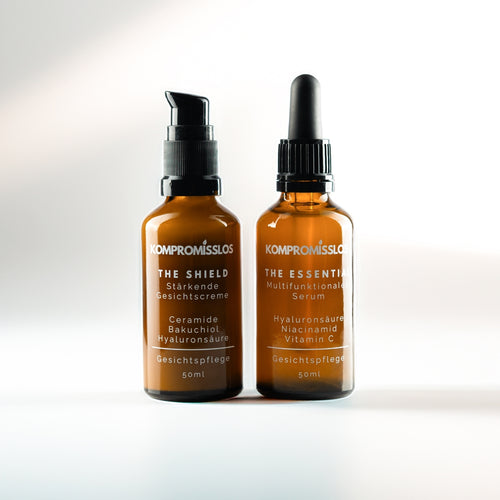
There is enough truth to them that authorities examine these substances specifically, but much less than warning lists suggest. The key lies in a distinction that the SCCS sets out in detail in its guidelines: an endocrine-active substance can interact with the hormone system, for example by binding to a receptor in cell culture. It only counts as an endocrine disruptor once a biologically plausible link between this activity and a harmful effect in the intact organism has been established. The SCCS states explicitly that natural and synthetic substances can interact with the hormone system and that such disturbances can stay within the body’s own compensating mechanisms. Many lists, however, already label activity in the lab as “hormonally active”. That includes plant substances too. Bakuchiol, which is in our cream, shows oestrogen-like activity in cell studies. What this means when it is applied to the skin has not been investigated. So the only honest statement is this: The Duo contains no hormones. If you are unsure about individual ingredients during pregnancy or because of a medical condition, the best thing is to check with your doctor.
How can you spot safe skincare without panicking?
You can spot safe skincare by a complete, verifiable ingredient declaration and by criteria that suit your skin, not by a label with as many “free from” claims as possible. A “without” is only worth as much as what goes in instead. A short checking routine that you apply the same way to every product makes more sense:
- The full INCI list is accessible, on the packaging and online, so that you can read it at your leisure.
- Check for fragrance: perfume, essential oils and declared fragrance allergens are the most important point for sensitive skin.
- Prefer a short list: the fewer ingredients, the easier it is to find out what you are reacting to.
- Read marketing claims with a cool head: fear-based messages are not a mark of quality.
- Watch how your skin reacts: introduce a new product on its own and observe it for two to three weeks.
What the term “without additives” means legally and why it is not a protected term is covered in the article on Swiss skincare without additives. If you are thinking long term, a stable skin barrier matters more than hunting for the perfect label; this idea is also behind skin longevity. One example of a short, verifiable list is The Duo, made up of serum and cream: fragrance-free and without parabens, silicones, mineral oil or microplastics. In her review on Judge.me, Barbara F. writes: “Two products, clear ingredients, no frills” (review translated from German).
If your skin reacts to lots of products, no warning list will help you as much as a patch test with a dermatologist. Afterwards you will know which specific substances you should avoid, instead of ruling out entire groups just in case.
I deliberately made The Duo fragrance-free and without parabens, silicones, mineral oil or microplastics. Not because all of these substances are dangerous, but because fragrance has no job to do in skincare yet is a well-known troublemaker for sensitive skin, and because I wanted a list you can go through in a few minutes. Even so, it cannot do without preservation altogether: The Duo contains sodium benzoate and sodium levulinate, and I say so openly. A short list is no promise that every skin will tolerate everything. But it does make it easier for you to find out. That is why the complete INCI list with every ingredient is openly available on our website, for you to read and compare, without having to take my word for anything.
Frequently asked questions
What is the difference between hazard and risk for ingredients?
Hazard is a substance’s inherent ability to cause harm; risk is the likelihood that this actually happens under real-life use. What determines the risk is how much of a substance is in the product, how often you use it and how much of it gets into the body. A substance with a high hazard can therefore be safe in a small amount.
Do EU bans on cosmetic ingredients also apply in Switzerland?
Yes, largely. The Swiss Foodstuffs and Utility Articles Ordinance refers to the current version of the EU Cosmetics Regulation, with its lists of banned and restricted substances. A small number of deviations are set out in the Swiss Ordinance on Cosmetic Products itself. As a rule, a cosmetic ingredient banned in the EU is therefore not permitted in Switzerland either.
Are microplastics still allowed in facial skincare?
Only under transitional periods. In Switzerland, the Chemical Risk Reduction Ordinance has banned intentionally added microplastics since 1 December 2025. Since 1 June 2026, scrubs containing microbeads can no longer be newly placed on the market. For facial skincare that stays on the skin, the transitional period runs until 17 October 2029, and for make-up, lip and nail products until 2035.
Who regulates cosmetics in Switzerland?
Enforcement lies with the cantons, usually the cantonal laboratory or consumer protection office. There is no approval before sale. As part of its self-regulation, the company itself has to ensure that its product is safe and keep a product information file with a safety report from a qualified expert ready for inspection.
Are natural ingredients automatically safe?
No. Natural substances can trigger allergies just as synthetic ones can. A review in the journal Dermatitis notes that almost 80 essential oils have already caused contact allergies. The SCCS also stresses that both natural and synthetic substances can interact with the hormone system. Origin therefore says little about how well your skin will tolerate something.
How reliable are cosmetic ingredient apps?
Cosmetic apps are only as reliable as the criteria they use for their ratings, and many do not know how much of a substance is in the product. What ingredient apps such as Yuka and Codecheck can do and where their limits lie is covered in a separate article.
Which questionable ingredients are not in The Duo?
The Duo contains no perfume, no essential oils, no phenoxyethanol, no parabens, no silicones, no mineral oil or paraffin, no microplastics and no alcohol denat. It is preserved with sodium benzoate and sodium levulinate. You can check the full list at any time before you decide on The Duo.
Sources
- Bundesamt für Lebensmittelsicherheit und Veterinärwesen BLV. Geregelte Stoffe in kosmetischen Mitteln. BLV, abgerufen 2026. Source
- Kanton Aargau, Departement Gesundheit und Soziales, Amt für Verbraucherschutz. Merkblatt Nr. 26: Vertrieb von Kosmetika in der Schweiz. Stand 26.03.2026. Source
- Scientific Committee on Consumer Safety SCCS. The SCCS Notes of Guidance for the Testing of Cosmetic Ingredients and their Safety Evaluation, 12th Revision. SCCS/1647/22, Corrigendum 2, 2023. Source
- Schweizerischer Bundesrat. Verordnung zur Reduktion von Risiken beim Umgang mit bestimmten besonders gefährlichen Stoffen, Zubereitungen und Gegenständen (Chemikalien-Risikoreduktions-Verordnung, ChemRRV, SR 814.81), Anhang 2.9 Ziffer 1 Mikroplastik. Stand 16.07.2026. Source
- de Groot AC, Schmidt E. Essential Oils, Part IV: Contact Allergy. Dermatitis, 2016. Source