Mineral oil in skincare: how bad paraffin really is and what’s behind the MOAH concerns
NATURAL SKINCARE
On current evidence, mineral oil in skincare is not bad for you as long as it is highly refined – and only highly refined grades may be used in cosmetics. Liquid paraffin and petroleum jelly stay largely in the outermost layer of the skin and, according to the available studies, do not enter the body. The criticism has substance where aromatic impurities (MOAH) are concerned and with products that get swallowed, above all lip care. On your face, mineral oil is therefore more a question of skin feel and origin than of poison.
Is mineral oil in skincare bad for you?
No, according to the available data, highly refined mineral oil in skincare is not considered harmful when applied to the skin. Mineral oils and mineral waxes are mixtures of mostly saturated hydrocarbons that are derived from crude oil and extensively purified for use in cosmetics. A review in Toxicology Letters analysed 13 studies in humans, animals and skin models on absorption through the skin. Most of the material stayed attached to the stratum corneum, only a small proportion reached deeper layers of the skin, and there was no evidence that mineral oils enter the body through the skin. A second review in the Journal of the European Academy of Dermatology and Venereology reaches the same conclusion and points to their long history of use, which it says is supported by clinical and epidemiological data.
An honest assessment also has to mention who wrote these papers: most of the authors of the first review work for cosmetics manufacturers and their trade association, and the lead author of the second works for a cosmetics group. That does not make the data wrong, but it explains why critics look more closely. When the word “harmful” sticks regardless, three things usually get mixed up: impurities in technical-grade mineral oils, swallowing lip care, and the feel of a dense layer of grease on the skin. Only the first two are safety questions.
What is MOAH and why is it criticised?
MOAH stands for “mineral oil aromatic hydrocarbons”, and the criticism comes mainly from the field of food safety. Broadly speaking, mineral oil consists of two fractions: saturated hydrocarbons, abbreviated to MOSH, and aromatic ones, abbreviated to MOAH. In 2023, the European Food Safety Authority (EFSA) updated its risk assessment of mineral oil in food. For MOSH, the relevant panel concluded that current dietary intake poses no health risk for any age group. For MOAH, the verdict is different: genotoxic and carcinogenic properties are associated with MOAH that have three or more aromatic rings, and for dietary intake EFSA identified a possible health concern. According to EFSA, toxicological data on MOAH with one or two rings are lacking.
This assessment concerns what you eat, not what stays on your skin. It still matters for cosmetics, because it shows why purification of the raw material is crucial. In the EU, mineral oils may only be used in cosmetics if they meet the purity requirements for polycyclic aromatic hydrocarbons set out in the European Pharmacopoeia and the EU Cosmetics Regulation. Refining is meant to exclude substances with carcinogenic potential and to minimise the MOAH content. Minimise does not mean zero, and that is exactly where the legitimate criticism comes in. It is aimed at impurities, not at the purified cosmetic raw material itself.
How can you spot mineral oil on an ingredient list?
You can spot mineral oil on the INCI list by names such as Paraffinum Liquidum, Mineral Oil, Petrolatum, Paraffin, Cera Microcristallina, Ozokerite and Ceresin. The INCI list is the ingredient list on the packaging, sorted by quantity: whatever is near the top makes up a large part of the formula. If Paraffinum Liquidum is in second or third place, mineral oil is a main ingredient. If a wax such as Cera Microcristallina is near the end, its main job is to give the product firmness. What the INCI list does not tell you, however, is how much MOAH a product contains, because it names the raw material, not its purity. The overview below is therefore a list of names, not a verdict on any individual product.
| INCI name | What it is | Typically found in |
|---|---|---|
| Paraffinum Liquidum, Mineral Oil | Liquid, purified mineral oil | Body lotions, cleansing oils, baby oils |
| Petrolatum | Petroleum jelly, a semi-solid mixture of mineral oil and waxes | Ointments, barrier creams and lip care |
| Paraffin, Cera Microcristallina | Solid waxes derived from crude oil | Lipsticks, balms, firmer creams |
| Ozokerite, Ceresin | Mineral waxes | Sticks, mascara, balms |
| Hydrogenated Polyisobutene, Polybutene | Synthetic hydrocarbons, not mineral oil in the strict sense | Lip gloss, creams |
Silicones such as dimethicone do not belong on this list. They do not come from plants either, but chemically they are something else, which is why they have their own guide on silicones in skincare. And mineral oil contains nothing of animal origin, so if you are looking for vegan facial skincare, you will find paraffin in vegan products too. Vegan tells you about animal-derived ingredients, not about crude oil. A “mineral oil-free” claim on the front of the pack is no substitute for checking the INCI list either, and neither is a certification label. How to assess a brand without one yourself is explained step by step in the guide to natural skincare without certification.
Should mineral oil in lip care and baby care be judged differently?
Yes, lip care is the area where the criticism has the most substance, because a large share of the product gets swallowed. Between 2012 and 2014, the Cantonal Laboratory of Basel-Stadt and the official food control authority of the Canton of Zurich tested a total of 175 lip products from the Swiss market, with the results published in the International Journal of Cosmetic Science. Around 68 per cent contained at least 5 per cent saturated hydrocarbons of mineral or synthetic origin, and around 31 per cent even contained more than 32 per cent. Some of these hydrocarbons accumulate in human tissue. The authors conclude that lip products should contain clearly less than 5 per cent of them. The review in the Journal of the European Academy of Dermatology and Venereology takes a different view: the trade association Cosmetics Europe recommends that manufacturers only use fractions for which an acceptable daily intake from the food sector applies, and the amount swallowed via lip care is said to be below 10 per cent of that value. The two positions stand side by side – one from official control laboratories, the other from industry.
The same logic applies to baby care. On the skin, mineral oil stays largely in the stratum corneum; it becomes relevant where product gets into the mouth via hands or face. The studies cited do not provide any data specifically on babies’ skin. Redness, rashes or weeping patches should be checked by a paediatrician, not dealt with from the skincare shelf.
If you apply lip balm many times a day, that is where a switch is most worthwhile. A balm based on plant waxes and oils is the simplest solution, without having to change the rest of your skincare.
Why do so many brands use plant oils instead?
Many brands use plant oils because they offer more than a protective film, because customers ask for them and because they come from renewable raw materials – not because mineral oil is dangerous. Mineral oil is chemically inert: it sits on the skin and slows down evaporation. A review in the International Journal of Cosmetic Science describes how it improves the softness and barrier function of the skin more than some other emollients and reduces water loss through the skin. Plant oils also supply fatty acids, plant sterols or vitamin E. Jojoba oil is actually a liquid wax ester and absorbs without leaving a heavy film.
Plant-based does not automatically mean better tolerated, though. Plant oils can oxidise and go rancid, and unlike highly refined mineral oil they can trigger allergies, as the review in the Journal of the European Academy of Dermatology and Venereology also points out. The difference therefore lies less in safety than in how it feels on the skin. The Duo of serum and cream relies on jojoba oil, squalane, sunflower oil, crambe oil and hydrogenated rapeseed oil and, according to its INCI list, contains no mineral oil, no paraffin and no petroleum jelly. In a review on Judge.me, D.Sch writes: “The product feels pleasantly light on the skin, absorbs quickly and doesn’t leave a greasy or heavy feeling” (review translated from German).
What do the authorities say about the safety of mineral oil in skincare?
From a regulatory point of view, highly refined mineral oil is a permitted raw material in cosmetics, provided it meets the purity requirements of the European Pharmacopoeia and the EU Cosmetics Regulation. EFSA’s concerns relate to food in which mineral oil ends up unintentionally, for example via packaging or during processing, not to purified cosmetic raw materials. The fact that Swiss control authorities nonetheless test lip products shows where they are looking: wherever cosmetics end up being eaten. Sorted by level of certainty, the picture looks like this:
- Well established: according to the available studies, highly refined mineral oils do not enter the body through the skin.
- Well established: in food, EFSA sees no health risk from MOSH at current intake levels, and a possible concern from MOAH with three or more rings.
- Disputed: how much mineral oil is acceptable in lip products is judged differently by control laboratories and industry.
- Open: toxicological data on MOAH with one or two rings are lacking.
This breakdown also helps with other substances that are labelled dangerous online. How to check such lists in general is covered in the guide to harmful ingredients in skincare.
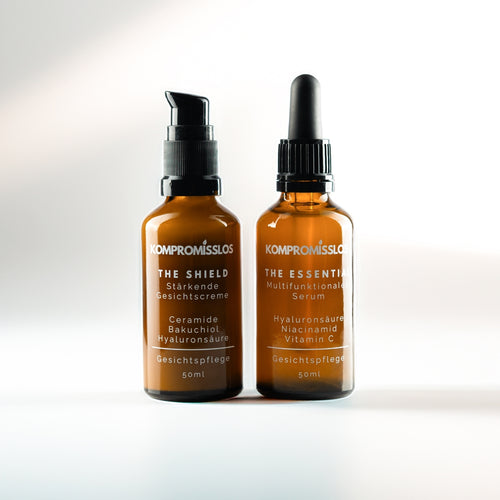
The Shield uses jojoba oil and squalane as its lipids – no paraffin and no petroleum jelly. That was not a decision made out of fear. Highly refined mineral oil is permitted, and I am not going to tell you it is poison. I wanted a cream that absorbs quickly and does not feel like a film on the skin, and jojoba oil and squalane fitted that idea better than a paraffin base. Then there is the origin: the oils in the Duo, such as jojoba, sunflower and crambe oil, come from plants, not from crude oil refining. The limits of this decision are clear: a petroleum jelly ointment seals more strongly than our cream. If your skin needs more in winter, an additional oil in the evening can make sense. The full list of what is in it is on our page of ingredients from A to Z.
Frequently asked questions
Is Vaseline a mineral oil?
Yes, Vaseline, or petroleum jelly, is a mineral oil product. On the INCI list it appears as Petrolatum, and it consists of a semi-solid mixture of purified hydrocarbons derived from crude oil. For cosmetics and medicines, it is highly purified, just like liquid paraffin. It forms a denser layer than liquid mineral oil, which is why it is used mainly in ointments and lip care.
Does paraffin clog pores?
Whether paraffin clogs pores cannot be answered across the board; what matters is the finished formula and your skin, not the individual raw material. Why comedogenicity ratings are of little use here is explained in the guide on what comedogenic means. If you use petroleum jelly as an overnight layer, you will find more in the guide to slugging.
Are plant oils better tolerated than mineral oil?
Not automatically. Highly refined mineral oil is chemically stable and practically never triggers allergies, whereas plant oils can oxidise and cause reactions in some people. In return, they bring fatty acids and other compounds that mineral oil does not have. Your own skin over a few weeks is the best indicator of which lipids suit you better.
Is mineral oil allowed in natural skincare?
Mineral oil is not allowed in certified natural skincare; the common standards exclude raw materials derived from crude oil, such as paraffin and petroleum jelly. Without a certification label, however, the term natural skincare is not protected. So rely on the INCI list: if it includes Paraffinum Liquidum, Petrolatum or Cera Microcristallina, the product contains mineral oil.
Does mineral oil dry out your skin?
No, mineral oil does not dry out your skin. It sits on the stratum corneum and slows down water loss, which is well documented in measurements. The claim that skin becomes “lazy” under mineral oil and produces less of its own oil is not supported by evidence. If you feel uncomfortable with mineral oil, you are usually reacting to the heavy feel on the skin, not to dryness.
Is mineral oil bad for the environment?
Mineral oil is a product of crude oil refining and therefore a fossil raw material – that is the strongest environmental objection. Plant oils are renewable, but they have a footprint of their own through cultivation, land use and transport. So there is no blanket answer. If origin matters to you, avoiding fossil raw materials is an understandable criterion.
Does The Duo contain mineral oil?
No. The INCI list of The Duo includes neither Paraffinum Liquidum nor Petrolatum nor any mineral waxes. Its lipids include jojoba oil, squalane, sunflower oil, crambe oil and hydrogenated rapeseed oil. That is a choice in favour of a light feel on the skin, not a move against a dangerous substance. You can find the full composition on the page for the Duo of serum and cream.
Sources
- Petry T, Bury D, Fautz R, Hauser M, Huber B, Markowetz A, et al. Review of data on the dermal penetration of mineral oils and waxes used in cosmetic applications. Toxicology Letters, 2017. Source
- Chuberre B, Araviiskaia E, Bieber T, Barbaud A. Mineral oils and waxes in cosmetics: an overview mainly based on the current European regulations and the safety profile of these compounds. Journal of the European Academy of Dermatology and Venereology, 2019. Source
- EFSA Panel on Contaminants in the Food Chain (CONTAM), Schrenk D, Bignami M, Bodin L, Del Mazo J, Grasl-Kraupp B, et al. Update of the risk assessment of mineral oil hydrocarbons in food. EFSA Journal, 2023. Source
- Niederer M, Stebler T, Grob K. Mineral oil and synthetic hydrocarbons in cosmetic lip products. International Journal of Cosmetic Science, 2016. Source
- Rawlings AV, Lombard KJ. A review on the extensive skin benefits of mineral oil. International Journal of Cosmetic Science, 2012. Source