Natural skincare without certification: how to recognise quality anyway
INGREDIENTS AND TRUST
Natural skincare without certification is not automatically worse than certified skincare. Certification labels are private standards, not law. What is binding in Switzerland is labelling under the Swiss Ordinance on Cosmetic Products (VKos): a full ingredients list, a named responsible person and no medicinal claims. A brand becomes verifiable when it discloses its ingredients and concentrations, not when it carries a logo.
Why some brands deliberately don’t carry a natural skincare certification
A missing certification label usually comes down to one of three reasons: cost, the size of the range or a deliberate formulation decision. Certifications such as COSMOS or NATRUE are private standards for which a brand pays fees, undergoes audits and keeps up ongoing documentation. For a label with two products, that effort weighs very differently than it does for a large group with a hundred items. The third reason is rarely stated openly: some standards exclude raw materials that have been stabilised in the lab, even if their effects are well researched. A brand that uses such raw materials will not get the label, even if the rest of the formula is plant-based. So a missing logo tells you that a brand does not meet, or has not paid for, a particular private standard. It tells you nothing about whether a product is safe, fully declared or right for your skin. You answer those three questions with the ingredients list. Which natural skincare certifications actually mean something in Switzerland is a subject in its own right.
What Swiss law requires, with or without certification
Every cosmetic product sold in Switzerland must carry the same mandatory information, regardless of any certification. Under Article 8 of the Swiss Ordinance on Cosmetic Products (VKos), the list of ingredients must appear on the packaging under the heading Ingredients, in descending order of quantity. Ingredients below one per cent by mass may be listed at the end in any order. On top of that come the intended use, the batch number, the shelf life and the name and address of the responsible person. References to a healing, soothing or preventive effect are prohibited for utility articles, the legal category cosmetics fall into. Which substances are permitted at all is governed by Article 54 of the Swiss Ordinance on Foodstuffs and Utility Articles (LGV), which refers to the annexes of the European Cosmetics Regulation: Annex II lists the prohibited substances, Annex III those permitted only with restrictions. These limits apply to the certified cream just as much as to the uncertified one. A certification label does not raise the legal bar; it adds extra private rules on top.
What a certification checks and what it doesn’t
A certification checks the origin and proportion of the raw materials, not how well a product works and not how well your skin tolerates it. Certification schemes set out what proportion of the ingredients must be of natural origin, which processing steps are allowed and which legally permitted substances must also be left out. What they do not check: whether an active ingredient is present at a meaningful concentration, whether the combination works in the product and whether your skin condition responds well to it. The international standard ISO 16128, which provides definitions for natural and organic cosmetic ingredients, is not a certification label either. It provides a calculation method and explicitly does not regulate marketing claims or labelling. So a brand can show a high natural-origin index and still carry no logo. The overview below shows where each checkpoint comes from and which ones you can verify yourself.
| Checkpoint | Required by law (CH) | Covered by a certification | Can you check it yourself? |
|---|---|---|---|
| Full ingredients list | Yes, under Article 8 VKos | Yes | Yes, on the packaging and product page |
| Prohibited substances excluded | Yes, via Article 54 LGV | Yes | Only indirectly via the INCI list |
| Proportion of natural raw materials | No | Yes, varies by standard | No |
| Avoiding permitted substances such as silicones | No | Yes | Yes, recognisable from the INCI names |
| Concentration of active ingredients | No | No | Only if the brand states it |
| No medicinal claims in advertising | Yes, under Article 47 LGV | No | Yes, from the product wording |
Five points for checking a brand without certification yourself
Without a certification label, you judge a brand by what it discloses voluntarily and by how precisely it does so. The order below is sorted by how much each point tells you: the first already separates most brands cleanly, the last is fine-tuning. What matters is not whether a brand writes nicely, but whether it commits itself. Vague attributes such as “highly effective” or “dermatologically inspired” cost nothing and bind nobody. A number binds. If a brand states what percentage of an active ingredient a product contains, it can be held to that. If it only says that an ingredient is included, that could be a single drop. This distinction is the most important filter you have without a lab. The full overview of a product’s ingredients also helps, because there you can compare the order of the list with the percentages stated.
- Does the brand state concentrations, or only the names of active ingredients? Percentages are voluntary and therefore a strong signal.
- Is the full INCI list online, not just a selection of the attractive ingredients?
- Is a responsible person named with an address, and can they be reached?
- Does the product wording stay cosmetic, or does it slip into promises of healing? The latter is not permitted by law and is a warning sign.
- Is there a returns option long enough to really test how your skin tolerates the product?
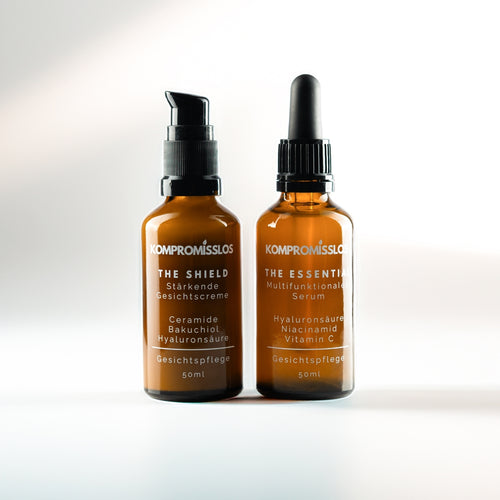
For the Duo of serum and cream, you will find an answer to each of these five points on the product page, including the percentages and the 100-day return period. The same checking logic works for the question of what the term “without additives” actually covers, and for claims about cruelty-free cosmetics in Switzerland.
When a certification is the better guide for you
A certification label is the better guide if you have neither the time nor the inclination to read INCI lists, and if a particular exclusion matters more to you than the density of active ingredients. That is exactly what certifications are made for: they bundle many individual decisions into one symbol. If, as a matter of principle, you don’t want any synthetically produced ingredients on your face, no matter how well researched they are, a strict natural skincare certification gives you that reassurance faster than any product description. A logo is also practical when buying a gift or shopping in a store without internet access. I say this deliberately: in that case, a certified product is the better choice for you, even if it is not mine. If, on the other hand, it matters to you which active ingredient ends up on your skin and in what amount, the ingredients list will get you further. How the two approaches differ also shows in the question of how to recognise genuinely sustainable natural skincare.
When to see a professional instead of trying new skincare
Skincare cares for healthy skin; it does not replace a medical assessment. If your skin weeps, bleeds or flakes heavily for weeks, changes over large areas, or if redness and swelling get worse rather than better, that belongs in the hands of a dermatologist. The same applies to a mole that changes shape, colour or size, and to any skin reaction that coincides with fever or breathing difficulties. In these cases, certification or no certification is not the right question. With a diagnosed skin condition, too, it is the treating professional who decides which skincare makes sense alongside treatment. A cosmetic product may and should support the look of your skin, but it does not treat anything. In Switzerland, this line is not just a matter of decency but drawn by law: references to a healing or soothing effect are prohibited for cosmetic products. A brand that uses them anyway tells you more about its marketing than about its product.
At Kompromisslos, I deliberately did not seek a natural skincare certification, and I’ll tell you why. The Duo contains 2% vitamin C as 3-O-ethyl ascorbic acid. This form is more stable than pure ascorbic acid, it is made in the lab, and that is precisely why it fails the strict natural skincare standards. I could have dropped it and got a logo instead. I chose the active ingredient and to state every concentration openly: 5% niacinamide, 2% hyaluronic acid, 0.3% bakuchiol. A certification would have given you a category. The numbers give you something you can check for yourself.
Frequently asked questions
Is natural skincare without certification less safe?
No. Safety requirements are set by law and apply equally to every cosmetic product, with or without certification. Prohibited and restricted substances are laid down in the annexes of the European Cosmetics Regulation, to which Swiss law refers. In addition, a safety report must exist for every product before it may be sold.
Why do some Swiss brands deliberately go without certification?
Because certain active ingredients rule out certification. Stabilised forms of vitamin C such as 3-O-ethyl ascorbic acid are made in the lab and do not meet strict natural skincare standards. A brand then has to decide: keep the active ingredient or get the logo. On top of that come ongoing costs for audits and documentation, which weigh heavily on small ranges.
What does the ISO 16128 standard say about natural skincare?
ISO 16128 provides definitions and a calculation method for the proportion of natural and organic ingredients. It is a technical guideline, not a quality mark and not a certification. It explicitly does not regulate marketing claims or labelling. A high natural-origin index under this standard is therefore no substitute for checking the ingredients list.
How can I tell whether a product is vegan without a certification label?
From the ingredients list. Animal-derived raw materials have recognisable INCI names such as Lanolin, Mel for honey, Cera Alba for beeswax or Collagen. If none of these entries appear, the product is vegan in its composition. Also check whether the brand makes this statement for all its products or only for some.
Is a missing certification a sign of greenwashing?
Not automatically. You recognise greenwashing by vague terms without evidence, not by a missing logo. Typical warning signs are nature imagery without numbers, promised effects without a stated concentration and wording that hints at a healing effect. A brand that states percentages and discloses the full list is doing the opposite of greenwashing.
Does a brand have to state the concentration of its active ingredients?
No. All that is required is the list of ingredients in descending order of quantity, with ingredients below one per cent by mass allowed at the end in any order. Percentages are voluntary. That is exactly why they are meaningful: a brand that commits to 5% niacinamide makes itself verifiable.
What must by law appear on the packaging in Switzerland?
The list of ingredients under the heading Ingredients, the intended use, the batch number, information on shelf life and the name and address of the responsible person. If any of this information is missing, the product is not labelled in line with the rules. These mandatory details apply regardless of whether a product carries a natural skincare certification.
Sources
- Cantonal Laboratory of Bern (Kantonales Laboratorium Bern), Kennzeichnung von Kosmetika, 2021. Source
- Federal Food Safety and Veterinary Office (FSVO), Geregelte Stoffe in kosmetischen Mitteln. Source
- International Organization for Standardization, ISO 16128-1:2016, Guidelines on technical definitions and criteria for natural and organic cosmetic ingredients and products. Source