Cruelty-free cosmetics in Switzerland: what the law guarantees and what it doesn’t
SWISS CONTEXT
Cruelty-free cosmetics are protected by law in Switzerland: Article 59 of the Swiss Ordinance on Foodstuffs and Utility Articles (LGV) prohibits placing on the market any cosmetic products that have been tested on animals for cosmetic purposes. Since 1 May 2018, cosmetics without animal testing have been the legal norm. However, the ban does not cover every test ever carried out on a raw material.
Are cruelty-free cosmetics guaranteed by law in Switzerland?
For sale, yes; for the entire history of a raw material, no. Article 59 of the Swiss Ordinance on Foodstuffs and Utility Articles prohibits placing on the market cosmetic products whose final formulation or individual ingredients have been tested on animals in order to verify compliance with food legislation or to assess their cosmetic effect. Which raw materials a brand uses, and in what concentration, is a separate matter and belongs in an open overview of active ingredients. The transitional provision of the same ordinance brought the ban into force one year after the ordinance itself, that is, from 1 May 2018. The Federal Food Safety and Veterinary Office (FSVO) can grant an exemption if there are serious safety concerns about an ingredient that is already in widespread use and cannot be replaced. For you, this means that a product sold legally in a Swiss online shop today has not been tested on animals for cosmetic purposes.
What is the legal position on cosmetics without animal testing in the EU?
In the EU, cosmetics without animal testing have been mandatory for more than a decade, and the Swiss rules are closely modelled on them in substance. According to a question in the European Parliament, animal testing of finished cosmetic products has been banned in the EU since 2004, and of cosmetic ingredients since March 2009; the legal framework is EU Cosmetics Regulation 1223/2009. The ban on placing cosmetics tested on animals on the market has applied without restriction since March 2013. The Swiss ordinance refers explicitly to the same EU regulation in several places, which is why the two hardly differ on this issue. In practice, this means that imported goods also fall under Article 59, because what matters is placing a product on the market here, not where it was made. Where Kompromisslos has its products made and how they reach you is explained on the page about production, packaging and delivery. Outside this legal area, different rules apply.
Where does the Swiss ban end, and why do gaps remain?
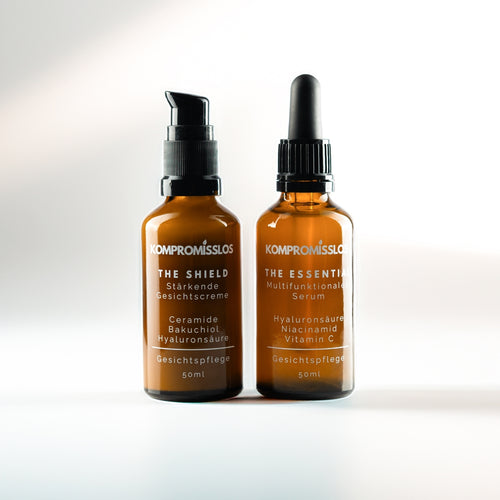
The ban is tied to the purpose of the test, not to the substance. What is prohibited is animal testing carried out to demonstrate compliance with food law requirements or to assess cosmetic effect. If the same raw material is tested under a different regulatory framework, for example as an industrial chemical or as an ingredient in a medicine, that test does not fall under Article 59. Many substances in creams and serums are also used outside cosmetics. This is exactly where the line runs between the legal statement and the expectation that the term cruelty-free creates. Then there is the time dimension: old data from tests carried out decades ago doesn’t disappear. If you want to be sure, look not only at the legal position but at a brand’s supply chain. For our Duo of serum and cream, we deliberately rely on a small number of clearly declared raw materials, because only a short list can actually be checked.
Is vegan skincare the same as cruelty-free skincare?
No, the two terms answer two different questions. Vegan relates to the composition: the product contains no ingredients of animal origin, so no beeswax, no lanolin, no honey, no animal-derived collagen. Cruelty-free, on the other hand, relates to testing: neither the finished product nor its ingredients have been tested on animals for cosmetic purposes. A product can be vegan and still contain raw materials that were tested on animals at some point. Conversely, a product can be sold as cruelty-free and still contain animal-derived ingredients. Both claims are useful, but they don’t replace each other, and neither is protected as an advertising term or uniformly defined in Switzerland. When you assess a brand, it is worth checking both separately and also looking at which plant extracts are used, such as gentian root extract as a plant-based active ingredient instead of an animal-derived starting material.
| Term | What it covers | What it doesn’t cover |
|---|---|---|
| Cruelty-free | No animal testing for cosmetic purposes on the product and its ingredients. | Tests on the same raw material under other legislation or a long time ago. |
| Vegan | No ingredients of animal origin in the formula. | Whether anything was ever tested on animals. |
| Article 59 LGV | Placing on the market in Switzerland and Liechtenstein. | Markets outside this legal area with their own requirements. |
Which certifications actually mean something?
The meaningful certifications are those that require a fixed cut-off date and check the supply chain. Cruelty Free International requires exactly that for its Leaping Bunny programme: a fixed cut-off date after which neither the brand nor its suppliers and manufacturers anywhere in the world carry out or commission animal testing of raw materials, an ongoing system for monitoring suppliers right down to the raw-material manufacturers, and regular independent audits. A certification without a cut-off date and without checks on the earlier stages says much less. It is also important to keep them apart: a natural skincare certification is not an animal-welfare certification, even if the two often appear together on packaging. Conversely, a brand without a certification isn’t automatically worse, because certification costs money and time, which hits small manufacturers in particular. What matters is whether a brand explains clearly what it does, as our customers describe in their feedback.
How can you check a brand yourself before you order?
Four points are enough for an honest assessment in a few minutes. First: is the full INCI list openly available on the product page, or do you have to go looking for it? Second: are concentrations given, or does it stop at names of active ingredients without figures? Third: does the brand say which countries it sells in? That determines which law applies in the first place. Fourth: does it distinguish properly between vegan and cruelty-free, or are the two terms used as synonyms? A brand that answers all four points openly has little to hide, and one that dodges any of them isn’t necessarily untrustworthy, but is worth asking. We state our figures for the Duo as a whole – for example 5% niacinamide, 2% hyaluronic acid and 0.3% bakuchiol. If you want to know how individual active ingredients differ, the comparison of vitamin C and niacinamide will help.
Where skincare ends and dermatology begins
Skincare cares for the appearance of the skin; it does not treat disease. That line is drawn by law, and it also makes sense in practice. A serum can support the skin barrier, ease tightness and help to even out the complexion. But it is no substitute for a medical assessment. If your skin weeps, bleeds or flakes heavily for weeks, or if your complexion changes suddenly and markedly, it belongs in the hands of a dermatologist. The same goes for severe itching, for pigmented moles that change, and for anything that has worried you for some time. Ethical questions such as animal testing and medical questions go separate ways here: a cruelty-free product is the better ethical choice, but that doesn’t make it a treatment. Skincare can improve how your skin looks; it can’t make a diagnosis. Keeping the two clearly apart helps you make better decisions for your own skin.
I deliberately set up Kompromisslos for Switzerland and Liechtenstein only. That was a logistical decision at first, but it has a second effect: I only have to deal with one legal area and can say for every batch which rules apply. In the same way, I chose a vegan formula with only a few raw materials, because only a short list can actually be checked. I would rather write what I can back up than phrase a promise that sounds good. If that is enough for you, you’ll find everything about the serum and cream in the Duo.
Frequently asked questions
Is animal testing for cosmetics banned in Switzerland?
Yes, with one narrow exception. Article 59 of the Swiss Ordinance on Foodstuffs and Utility Articles prohibits placing on the market cosmetic products that have been tested on animals for cosmetic purposes or to meet food law requirements. The FSVO can grant an authorisation if there are serious safety concerns about an ingredient that cannot be replaced.
Since when has this ban applied in Switzerland?
Since 1 May 2018. The ordinance came into force on 1 May 2017, and for the ban on placing cosmetics tested on animals on the market, the legislator provided a one-year transition period. Products regularly on sale in Swiss shops today are therefore covered by this rule.
Does the ban also apply to imported cosmetics?
Yes. What matters is placing a product on the market in Switzerland, not where it was made. A product from abroad that is sold here is subject to the same rule as one made here. Whoever imports it is responsible for ensuring that the requirements are met. So the place of manufacture alone doesn’t tell you the legal position.
Is vegan skincare automatically cruelty-free?
No. Vegan describes the formula, meaning the absence of animal-derived ingredients such as beeswax, lanolin or honey. Cruelty-free describes the testing of the product and its ingredients. The two claims can coincide, but they don’t necessarily. So check both points separately if both matter to you.
What does a fixed cut-off date mean for an animal-welfare certification?
A fixed cut-off date is a set date after which neither the brand nor its suppliers and manufacturers may carry out or commission animal testing of raw materials. Without such a cut-off date, it remains unclear from when a commitment actually applies. Programmes such as Leaping Bunny also require ongoing monitoring of the supply chain.
Are cosmetics without animal testing automatically better tolerated?
No. Cruelty-free is a legal and ethical statement, not a statement about tolerance. Whether a product suits sensitive skin depends on the formula – for example on fragrances, essential oils and the concentration of active ingredients. So also check the INCI list if your skin reacts easily.
What does this mean for Kompromisslos specifically?
We sell exclusively in Switzerland and Liechtenstein, so Article 59 of the Swiss Ordinance on Foodstuffs and Utility Articles applies to our range. The formula is vegan, which means it contains no animal-derived ingredients. The concentrations apply to the Duo as a whole – for example 5% niacinamide, 2% hyaluronic acid and 2% vitamin C.
Sources
- Swiss Confederation, Swiss Ordinance on Foodstuffs and Utility Articles (LGV, SR 817.02), Article 59 and Article 95, 2016. Source
- European Parliament, question on a worldwide ban on animal testing for cosmetics, O-000091/2017. Source
- Cruelty Free International, Leaping Bunny Programme, certification criteria. Source