Swiss skincare without additives: what the term really means
SWISS CONTEXT
Swiss skincare without additives is not a protected term but an advertising promise. Swiss law regulates which substances are banned or only permitted with restrictions – not which product may call itself additive-free. The only meaningful information is therefore the ingredient list on the back. It shows you what the formula actually contains.
What does Swiss skincare without additives mean in legal terms?
In legal terms, the phrase means nothing binding. In Switzerland, Article 54 of the Swiss Ordinance on Foodstuffs and Utility Articles sets out which substances are banned in cosmetic products, which may only be used with restrictions, and which colourants, preservatives and UV filters are permitted at all. For this it refers to the annexes of the EU Cosmetics Regulation, which therefore also apply to the Swiss market. Substances not regulated there may be used, provided their safety is documented in a product safety report. There is, however, no official list of additives that a formula must leave out in order to call itself additive-free. The term can be used freely as long as it isn’t misleading. For you, this means that two creams can both say without additives on the front and still have completely different compositions. The only binding information is the full declaration of ingredients that every product in Switzerland must carry.
Which additives really matter for sensitive skin?
One group matters above all: fragrances. They are among the most common triggers of contact allergies in the population, while many other groups of substances labelled as problematic remain harmless for most people. A long way behind come alcohol in high concentrations, which can dry out the skin, and essential oils, which as a natural source of fragrance bring the same allergens as synthetic perfume. Colourants are rarely necessary in facial skincare and almost always serve to make the product look good in the jar. Preservatives, on the other hand, have a safety function and don’t belong on a blanket blacklist. Plant-based ingredients aren’t automatically problematic either: an aqueous extract such as gentian root brings no fragrance allergens with it, whereas an essential oil from the same plant world does. So if your skin reacts to a lot of things, a sweeping ban on everything synthetic won’t help – a targeted look at two or three groups will. This distinction is often lost in discussions about irritation and an unsettled complexion, because they usually focus on active ingredients and hardly ever on the rest of the formula.
| Group of substances | Function in the formula | When it can cause problems | How it appears in the ingredient list |
|---|---|---|---|
| Fragrances | Scent and product experience | With a known contact allergy or very reactive skin | Parfum, Aroma, Linalool, Limonene, Citronellol |
| Essential oils | Scent plus plant-derived compounds | They contain the same allergens subject to mandatory labelling as perfume | Latin plant name followed by Oil |
| Alcohol | Quick absorption and a thinner texture | In high concentrations, on dry skin | Alcohol Denat. near the top of the list |
| Preservatives | Protection against microbes in water-based products | Rarely, usually with a specific intolerance | Sodium Benzoate, Phenoxyethanol, Sodium Levulinate |
| Colourants | How the product looks in the jar | No functional benefit in facial skincare | CI followed by a five-digit number |
What does fragrance-free skincare actually achieve?
Fragrance-free skincare lowers the risk of an allergic reaction – but no more than that. In a population study from five European countries, 2.6% of those tested reacted to fragrance mix I in a patch test and 1.9% to fragrance mix II. That is a small share of the population as a whole, and a lot if you happen to be one of them. To make matters more complicated, fragrance ingredients may be grouped together in the ingredient list: a single entry reading Parfum can stand for dozens of individual substances. Only particularly allergenic fragrances must also be listed by name above a set concentration – currently 81 substances. For very reactive skin, avoiding fragrance altogether is therefore the more pragmatic solution than studying individual names on the pack. You can read in the feedback from our customers that fragrance-free skincare can still feel pleasant on the skin and doesn’t have to smell of sacrifice.
Are preservatives an additive you should avoid?
No, in water-based products they are necessary. As soon as a formula contains water, microbes can multiply, and a contaminated cream is far riskier for your skin than the preservative itself. In Switzerland, only what is listed in the relevant annex of the EU Cosmetics Regulation is permitted, including maximum amounts and restrictions on use. Products advertised as preservative-free are either water-free, such as pure oils and balms, or use substances with a preserving side effect that do not formally count as preservatives. Both are legitimate, but neither is proof of quality. A more useful question than whether is which: a gently dosed system based on salts of organic acids is something quite different from a high-dose formaldehyde releaser. Hardly any advertising copy on the front makes this distinction – but the ingredient list on the back does, if you know which names belong to which group.
How do you check an ingredient list in one minute?
You read it from top to bottom and look out for three things. First, the order: all ingredients above one per cent are listed in descending order by weight, and anything below that may follow in any order. So an active ingredient right at the end is only present in a small amount. Second, the first five entries, because they make up the bulk of the formula and determine how a product feels. Third, a search for the groups in the table above, above all Parfum. Position alone doesn’t tell you whether an ingredient is effectively dosed, though – for that you need a stated percentage. This is exactly where many products fall short: they name active ingredients prominently but, unlike the stated concentrations in the Duo, don’t put a figure on them. For how differently two well-known active ingredients perform, and what matters when it comes to dosage, see the direct comparison of vitamin C and niacinamide.
When is skincare no longer enough?
If your skin keeps burning, weeping or flaking, or its condition gets worse over weeks despite a pared-back, fragrance-free routine, it needs to be looked at. Skincare cares for and supports the appearance of the skin; it doesn’t replace a diagnosis. A genuine contact allergy can’t be identified by trial and error, only by a patch test carried out by a dermatologist – and only that result tells you which individual substance you need to avoid in future. With skin conditions under medical treatment, too, skincare remains an accompaniment and never becomes a therapy. We draw this line very clearly on purpose, because the world of natural skincare often suggests exactly the opposite. If you are unsure, it is worth making an appointment sooner rather than later. It saves you from trying one new product after another, which puts extra strain on your skin and tends to obscure the real cause rather than clarify it.
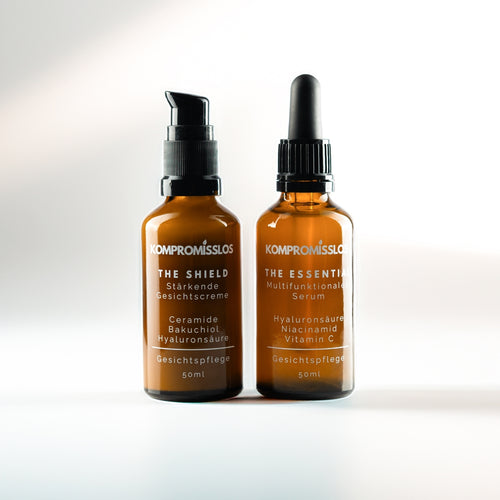
For our Duo of serum and cream, I deliberately left out perfume, even though that is a disadvantage. Scent sells – you notice it the moment you apply a product, and much of the feedback in retail revolves around exactly that. But the experiences of customers with reactive skin were clear enough that the decision was obvious to me. Both products are still preserved, with Sodium Levulinate and Sodium Benzoate, because both contain water. I think it is more honest to say so than to advertise with a term like additive-free that nobody has defined in a binding way.
Frequently asked questions
Is skincare without additives automatically better tolerated?
No. The term isn’t defined, so on its own it says nothing about tolerance. What matters is which specific substances are left out. If fragrances are left out, the risk of allergy falls measurably. If preservatives are left out of a water-based product, on the other hand, that can even make it less safe.
How do I recognise fragrance-free skincare from the ingredient list?
Look for the entries Parfum and Aroma. If neither is there, the product has not been perfumed. It is also worth checking for names such as Linalool, Limonene or Citronellol, and for Latin plant names followed by Oil, because essential oils bring the same allergens as synthetic fragrance.
Does The Duo contain fragrance or colourants?
No, both products are free from perfume and colourants. Instead, they contain declared active ingredients such as 5% niacinamide, plus edelweiss and gentian root extract, each based on the Duo as a whole. The faint natural scent comes from the raw materials themselves, not from added fragrance.
Are natural fragrances better tolerated than synthetic ones?
Not in principle. Many fragrance allergens subject to mandatory labelling are components of natural essential oils, for example from citrus or peppermint oil. For your skin, what counts is the individual substance, not its origin. So natural is no advantage here, and in some cases even an additional risk.
What does Parfum mean in an ingredient list?
Parfum is a collective term. It covers all the fragrance ingredients in a formula that don’t have to be named individually. Only particularly allergenic fragrances are also listed by name above a set concentration. So a single entry can hide many different individual substances.
Is Swiss cosmetics law stricter than EU law?
No, the requirements are largely identical. For banned and restricted substances, Swiss food law refers directly to the annexes of the EU Cosmetics Regulation. There are differences only on a few individual points. Made in Switzerland therefore doesn’t mean a stricter list of substances, just a different place of production.
Do I need to avoid all the unpronounceable names on the list?
No. The names follow an international nomenclature, which is why even completely harmless substances sound technical. Water is listed as Aqua and vitamin E as Tocopherol. A long name is no warning sign; conversely, a plant-sounding name is no guarantee of good tolerance.
Sources
- Federal Food Safety and Veterinary Office (FSVO/BLV), Geregelte Stoffe in kosmetischen Mitteln, 2026. Source
- German Federal Office of Consumer Protection and Food Safety (BVL), Kennzeichnung von Kosmetik, 2024. Source
- Diepgen TL, Ofenloch R, Bruze M et al., Prevalence of fragrance contact allergy in the general population of five European countries, British Journal of Dermatology, 2015. Source