Sustainable natural skincare: how to recognise the real thing
NATURAL SKINCARE SWITZERLAND
You do not recognise sustainable natural skincare by a word on the packaging, but by three points you can check: a fully published ingredient list, a traceable origin for raw materials and manufacturing, and an environmental claim that is backed up. If the justification is missing, the claim is open to challenge under Swiss advertising rules – and worthless to you.
What does sustainable actually mean for natural skincare?
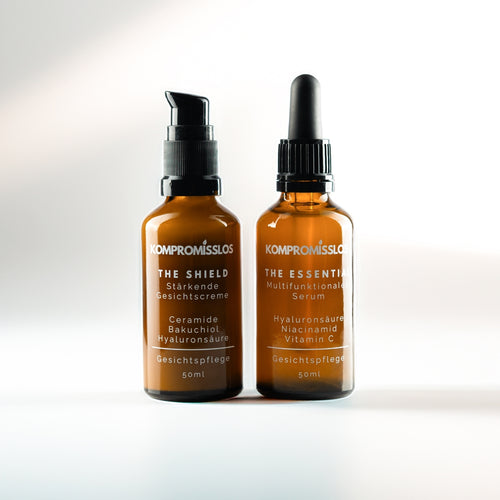
In Swiss advertising practice, sustainable means measures that go clearly beyond what the law and the industry already require. The Swiss Fairness Commission (Schweizerische Lauterkeitskommission) set this out in its guideline on commercial communication using environmental arguments, and it places the burden of proof on whoever is advertising. Anyone who prints “sustainable” on a tube must be able to show, if asked, which specific measure lies behind it. That has two consequences for you as a buyer. First, a brand that advertises something that is standard practice anyway is not more sustainable than the rest – it is just communicating more loudly. Second, a claim must not remain vague: the communication has to make clear whether the promise refers to a product, an ingredient or the whole company. I am writing this as someone who runs a brand himself. Exactly the same burden of proof applies to our Duo of serum and cream.
In practice, this means the more general a promise is, the less there usually is behind it. A figure, a process or a named measure is worth more than an adjective.
Is natural skincare automatically sustainable?
No, naturalness and environmental impact are two separate questions. The most widely used international standard for natural cosmetics, ISO 16128, only defines how natural the origin of individual ingredients is. It explicitly excludes environmental safety, packaging material and the claims on the label. A product can therefore have a very high naturalness index and still come in heavy multi-layer packaging, be shipped halfway around the world or be based on a raw material whose cultivation takes up a lot of land. The reverse is equally true: a synthetically produced active ingredient can be more resource-efficient to make than a plant-based one that requires large quantities of biomass to be processed. Plant-based is a statement of origin, not a life-cycle assessment, even though marketing likes to blur the two. With alpine plants, the point is particularly clear, because wild populations are sensitive to over-harvesting. What gentian root extract does in skincare tells you nothing about how it was obtained.
How can you recognise sustainable natural skincare on the shelf?
You recognise it by five signals you can check yourself without specialist knowledge. What all five have in common is that they can be verified rather than just felt: they are either on the packaging or the website, or they are not. The order matters. First, check whether the brand discloses in full what is inside at all, because without that foundation no other claim can be checked. Next comes the question of origin and manufacturing, then whether an environmental claim is backed up. Packaging comes right at the end, even though it usually comes first in marketing. If a brand says nothing about the first three points but talks at length about its cardboard, you know enough about its priorities without troubling a single laboratory. That is exactly why our full overview of ingredients is public.
| Signal | What it tells you | How to check it |
|---|---|---|
| Full INCI list online | The brand has nothing to hide. | Look for the list on the product page, not just on the pack. |
| Specific concentrations | The active ingredients are more than decoration. | Look for percentages rather than mere mentions. |
| Named origin and manufacturing | The supply chain is at least partly traceable. | Check whether the country of production and the filling site are named. |
| Environmental claim with a justification | There is a specific measure behind the word. | Ask yourself whether there is an explanation next to the adjective. |
| Small range | The brand does not depend on a constant stream of new launches. | Count how many products are added each year. |
How much difference does packaging really make?
Packaging is the most visible lever, but rarely the biggest. It is ideal for marketing because you hold it in your hand, and that is exactly why it gets overemphasised. In factual terms, the picture is less clear-cut than advertising suggests: glass is easy to recycle but heavy, which increases the impact of transport. Plastic is light, but only works in a closed loop if it is a single material and actually ends up in the collection. Multi-layer packaging made of cardboard, film and metal often looks more sustainable than a simple plastic container, yet is harder to separate. For you, that means: do not judge the material as such, but whether the container can be emptied completely and put into the right collection as a single material. And consider how often you buy new packaging at all, because that is the factor that carries more weight.
To be transparent about ourselves: our products are developed, made and filled in Switzerland and printed in single-colour screen printing. The bottles are amber glass from Germany, chosen for their high share of recyclable material. The shipping box and folding carton are FSC-certified and made of 90% recycled corrugated board; the filling material is 100% recycled paper. Where each component comes from is set out in full on our page about production, packaging and delivery.
What makes the biggest difference in sustainable skincare?
The biggest lever is the number of products you buy and do not use up. A seven-step routine uses more raw materials, more packaging and more transport than a two-step one, however natural the individual formulas are. On top of that comes an effect hardly anyone factors in: half-used products that are thrown out after three weeks are the most expensive and ecologically worst part of a skincare routine. That is exactly why we have stuck to two products. The serum and cream last two to four months, depending on how often you use them, with three to six drops and three to six pumps morning and evening. You can see what that looks like day to day on the page about how to use the serum and cream properly. So if you are wondering whether vitamin C or niacinamide should come first, you rarely need a third product.
In other words: consistency beats choice. Two products instead of seven is not going without – it is the more realistic calculation.
I deliberately chose not to print the word “sustainable” in large letters on our packaging, even though it sells. Instead, our website states where each component comes from, right down to the folding carton and the filling paper. The reason is simple: you can check a list of materials, but you cannot check an adjective. That includes naming the gaps. The dropper and the pump dispenser contain TPE; that is the part I have not yet found a better solution for. I would rather have a list with an admitted gap than a green label without one.
When is new skincare not the answer?
If your current skincare works, switching is the least ecological decision of all. That applies even if the new product is more natural on paper: a half-used jar on the shelf saves nothing. Use up what you have first, and only switch when something specifically and repeatedly bothers you, such as tightness after cleansing, redness or an unsettled complexion over several weeks. The upper limit is just as important: skincare cares for the skin, it does not replace a dermatological assessment. With severely inflamed patches, sudden changes, persistent itching or a suspected skin condition, the assessment belongs in a doctor’s surgery, not in an online shop. If, on the other hand, recurring blemishes are your concern, the article on blemish-prone skin and its causes will help you far more than changing your whole routine.
Frequently asked questions
Are natural ingredients always more environmentally friendly?
No. Where a raw material comes from says little about its environmental footprint. The widely used standard ISO 16128 only assesses natural origin and explicitly excludes environmental safety and packaging. A plant-based raw material can require considerably more effort to grow, harvest and purify than a synthetically produced one.
What does sustainable mean under Swiss advertising rules?
According to the Swiss Fairness Commission’s guideline, the average consumer understands it to mean measures that go clearly beyond legal or industry-standard requirements. The burden of proof lies entirely with the advertiser. Anyone who says “sustainable” must be able to prove the specific measure behind it; otherwise, under this guideline, the claim is not permitted.
Is glass more sustainable than plastic?
Not across the board. Glass is easy to recycle but heavy, which adds to the burden of transport. Plastic is light, but only works in a closed loop as a single material. More important than the material is whether the packaging can be emptied completely and disposed of as a single material, and how often you replace it.
Where do Kompromisslos’s materials come from?
Development, manufacturing and filling take place in Switzerland. The amber glass comes from Germany; the shipping box and folding carton come from Poland, are FSC-certified and made of 90% recycled corrugated board; and the filling material is 100% recycled paper. The full breakdown is publicly available on our website.
Are vegan cosmetics automatically more sustainable?
No. Vegan means free from animal-derived ingredients and is an ethical choice, not an environmental footprint. A plant-based raw material can be resource-intensive to grow and process. In practice, vegan and sustainable often overlap, but they are two different promises that have to be proven in different ways.
How can I spot greenwashing in skincare?
Watch out for general adjectives without any explanation, nature imagery with no connection to what is actually inside, and advertising that makes a virtue of things every supplier has to do anyway. A particularly strong warning sign is a brand that talks at great length about its packaging but does not make the full ingredient list publicly available anywhere.
How long does the Kompromisslos Duo last?
Two to four months, depending on how often you use it. We recommend three to six drops of serum and three to six pumps of cream morning and evening. If you only use it in the evening, it will last correspondingly longer. The Duo therefore replaces several individual products and reduces the amount of packaging.