Natural skincare certifications: which ones really count in Switzerland
SWISS CONTEXT
Natural skincare certifications are private standards, not government requirements. In Switzerland you will mainly come across NATRUE and COSMOS for natural skincare itself, plus the V-Label for vegan products. They check where raw materials come from, how they are processed and how products are labelled – but not how much active ingredient the formula contains. A certification is a first filter, not proof that a product works.
Who awards natural skincare certifications, and on what basis?
A natural skincare certification is awarded by a private association or certification body, not by a public authority. The term natural cosmetics has no legal definition in Switzerland, so there is no official list setting out when a cream may call itself that. What is regulated is safety, composition and labelling: according to the Federal Food Safety and Veterinary Office (FSVO), cosmetic products have been subject to a ban on misleading claims, among other rules, since 1 May 2017. So a brand may not claim anything that isn’t true, but it may use the term natural cosmetics even without a certificate. The private standards have stepped into exactly this gap. They set rules where the law provides no definition, and they do so voluntarily and at the manufacturers’ expense. The quickest way to see what that means for a specific formula is an open overview of the ingredients used, not the front of the packaging.
Which natural skincare certifications will you see in Switzerland?
In Swiss chemists, pharmacies and online shops, you will almost always come across the same four marks. NATRUE and COSMOS cover natural skincare in the narrower sense, meaning the origin and processing of the raw materials. The V-Label stands for vegan or vegetarian and says nothing about the natural content. The Leaping Bunny from Cruelty Free International stands for no animal testing and, in turn, says nothing about whether the product contains animal-derived ingredients. These marks answer four different questions, and none of them answers all four. If you simply reach for the greenest logo, it is easy to mix up the categories and end up buying something that doesn’t meet your own criterion. The overview below explains what lies behind each mark and where its meaning ends. It doesn’t replace a look at the back of the pack, but it makes that look much quicker and more targeted, because you know which question remains open.
| Certification | What is checked | What it doesn’t guarantee |
|---|---|---|
| NATRUE | The origin and processing of all raw materials, at two levels: natural or organic. | How highly individual active ingredients are dosed. |
| COSMOS | Sources of raw materials, manufacturing processes and labelling, certified as COSMOS NATURAL or COSMOS ORGANIC. | That a product suits the condition of your skin. |
| V-Label | Whether the entire manufacturing process is free from animal-derived substances. | That the formula is predominantly natural. |
| Leaping Bunny | No animal testing throughout the supply chain. | That no animal-derived ingredients are included. |
What exactly do NATRUE and COSMOS check?
NATRUE and COSMOS check where a raw material comes from and how heavily it may be processed. According to the NATRUE criteria, version 3.9, since 1 January 2021 NATRUE has certified finished products at just two levels: natural and organic. For the organic level, at least 95% of the natural plant and animal substances contained must come from certified organic farming or controlled wild collection. On top of this there is a rule at brand level: at least 75% of a brand’s products must meet the criteria before the label may be used at all. COSMOS-standard AISBL follows a similar logic and certifies finished products as COSMOS NATURAL or COSMOS ORGANIC. Natural and organic are not the same thing here: the first level only governs the permitted origin of the raw materials, and only the organic level additionally requires a defined proportion from certified organic cultivation.
Why a certification says nothing about the amount of active ingredient
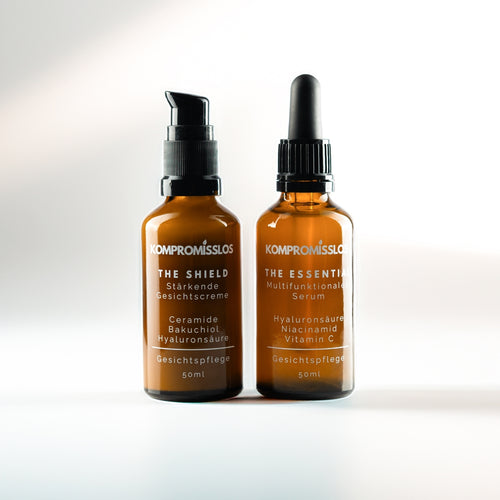
A certification answers the question of origin, not the question of dose. Two creams can both be certified and still be formulated completely differently: one with a trace of plant extract at the very end of the ingredient list, the other with a meaningful amount. Both may carry the same logo, because what is checked is whether a raw material is permitted, not how much of it is in the formula. In practice, this is exactly where it is decided whether a product does something for you or just looks good. That is why the percentage is more honest information than the logo on the front. In the Duo of serum and cream, the concentrations are stated – for example 5% niacinamide, 2% hyaluronic acid and 0.3% bakuchiol, each based on the Duo as a whole. For a sense of how much two well-known active ingredients differ, see the comparison of vitamin C and niacinamide.
Does vegan mean the same as natural skincare?
Vegan and natural are two separate claims. Vegan means that no animal-derived raw materials are used, either in the formula or during manufacture. Natural skincare means that the raw materials are predominantly of plant or mineral origin and may only be processed to a limited extent. A product can be vegan and still largely synthetic, and a certified natural skincare product can contain beeswax or lanolin, which means it is not vegan. The V-Label is only awarded if the entire manufacturing process meets the criteria of the relevant category, including processing aids that don’t even have to be declared on the packaging. Even with purely plant-based raw materials it pays to look closely, because one plant extract is not the same as another: what gentian root extract does in a formula depends on the concentration, the extraction method and the part of the plant used, and none of these three criteria appears on a logo. If you are looking for vegan, check both points separately.
What if a brand has no natural skincare certification?
A missing certification is not a verdict on quality. Certification costs money and time, and for small ranges NATRUE’s brand-level rule is often the practical stumbling block. More important than the logo is whether a brand answers the questions a certification leaves open. Check three things. Is the full ingredient list publicly available, not just in small print on the pack? Are concentrations given, not just the names of active ingredients? Is it clear who manufactures the product and where it is filled? If a brand struggles on all three points, a certificate won’t help much either. Independent feedback from customers is an additional indicator, because it reflects everyday tolerance, which no standard can test. Our serum and cream set is documented according to exactly this logic, with stated percentages rather than just a list of active ingredients on the front.
I am regularly asked why our bottles don’t carry a big natural skincare logo. My honest answer: a certification would have sidestepped the question customers actually ask me. That question is never whether a raw material was processed in a permitted way, but how much of it is in there. So I decided to disclose the concentrations rather than outsource trust to a logo. That is less comfortable, because every figure can be checked. That is exactly why it is there. If you would rather look specifically for certified products, there are good brands in Switzerland with NATRUE or COSMOS certification, and that is absolutely fine.
When a certification can’t help any further
No certification replaces a dermatological assessment. Natural skincare standards check raw materials and processes, not the condition of your skin. If your skin itches constantly, weeps, flakes or reacts strongly to several products in a row, that belongs in a doctor’s hands, not in yet another shelf comparison. The same applies if you suspect a contact allergy: only a test can show which substance is the trigger, and that can just as well be a certified plant extract. Essential oils and natural fragrances are explicitly permitted in certified natural skincare and are among the more common triggers of intolerance. So a certification doesn’t protect you from that – it simply says nothing about tolerance. Skincare cares for and supports the appearance of the skin; it does not treat disease. That line is not a formality but the point at which you save yourself time, money and unnecessary detours by asking the right person.
Frequently asked questions
Is natural skincare legally defined in Switzerland?
No. Cosmetic products are subject to requirements on safety, composition and labelling, plus a ban on misleading claims, but there is no official definition of the term natural cosmetics. That is why private standards such as NATRUE and COSMOS fill this gap. A brand may still use the term without a certificate, as long as it doesn’t mislead.
Which is the strictest natural skincare certification?
There is no blanket ranking, because the standards calculate differently. Within NATRUE, the organic level is stricter than the natural level because it additionally requires an organic share. The comparison between NATRUE and COSMOS depends on the product category and can’t be settled in a single sentence.
Does vegan automatically mean natural skincare?
No. Vegan only means that no animal-derived raw materials are used. It says nothing about the natural content, the processing or synthetic components. Conversely, certified natural skincare isn’t automatically vegan, because beeswax, honey and lanolin are permitted under the common natural skincare standards.
Is skincare without a certification worse?
Not necessarily. Certification costs money and often requires a large part of the range to be certified too. What matters is whether the full ingredient list is publicly available, whether concentrations are stated and whether it is clear where the product is manufactured and filled. If that information is missing, a logo won’t help much either.
Does a natural skincare certification test effectiveness?
No. What is checked is the origin and processing of the raw materials and the labelling, not the result on your skin. Two certified creams can contain the same active ingredient in completely different amounts and still carry the same mark. To judge a product, you need the concentration, not the logo.
How can you spot greenwashing on packaging?
Typical signs are terms with no fixed meaning, such as nature-inspired, clean or chemical-free, combined with green design and images of plants. Check the ingredient list on the back instead: it is listed in descending order of quantity. If the advertised plant ingredient is right at the end, it is only present in a small amount.
Do natural skincare certifications apply equally in Switzerland and the EU?
Yes, the major standards work across borders with the same criteria. NATRUE and COSMOS are international in design and are monitored by accredited bodies, regardless of the country of sale. The differences lie not in the standard itself but in national cosmetics law, which must also be complied with.