Mineral or chemical sunscreen: what the difference means for your skin
ROUTINE
Mineral sunscreen works with zinc oxide or titanium dioxide, chemical sunscreen with organic filters such as avobenzone or octocrylene. Both groups protect mainly by absorbing UV radiation. The difference you notice lies in texture, white cast and how well your skin tolerates it. How much protection you get is shown only by the sun protection factor on the pack.
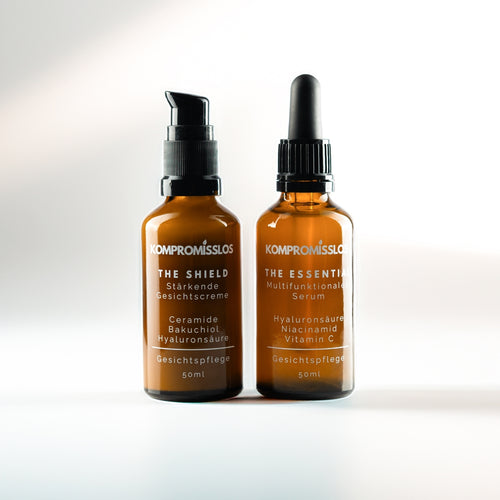
Whichever filter you choose, the skincare underneath should be light and not contain a UV filter of its own, like The Duo – Serum & Face Cream.
How do mineral UV filters work?
Mineral UV filters consist of zinc oxide or titanium dioxide and absorb most UV radiation rather than reflecting it away from the skin. The image of a mirror is persistent, but it is not accurate. A series of measurements in the journal Photodermatology, Photoimmunology and Photomedicine shows that zinc oxide and titanium dioxide reflect only around 4 to 5 per cent of radiation across the entire UV range. By far the larger remainder is absorbed by the particles and converted into a very small amount of heat. At its core, then, the same thing happens as with an organic filter, only by a different physical route. For you, one thing follows above all: you need to apply a mineral product just as carefully and just as generously as any other sun product. A thin veil does not protect you, whichever filter it contains. Why UV radiation carries so much weight here is explained in our article on what actually slows down skin ageing.
How do chemical UV filters work?
Chemical UV filters are organic molecules that absorb UV radiation and release the energy again as heat. Well-known examples are avobenzone, octocrylene, homosalate, octisalate and newer filters such as tris-biphenyl triazine. They are soluble and can therefore be worked into light textures that remain practically invisible on the skin. That is their biggest practical advantage, because a sunscreen that feels pleasant is more likely to be used every day and in a sufficient amount. Some organic filters are less stable in light than others and are combined with partner filters in modern formulas so that the protection lasts while you wear it. That, too, is an argument for reapplying, not against this class of filter. Incidentally, chemical in this context only means that they are organic compounds. It says nothing about whether a product is well or poorly tolerated.
Mineral or chemical: a direct comparison
On most points, the comparison is a draw, because both types of filter achieve high sun protection factors and both are only permitted in Switzerland at tested maximum concentrations. The differences show up in how they feel to wear, how visible they are on the skin and how a formula is received by irritated skin. Mineral formulas get by with few filter substances and are therefore often the more straightforward choice for very reactive skin, especially if you already know that you react to many fragrances and auxiliary ingredients. Chemical formulas score on texture and everyday practicality, and are therefore more often used consistently. Which option suits you depends less on the class of filter than on how your skin is currently reacting and which product you actually reach for in the morning. The best sunscreen is the one you apply generously, not the one with the purer ingredient list on paper. We have explained separately what lies behind the term sensitive skin.
| Criterion | Mineral filters | Chemical filters |
|---|---|---|
| Typical substances | Zinc oxide, titanium dioxide | Avobenzone, octocrylene, homosalate |
| How they protect | Mainly absorption of UV radiation, around 4 to 5 per cent reflection | Absorption of UV radiation and release as heat |
| White cast | Possible, because the particles reflect up to 60 per cent of visible light | Usually none |
| Maximum concentration | 25 per cent each for zinc oxide and titanium dioxide | Set individually for each filter |
| Application | Around 20 minutes before going out, generously | Around 20 minutes before going out, generously |
Why mineral sunscreen leaves a white cast
Mineral sunscreen leaves a white cast because, in visible light, zinc oxide and titanium dioxide do exactly what they barely do in the UV range: they reflect it. The same series of measurements that finds only 4 to 5 per cent reflection in the UV range measures up to 60 per cent in the long-wave and visible range. So the white sheen is not a formulation error but a direct consequence of the raw material. It can be reduced with smaller particles, with tinted versions containing iron oxides, and with formulas that distribute the filter better in the emulsion. With high proportions of zinc oxide, it will rarely disappear entirely. If the effect bothers you, there are two honest options: a tinted mineral version or a chemical product. What you should not do is apply less so that less is visible. That is precisely when you lose most of the protection.
Which UV filters are permitted in Switzerland?
In Switzerland, only the UV filters listed in Annex VI of the European Cosmetics Regulation 1223/2009 may be used. The Federal Food Safety and Veterinary Office (FSVO) refers directly to this list, with a few deviations set out in the Swiss Ordinance on Cosmetic Products (VKos). A substance that is not on it may not be used as a UV filter in a Swiss sun product, however natural it sounds. For zinc oxide, the maximum concentration is 25 per cent, and the same applies to titanium dioxide. Both are excluded from applications in which the lungs could be exposed, meaning sprays and aerosols. All filters are declared in the ingredient list, with nano forms additionally marked with the word nano in brackets. You can see exactly which substances our two products contain in the overview of all ingredients. Zinc is listed there at 1 per cent, but not as zinc oxide: what zinc PCA does in skincare has nothing to do with sun protection.
What this means for your routine if your skincare has no SPF
If your skincare has no sun protection factor, sunscreen goes on top as the last step, once the serum and cream have absorbed. The order is therefore serum, cream, sunscreen – in that sequence and with a few minutes in between, so that the protective film builds up evenly. The Duo, our serum and cream, deliberately contains no UV filter and therefore does not replace a sunscreen. In the evening the step falls away; in the morning it belongs in your routine on bright days. If you have to choose between skincare with a filter and two separate steps, two steps are the more reliable option, because you can dose the sunscreen independently of your skincare and reapply it during the day. How serum and cream work together day to day is explained in our article on whether you really need both, and you will find the exact amounts on the how to use page. For the Duo, that is 3 to 6 drops of serum and 3 to 6 pumps of cream, morning and evening.
One customer wrote to us that she had spotted zinc in the ingredient list and concluded that the cream provided some light sun protection. She wanted to know whether she could skip applying extra sunscreen on cloudy days. The answer was clear: no. Zinc in a skincare formula is not zinc oxide as a UV filter, and without a declared sun protection factor there is no sun protection, not even in small amounts. This mix-up happens often, because both terms contain the word zinc.
Cosmetics have a clear limit here. If a mole changes, a patch of skin does not heal or your skin reacts unusually strongly after a short time in the sun, that belongs with a dermatologist or your GP, not in a skincare routine. Sun protection is everyday prevention, not a diagnosis.
I am often asked why we did not put a sun protection factor into the Duo. The answer is uncomfortable but honest: a face cream is never applied in the amount that a sun protection factor assumes. The figure on the pack is determined under standardised conditions with a thickly applied layer. In everyday life you spread a cream thinly and sparingly, which puts you well below the figure on the label. I decided against it because otherwise I would be selling you a sense of security that the formula cannot deliver. We would rather make two products that do one thing well and tell you openly that for the rest you need a proper sunscreen. We do not sell one. What we make instead is on the page for the serum and cream set.
Frequently asked questions
Is mineral sunscreen better for sensitive skin?
For very reactive skin, mineral sunscreen is often considered the more straightforward choice, because the formulas get by with few filter substances. But it is not automatic. Mineral products also contain emulsifiers, preservatives and sometimes fragrances. What matters is the formula as a whole, not the class of filter alone. Test a new product on a small area first.
Which is better for the environment, mineral or chemical?
There is no clear-cut answer. Some organic filters are criticised because of possible effects on corals, and mineral particles are not considered unproblematic in water either. If you want to protect rivers, lakes and seas, you achieve the most through clothing, shade and timing, not through choosing between two classes of filter.
Are nanoparticles in mineral sunscreen a problem?
Nano forms of zinc oxide and titanium dioxide are permitted as UV filters in Switzerland and are labelled with the word nano in the ingredient list. Applications in which the particles could be inhaled, meaning sprays, are excluded. For creams and sticks, they are permitted up to a maximum concentration of 25 per cent.
Is a day cream with SPF enough sun protection?
For a day at the office with short trips outside, it is usually enough. For longer periods outdoors it is not, because a day cream is applied in a smaller amount than a sunscreen, so the sun protection factor ends up well below the figure on the pack. When you know you will be spending time in the sun, a dedicated sun product is the more reliable choice.
Does The Duo have an SPF?
No. The Essential serum and The Shield cream contain no UV filter and have no sun protection factor. The Duo costs CHF 109.90 and is intended as skincare for morning and evening. On sunny days, apply your sunscreen over it as the last step, once the cream has absorbed.
Do I need to wear sunscreen when it is cloudy?
Yes, on bright days it is worth it, because some UV radiation reaches the skin even through cloud cover. What matters is less how sunny it looks than how long you are outside and what the UV index for the day is. Short trips outside in winter do not need a daily filter.
Sources
- Cole C, Shyr T, Ou-Yang H. Metal oxide sunscreens protect skin by absorption, not by reflection or scattering. Photodermatology, Photoimmunology and Photomedicine, 2016. Source
- Federal Food Safety and Veterinary Office (FSVO). Geregelte Stoffe in kosmetischen Mitteln, 2026. Source
- European Commission. Commission Regulation (EU) 2016/621 amending Annex VI to Regulation (EC) No 1223/2009, 2016. Source