Sun allergy on the face: how to recognise it and how to prevent it
SKIN CONCERNS
A sun allergy on the face is usually polymorphic light eruption: hours to a few days after strong sun, itchy red bumps, small blisters or patches appear, and they fade without scarring after about a week. The face is affected less often than the chest and arms. If it is your face in particular that reacts, it is also worth looking at substances that can react with light, such as fragrances, certain UV filters or medicines. You can prevent it by getting your skin used to the spring sun gradually and using UVA protection consistently.
What is a sun allergy, and why is it usually not a true allergy?
‘Sun allergy’ is an everyday term for various skin reactions to light, and in most cases it is not an allergy to something from outside the body but polymorphic light eruption, or PLE for short. In PLE, the immune system reacts with a delay to the skin’s own components after UV radiation has altered them. That is how a review in the Journal of the European Academy of Dermatology and Venereology describes it; according to the review, the main trigger lies in the UVA range, although some people also react to UVB or to both. So there is no allergen you could avoid, and a standard allergy test is of no help. PLE is common all the same: a systematic analysis of population studies in the same journal arrived at a pooled prevalence of 10 per cent, with figures ranging from 0.65 per cent in China to 21.4 per cent in Ireland. The further a country lay from the equator, the more common PLE was in these studies.
There are, however, light-dependent reactions that really are allergic. In a photoallergic reaction, a substance on the skin only becomes an allergen through light – a UV filter or a fragrance, for example. A phototoxic reaction does not involve the immune system at all: under light, the substance damages the skin directly, much like an intensified sunburn. Then there is so-called Mallorca acne, which is counted among the light-induced skin reactions. Because the appearance and the trigger differ, so does what helps prevent them.
How do you recognise a sun allergy on the face, and what only looks similar?
You recognise a sun allergy mainly by its timing and the itch: at first your skin looks unremarkable after time in the sun, and only hours to a few days later do itchy or burning bumps, small blisters or reddened patches appear – and only where the light reached. A paper in Advances in Experimental Medicine and Biology describes its forms as highly varied, ranging from redness to bumps, small blisters and occasionally larger blisters. In any one person, though, the reaction usually looks much the same each time. Sunburn, by contrast, shows up as hot, painful redness across a whole area just a few hours after sun exposure and peels later on; how to look after it on your face is a separate topic. Mallorca acne looks like lots of small spots of the same size, without blackheads. And a contact allergy to a cream also appears on days with no sun at all, which clearly sets it apart from light reactions.
| Form | Typical appearance | Trigger | What helps prevent it |
|---|---|---|---|
| Polymorphic light eruption | Itchy bumps, small blisters or patches, hours to days after sun exposure, mainly on the chest and arms | UV light, especially UVA, typically in spring | Gradual exposure, UVA protection, clothing |
| Mallorca acne | Lots of small, uniform bumps that look like spots, without blackheads, usually on the shoulders, chest and upper arms | UV light, often mentioned in connection with rich sun products | UV protection in a light texture, gradual exposure |
| Photoallergic reaction | Itchy, eczema-like, can spread beyond the sun-exposed area | A substance on the skin plus light, for example certain UV filters or fragrances | Identifying and avoiding the trigger, investigation with a photopatch test |
| Phototoxic reaction | Like a severe sunburn, sharply defined, sometimes with blisters, later brown patches | A substance plus light without an immune reaction, for example some citrus oils or medicines | Leaving the substance off before sun exposure, reading the patient information leaflet |
| Sunburn (for comparison) | Hot redness across a whole area after a few hours, peels | Too much UV radiation | Enough sun protection, shade |
Why does it often affect the chest and arms, but the face less often?
The face is affected by polymorphic light eruption less often, probably because it gets light all year round and is therefore more accustomed to UV, whereas the chest, arms and legs are suddenly exposed to the sun unprotected after the winter. The review in Advances in Experimental Medicine and Biology lists the V of the neckline, the arms and forearms, the legs and the upper back as typical sites, and the face only rarely. A review in Dermatologic Clinics describes PLE as particularly common in young women in temperate climates, with flare-ups in spring or early summer. This fits with the recommendation in the JEADV review to get the skin used to natural sunlight gradually.
So if it is your face that reacts, it is worth taking a second look: what was on your skin before you went out into the sun? A new sunscreen, perfume on your neck, a scented facial oil or a medicine can trigger a light-dependent reaction that appears exactly where the substance was. Redness that gets worse in the sun but comes without bumps or itching, and persists on dull days too, often has other causes. There is more on this in the article on facial redness.
Can sunscreen, perfume or medicines trigger the reaction?
Yes, sunscreen, perfume and medicines can trigger light-dependent reactions – not classic polymorphic light eruption, though, but photoallergic or phototoxic reactions. In photoallergy, UV light alters a substance on the skin in such a way that the immune system classifies it as foreign. A European photopatch study in the British Journal of Dermatology, involving 1,031 patients from 30 centres in 12 countries, found that among the organic UV filters, octocrylene, benzophenone-3 and butyl methoxydibenzoylmethane caused reactions most often; newer filters rarely triggered anything. That does not mean these filters are a problem for everyone, as the people studied were suspected of having such a reaction. But if you keep reacting after a particular sunscreen, exactly where you applied it, it is worth switching to a product with different filters. A separate article explains what sets mineral or chemical sunscreen apart.
Phototoxic reactions are mainly caused by certain citrus oils such as bergamot, which can be found in perfume and in scented natural skincare. The article on essential oils in skincare explains why. Some medicines, whether taken as tablets or applied as gels, also make the skin more sensitive to light; in the photopatch study mentioned above, two anti-inflammatory pain-relief gels were in fact the most frequent triggers. The rule here: read the patient information leaflet, ask at the pharmacy and never stop taking anything on your own initiative. If your skin is sensitive to the sun, perfume does not belong where the sun reaches anyway – not even as a spritz on your neck and chest.
How do you prevent a sun allergy on your face in spring and on holiday?
The most effective way to prevent it is to get your skin used to the sun gradually in spring and to make sure you have good UVA protection from the start. No cream reliably prevents a sun allergy, but the specialist literature names this combination as the foundation: the JEADV review recommends regular sun protection together with gradual exposure to natural sunlight. The critical times are the first sunny weekends in March and April, and holidays in the south or in the snow, when skin goes straight from winter into strong sun. How skin generally reacts to the change of season is covered in the article on skin in spring.
- Build up slowly: in the first few weeks, go outside for short spells only and avoid the midday hours, then stay out a little longer from week to week.
- Look for UVA protection: a sunscreen with the UVA logo as the last step in the morning, applied generously and reapplied. Which SPF and how much is explained in the article on sunscreen for your face when your skincare has no SPF.
- Fabric protects more reliably than any cream: a wide-brimmed hat, sunglasses, a scarf or a top that covers your chest.
- Nothing underneath that can react with light: skincare without perfume and without essential oils. What to look for in the ingredient list is covered in the article on fragrance-free moisturiser.
- Nothing new on holiday: if you react to something you applied for the first time on the beach, there is no way of telling whether the product or the light is to blame. Before you travel, find out how to patch test new skincare.
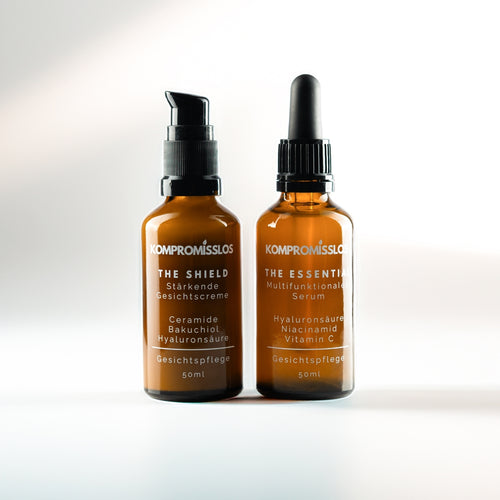
As for the skincare under your sunscreen: The Duo is fragrance-free and, according to its INCI list, contains no essential oils; what it does contain is ceramide NP, squalane and panthenol, which support the skin barrier. It has no sun protection factor, so sunscreen always goes on separately on top. If you have strong reactions that come back every year, your dermatologist can discuss further options with you, such as preventive light therapy in spring.
On holiday, use the sunscreen your skin has already been tolerating at home for weeks. If your skin still reacts, at least you will know that the light is a more likely culprit than the product.
When should you see a dermatologist about a reaction on your face?
You should see a dermatologist about a reaction on your face if it is severe the first time it appears, does not fade within about a week or comes with general symptoms. According to the review in Advances in Experimental Medicine and Biology, polymorphic light eruption fades in about a week without scarring; anything that lasts much longer should be looked at. See a doctor straight away for butterfly-shaped redness across the cheeks and the bridge of the nose, blisters, severe swelling of the face or eyelids, fever or joint pain, and for any reaction that appears after starting a new medicine. In rare cases, sensitivity to light can also be a sign of another condition, such as lupus erythematosus, which only a doctor can diagnose. A dermatologist can use light tests and a photopatch test to establish what your skin is actually reacting to, and will discuss whether treatment or targeted prevention makes sense. Experimenting with creams from your medicine cabinet is no substitute for that.
I deliberately made The Shield without a sun protection factor. Sun protection only works when you use enough of it, and people rarely apply that much of a day cream. For sun-sensitive skin in particular, I think it is more honest for sunscreen to be a separate product that you choose to suit your needs and apply generously as the last step. The second decision concerns what goes underneath: The Duo is fragrance-free and contains no essential oils, so that no fragrance sits on your skin beneath your sunscreen. What the Duo cannot do is prevent a sun allergy or treat a reaction that is already under way. That is a job for UV protection, patience in spring and, if in doubt, your dermatologist. Exactly what goes into it is set out in the full list of ingredients.
Frequently asked questions
How long does a sun allergy on the face last?
A typical case of polymorphic light eruption usually fades after about a week, especially if you avoid further strong sun during that time. The reaction appears hours to a few days after sun exposure, lasts a few days and clears without scarring. If it lasts much longer, spreads or blisters develop, have it looked at by a dermatologist.
Does calcium or beta-carotene help with sun allergy?
There is not enough evidence for it. Calcium is often recommended, but good studies on it are largely lacking. There are a few studies on beta-carotene and other antioxidants, but the data are thin. Supplements replace neither UV protection nor gradual exposure. If you would like to take something, talk it through with your doctor or pharmacist first.
Is mineral sunscreen better for sun allergy?
Not automatically. For polymorphic light eruption, what matters most is good UVA protection, whichever filters provide it. Switching to mineral filters can make sense if you have a photoallergic reaction to a particular organic filter. If in doubt, a photopatch test at your dermatologist’s will show whether that is the case.
Can you get a sun allergy on your face without sunbathing?
Yes. A long walk, a day’s skiing or, if your skin is sensitive, even hours behind a window can be enough, because UVA radiation is present on cloudy days too and partly passes through window glass. According to one review, the reaction can also follow artificial UV light, for example on a sunbed. What often matters is less the duration than the contrast with skin that is still pale from the winter.
What is Mallorca acne?
Mallorca acne is a light-induced skin reaction with lots of small, uniform bumps that look like spots but have no blackheads. It usually appears on the shoulders, chest and upper arms, less often on the face. It has little to do with acne in the true sense, which is why spot creams are the wrong approach. Light-textured sun protection and gradual exposure make more sense.
Does a sun allergy go away?
The individual reaction does, but the tendency often does not. Many people get light eruption again every spring, though usually more mildly as the summer goes on, because the skin gets used to the sun. How it develops over the years varies from person to person. If you react strongly every year, it is best to discuss preventive measures with your dermatologist.
Can I use The Duo if I am prone to sun allergy?
As a rule, yes, as skincare under your sunscreen. The Duo is fragrance-free and, according to its INCI list, contains no essential oils. It cannot prevent or treat a sun allergy, though, and it has no SPF. If you have an acute reaction, leave out anything new and have it checked by a doctor. You will find all the ingredients and how to use it on the page for The Duo.
Sources
- Burfield L, Rutter KJ, Thompson B, Marjanovic EJ, Neale RE, Rhodes LE. Systematic review of the prevalence and incidence of the photodermatoses with meta-analysis of the prevalence of polymorphic light eruption. Journal of the European Academy of Dermatology and Venereology, 2023. Source
- Stratigos AJ, Antoniou C, Katsambas AD. Polymorphous light eruption. Journal of the European Academy of Dermatology and Venereology, 2002. Source
- Guarrera M. Polymorphous Light Eruption. Advances in Experimental Medicine and Biology, 2017. Source
- Gruber-Wackernagel A, Byrne SN, Wolf P. Polymorphous light eruption: clinic aspects and pathogenesis. Dermatologic Clinics, 2014. Source
- European Multicentre Photopatch Test Study (EMCPPTS) Taskforce. A European multicentre photopatch test study. British Journal of Dermatology, 2012. Source