Skin in spring: why it turns sensitive after winter
SKIN CONCERNS
Skin often turns sensitive in spring because it heads into a season full of new triggers with a barrier that winter has already weakened: stronger sun, pollen, wind and rapid swings between warm days and cold nights. Tightness, itching and stinging are therefore usually a transitional problem, not a new skin type. What helps most is a calm routine without new experiments, plus sunscreen that you take seriously again. If hives, swelling or weeping patches appear, have it checked by a doctor.
Why does skin become sensitive in spring?
Skin becomes sensitive in spring because two strains coincide: the after-effects of winter and the first triggers of the new season. A review in the Journal of the European Academy of Dermatology and Venereology evaluated the research on humidity, temperature and skin. Its conclusion: low humidity and low temperatures generally weaken the skin’s barrier function, which makes the skin more reactive to irritants and allergens. That is exactly the state your skin is in after a winter of central heating, cold and the biting Bise wind. A weakened barrier does not recover overnight, and while it is still recovering, spring is already under way. What helps during the winter itself is covered in the article on winter face cream. This article is about the moment afterwards, when the cold eases off and your skin still will not settle down.
A study in the Journal of Cosmetic Dermatology with 140 participants also shows that the seasons bring measurable changes. It compared healthy and sensitive skin in winter and in summer and found significant differences between the two seasons in water loss through the skin, pH and skin blood flow – in every group studied. Sensitive skin reacted to differing degrees depending on the subgroup. Spring is the stretch in between. So if your skin feels different at this time of year, you are not imagining it: it is adapting to new conditions.
What does the switch from central heating to spring sunshine do to your skin?
The switch from central heating to spring sunshine requires your skin to adapt to completely different conditions within a few weeks, and often within a single day. In March and April, the heating is usually still on indoors, while outside the midday sun is already strong, mornings and evenings are cool, and on some days the Bise blows. Your skin swings back and forth between dry indoor air, wind and warmth. The typical result is skin that feels tight and looks shiny in places at the same time, or that feels rough after washing even though the winter days are over. Often the cause is a lack of water in the skin’s outermost layer rather than a lack of oil. How to tell the difference is explained in the article on dehydrated skin.
In autumn, the same thing happens in reverse. Anyone who has seen what happens to skin after summer will recognise the pattern: skin shows stress with a delay, and the reflex of buying new products straight away rarely makes things better. The overview below puts the typical spring triggers into context.
| Spring trigger | What you notice on your skin | What makes sense |
|---|---|---|
| The last weeks of central heating | Tightness, rough patches, a dull look | Keep your routine, adjust the amount to how your skin feels |
| The first strong sun | Redness, stinging, sunburn that comes on quickly | Daily sunscreen on your face, keep an eye on the UV index |
| Pollen season | Itching and stinging around the eyes and nose | Cleanse your face with water in the evening, avoid rubbing |
| Wind and sudden temperature changes | Red cheeks, tingling | Do not skip cream as the final step |
| New products bought in a spring clear-out | Unclear reactions, stinging on application | Only one new product at a time |
Why does your face itch and sting during pollen season?
Your face itches and stings during pollen season mainly if you have a pollen allergy, because it is uncovered and takes the full brunt of the pollen. On top of that come watering eyes, constant nose-blowing and rubbing, which put extra strain on the skin around the eyes and nose. A cross-sectional study in the journal Allergology International shows how often the skin reacts too. It included 4,119 patients in Japan who had hay fever during the cedar and cypress pollen season: 48.4 per cent reported skin symptoms, and just under half of them found these got worse during the pollen season. In 64.8 per cent of those with skin symptoms, the face was affected. In this study, people with more severe skin symptoms were also more likely to have severe hay fever.
A controlled study in the Journal of Allergy and Clinical Immunology shows that pollen can trigger a reaction on the skin itself. Adults with atopic dermatitis (eczema) and a confirmed sensitisation to grass were exposed to grass pollen in a chamber on two days, while a comparison group was given clean air. Their eczema worsened significantly, above all on skin exposed to the air and less so on covered skin. This applies to a specific group of people and cannot be generalised to all skin. But it does explain why the face is often the first to react in spring. If your skin is sensitive to lots of things at once, it is worth looking into the causes of sensitive skin before you go looking for a new product.
Do you need to change your skincare in spring?
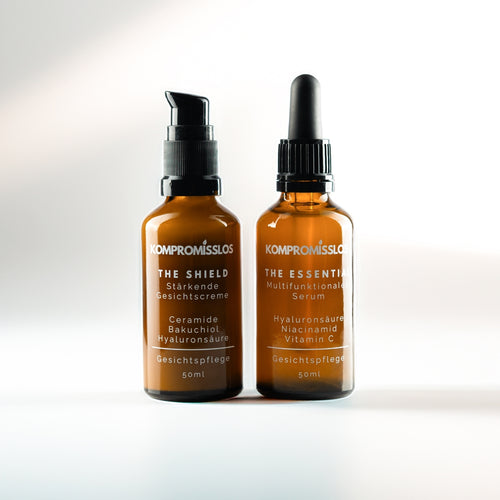
No, in most cases you do not need to change your skincare in spring – you only need to adjust two things: the amount, based on how your skin feels, and your sun protection. Overhauling your entire routine just when your barrier is still compromised brings new irritants into a phase that is already reactive. Some skin needs less rich care as humidity rises; other skin stays dry all year round. Let your skin decide, not the calendar. How to recognise a damaged skin barrier, and what it needs, is a more useful question than where to find a spring cream. With a serum-and-cream routine such as The Duo, the application stays the same throughout the year: morning and evening, first the lighter serum, then the cream. For dry skin, the instructions allow for a little more product. The only new addition in spring is sunscreen in the morning.
- Stays the same: gentle cleansing, serum, cream, morning and evening.
- Add: daily sunscreen on your face whenever you are outdoors.
- You can skip: intensive spring exfoliation treatments, detox masks, three new serums at once.
- Wait: introduce new active ingredients only once your skin has calmed down, and then one at a time.
If you do want to try something new in spring, introduce one product at a time with one to two weeks in between. That way, if your skin reacts, you know where the reaction came from instead of having five suspects at once.
When do you need more sun protection again?
You need more sun protection as soon as the sun climbs higher again in spring and you spend more time outdoors – not only once summer arrives. MeteoSwiss explains that UV radiation varies not only over the course of the day but also across the year, because it depends on the position of the sun. With every spring month, the sun stands higher and the radiation reaching the ground grows stronger. At the same time, your skin is barely used to the sun after winter. In the mountains, there is even more to it: according to MeteoSwiss, radiation intensity rises by 10 to 12 per cent for every 1,000 metres of altitude, and a snow-covered surface can reflect up to 80 per cent of the sun’s radiation. A sunny day on the slopes in March or a spring hike above the snow line is therefore far more demanding on the skin of your face than the air temperature would suggest.
Many face creams contain no SPF, and spring is when you first notice that again. In her review on Judge.me, Irène S. writes: “I do miss the sun protection a little” (review translated from German). It is a fair point, and the solution is a separate sunscreen as the last step in the morning. Which SPF is enough for everyday life and how to combine it with serum and cream is covered in detail in the article on sunscreen for your face.
When is it an allergy rather than a skincare issue?
An allergy or a skin condition is more likely to be behind it if the symptoms come back every spring, coincide with hay fever or go beyond what dry, irritated skin does. Tightness and mild stinging after winter are part of the transition. Certain signs, however, are not a skincare matter but one for a professional – your GP, a dermatologist or an allergy assessment:
- Hives, meaning itchy, raised patches that come and go.
- Swelling of the eyelids or lips.
- Weeping, scaly or very red patches that do not improve despite gentle care.
- Reactions that always appear after a particular product or after time spent outdoors.
- Known atopic dermatitis that gets worse during pollen season.
A cream cannot rule out or confirm an allergy – that takes a proper assessment. During this time, skincare can play a supporting role by not irritating your skin any further, but it is no substitute for a diagnosis.
There is no SPF in The Shield, and that was a deliberate decision. A cream you use morning and evening, in the same way all year round, cannot also be a good sunscreen. Sunscreen has to be applied generously and topped up during the day, and in the evening you do not need it at all. Spring is when this separation is most noticeable. Serum and cream stay the same; the most important new step is the separate sunscreen on top. That also means The Duo does not protect you from sunburn – it cannot, and it should not pretend to. How serum and cream work together day to day is explained in the instructions for use. Sunscreen comes after that, as the last step in the morning.
Frequently asked questions
Does spring fatigue show on your skin?
Spring fatigue is not a medical diagnosis, and there is no evidence that it shows up specifically on the skin. If your skin looks dull after winter, dryness is usually the reason: a rough surface reflects light less evenly. Moisture, a cream as the final step and a little patience are more likely to change that impression than a product promising to wake your skin up.
Can skin react to pollen?
Yes, especially in people with a pollen allergy or atopic dermatitis. Studies show that with hay fever the skin often reacts as well, and the face is frequently affected. In people with atopic dermatitis and a grass allergy, the skin got worse after contact with pollen, particularly in uncovered areas. Symptoms that keep coming back during pollen season call for an allergy assessment.
Should I exfoliate in spring?
You do not have to exfoliate in spring, even if the idea of a spring clean is tempting. If your skin is irritated after winter, exfoliating puts extra strain on the barrier. If you do want to exfoliate, keep it gentle and infrequent, and do not combine it with other new products. Sun protection is especially important afterwards.
Do I need a lighter cream in spring?
Not automatically. Some skin gets by with less rich care as humidity rises, but dry and mature skin often stays dry all year round. What matters is how your skin feels in the afternoon: if it feels tight, your skincare is not too heavy. If it is very shiny or feels coated, you can reduce the amount.
Why do I get more spots in spring?
There is no single, well-established cause of spring breakouts. Common suspects are a new, heavy sunscreen, sweating more on the first warm days, touching your face often because of hay fever, or too many new products at once. Start by checking what has changed in your routine. If the breakouts persist for weeks, have them looked at by a dermatologist.
How do I protect my skin from the first spring sun?
With daily sunscreen on your face whenever you are outdoors, not just in summer. Check the UV index, avoid the midday sun during the first warm weeks and remember a hat or cap. In the mountains and on snow, the radiation is considerably stronger, so sunscreen belongs on your face there even when it is cool.
Do I need to use The Duo differently in spring?
No. The application stays the same all year round: cleanse your face with water, then apply 3 to 6 drops of serum followed by 3 to 6 pumps of cream, morning and evening. If your skin is dry, you can use a little more. Because The Duo contains no SPF, in spring you add a separate sunscreen as the last step in the morning.
Sources
- Engebretsen KA, Johansen JD, Kezic S, Linneberg A, Thyssen JP. The effect of environmental humidity and temperature on skin barrier function and dermatitis. Journal of the European Academy of Dermatology and Venereology, 2016. Source
- Jiang W, Wang J, Zhang H, Xu Y, Jiang C, Yang J et al. Seasonal changes in the physiological features of healthy and sensitive skin. Journal of Cosmetic Dermatology, 2022. Source
- Simamura A, Sato S, Matsuoka T, Ishii H, Sakurai D. Skin symptoms during the pollen seasons and their association with the severity of seasonal allergic rhinitis in Yamanashi, Japan. Allergology International, 2026. Source
- Werfel T, Heratizadeh A, Niebuhr M, Kapp A, Roesner LM, Karch A et al. Exacerbation of atopic dermatitis on grass pollen exposure in an environmental challenge chamber. Journal of Allergy and Clinical Immunology, 2015. Source
- Bundesamt für Meteorologie und Klimatologie MeteoSchweiz. UV-Index. Wetter und Klima von A bis Z. Source