Winter face cream: what mature, dry skin really needs in the cold
SKIN OVER 40
For mature skin, a winter moisturiser usually does not have to be a new product. Cold, the bise and dry heated air weaken the skin barrier, and mature skin has fewer lipids of its own to make up for it. What helps is skincare that delivers humectants and skin-identical lipids together, a little more of it morning and evening, plus a sensible indoor climate. You only need an extra winter cream or a thick, oil-based cream in exceptional cases.
Do you really need a different face cream in winter?
No, in most cases you do not need a different face cream in winter, just more of a good one. What matters is not the season on the label but whether your cream can do two things: bind water in the skin’s outer layer and fill the gaps in its lipid layer. A cream that manages this in October will manage it in January too – it simply needs to be applied more generously. It is a different story if your summer skincare was a light gel or fluid with hardly any lipids. Then a building block really is missing in winter, and you add it with a cream that contains it, not with three new products.
In fact, one of the most common mistakes in winter skincare is the opposite: your skin feels rough, and suddenly there is a winter cream, a mask and an oil in the bathroom. Why that tends to get in the way rather than help is explained in the article on skin after summer and why less skincare now does more. The same logic applies in winter: change one thing, watch your skin for two weeks, then decide what to do next.
Why does mature skin dry out faster in winter than it did at 30?
Mature skin dries out faster in winter because two losses add up: the amount of barrier lipids falls with age, and it falls again in winter. A study in the Archives of Dermatological Research measured the lipids in the stratum corneum on the face, hands and legs of women in different age groups. With increasing age, all the major lipid classes were markedly reduced, ceramides in particular. In winter, levels at every site measured were also far below those recorded in spring and summer. The authors see this as one reason why older skin is especially prone to dryness during the winter months.
Then there is repair. In a study in the Journal of Clinical Investigation, a deliberately disrupted skin barrier recovered by 50 per cent within 24 hours in 20- to 30-year-olds, but only by 15 per cent in people over 80. The age groups in between were not studied, yet the direction is clear: the older the skin, the longer it takes to rebuild a damaged barrier. What this barrier is made of is covered in more detail in the article on ceramides and a weakened skin barrier. The habits that make matters worse in winter, from hot showers to long baths, are the subject of our guide to dry skin with age.
How dry is indoor air in winter, and what difference do airing and a humidifier make?
On cold winter days, the relative humidity in heated rooms can drop below 30 per cent for several days, and yet a humidifier is rarely the first answer to dry heated air and dry skin. That is what the brochure “Vorsicht Schimmel” (“Beware of mould”) from the Swiss Federal Office of Public Health (FOPH) says. As a rule of thumb, the FOPH recommends a relative indoor humidity of 30 to 50 per cent, and no more than 40 per cent on very cold days, because otherwise moisture problems can develop on cold parts of the building. According to the FOPH, low humidity is not a problem for many people. Sensitive people, however, can suffer from a feeling of dryness and irritation if the humidity stays below 30 per cent for a long time. Before you buy a device, the FOPH recommends simpler steps:
- Turn heavily heated rooms down to 20 to 21 °C – this raises the humidity by itself.
- Vacuum regularly and wipe surfaces with a damp cloth, because irritants make the feeling of dryness worse.
- Avoid tobacco and candle smoke, air fresheners and incense sticks.
- Air rooms regularly with a through draught, which reduces irritants given off by furnishings.
- Only if the humidity stays well below 30 per cent for several days and you have symptoms: humidify to 40 per cent, check it with a hygrometer, always use fresh water and clean the device regularly.
A good indoor climate is no substitute for skincare, but it takes some of the work off your skin. If your face feels tight mainly straight after washing, that is often down to your cleanser rather than the air – read more about tight skin and where the feeling comes from.
What does the bise do to mature skin?
The bise puts mature skin under strain because it brings cold air and wind to your face at the same time. MeteoSwiss describes it as a mostly cold north-easterly wind that carries continental air from north-eastern Europe and, channelled between the Jura and the Alps, usually reaches its strongest gusts in the Lake Geneva region. A review in the Journal of the European Academy of Dermatology and Venereology concludes that low humidity and low temperatures generally weaken the skin’s barrier function and make it more susceptible to mechanical stress. The skin then also reacts more sensitively to irritants. When the bise blows, your face meets cold wind outdoors and dry heated air indoors. Mature skin, which already replenishes fewer lipids, often feels this sooner: cheeks and the sides of the nose can turn red, and skin can feel rough after a walk. What actually protects you outdoors, and when a special cream makes sense, is covered in the article on cold weather face cream.
Which ingredients should a winter moisturiser for mature skin contain?
A winter moisturiser for mature skin should combine humectants and skin-identical lipids, with as little as possible that further irritates a weakened barrier. Humectants such as hyaluronic acid or glycerin bind water in the skin’s outer layer. Lipids such as ceramides, squalane or plant oils fill the spaces between skin cells, which are less well supplied in winter, and slow down evaporation. One without the other works less well in winter: moisture without lipids evaporates again quickly, and lipids without moisture make skin soft but not plump. With mature and sensitive skin, tolerance also counts in winter. Your skin does not need fragrance or essential oils for any of this, and on irritated winter skin they are more of a risk than a benefit.
| Building block | How it appears in the INCI list | Job in winter |
|---|---|---|
| Humectants | Sodium Hyaluronate, Glycerin, Panthenol | Bind water in the skin’s outer layer |
| Skin-identical lipids | Ceramide NP, Squalane | Fill gaps in the lipid layer |
| Plant oils | Simmondsia Chinensis Seed Oil (jojoba), Helianthus Annuus Seed Oil (sunflower) | Slow down evaporation, keep skin supple |
| Best avoided | Parfum, essential oils, Alcohol denat. near the top of the list | Further irritate a weakened barrier |
So which face cream suits you in winter comes down to the ingredient list, not the word “winter” on the tube. General buying criteria that apply at any age can be found in our guide on what to look for in a moisturiser for dry skin.
When is more of your cream enough in winter, and when is a different product worth it?
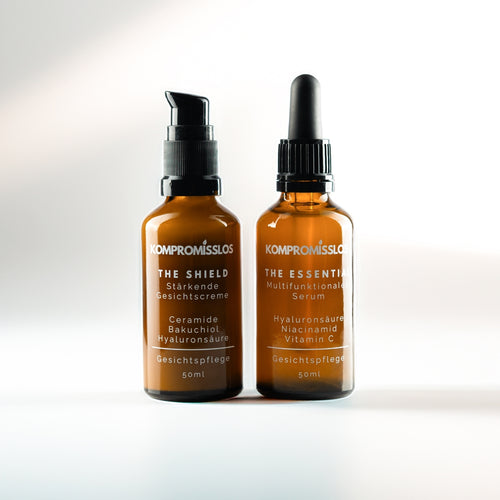
More cream is enough as long as your skin stays supple for several hours after you apply it and the roughness eases within one to two weeks. For the serum and cream in The Duo, that means in practice: the routine stays the same, and if your skin is dry, the application guide simply says to use a little more. The Essential provides hyaluronic acid in three molecular sizes, and The Shield on top adds ceramide NP, squalane and jojoba oil. This layering – moisture underneath, lipids on top – works in winter too; you simply use more of each.
You need something extra if, despite more cream and a sensible indoor climate, your skin is still flaking after two weeks or already feels tight again by lunchtime. In that case, a small addition in the evening makes more sense than a third cream. In her review on Judge.me, Daniela B. is candid about this: “In winter, however, the cream does not give my mature, dry skin enough moisture. That is why I combine it with a natural facial oil in the evening, so that my skin is better nourished” (review translated from German). That is a sensible solution: a few drops of a pure plant oil as the last step in the evening, as an addition rather than a replacement.
Cracked, weeping or very itchy patches that do not improve despite skincare are not a case for a new cream. They should be seen by a dermatologist, especially if they come back every winter.
I deliberately decided against making a separate winter cream. Two products instead of eight also means no seasonal extra that you are meant to add to your bathroom shelf in October. Mature skin needs the same building blocks in winter as in summer – moisture and lipids – just in larger amounts. That is why the application guide does not mention a second cream, only that dry skin should use a little more. I am just as clear about one limit: the serum and cream contain no sun protection factor. I kept the two separate on purpose, and that applies in the colder months too. So during the day you still need sunscreen for your face, even in winter. How much serum and cream to use, and in which order, is set out in the guide on how to apply the serum and cream.
Frequently asked questions
Do I need an extra night cream in winter?
Not necessarily. You can apply a cream that provides humectants and lipids in the evening just as you do in the morning – in winter, simply a little more generously. When a separate night cream does make sense is covered in the article on whether you really need a night cream.
Do I need a cold weather cream for everyday use?
Usually not for your commute or a walk – your normal skincare, applied generously, is enough. For long hours in sub-zero temperatures, in a strong bise or on the slopes, it is worth looking at when a cold weather face cream makes sense.
Should I switch to a rich, oil-based cream in winter?
Only rarely, because an oil-based cream without humectants provides lipids but no water for the skin’s outer layer. Which texture dry skin needs and when is explained in the comparison rich vs light moisturiser.
Can I keep using niacinamide and vitamin C in winter?
Yes, you can keep using both active ingredients in winter. Niacinamide and stable forms of vitamin C are not among the active ingredients you need to stop for the season. If your skin reacts sensitively when you apply them on irritated days, you can use just the cream for a few days and add the serum back in once your skin has calmed down. If the stinging persists, have it checked by a doctor.
How can I tell if my winter cream is too heavy?
If there is still a film on your skin after half an hour, your skin looks greasy and shiny, or small blemishes start to multiply, the product is too heavy for you or you are applying it too thickly. Mature skin needs more lipids in winter, but not a layer that never sinks in. Reduce the amount first before you switch products.
How much more cream does dry skin need in winter?
There is no fixed figure, because skin condition, indoor air and products all differ. It makes sense to increase the amount in small steps, for example by one pump or a pea-sized amount, and watch how your skin responds for a week. If it still feels supple in the afternoon, the amount is right. If it looks shiny or a film remains, it was too much.
Do I need to use The Duo differently in winter?
No, the order stays the same: morning and evening, after cleansing with water, first the serum, then the cream. The recommendation is 3 to 6 drops of serum and 3 to 6 pumps of cream, a little more for dry skin – so in winter, towards the upper end of the range. During the day, add sunscreen, because The Duo contains no sun protection factor.
Sources
- Rogers J, Harding C, Mayo A, Banks J, Rawlings A. Stratum corneum lipids: the effect of ageing and the seasons. Archives of Dermatological Research, 1996. Source
- Ghadially R, Brown BE, Sequeira-Martin SM, Feingold KR, Elias PM. The aged epidermal permeability barrier. Structural, functional, and lipid biochemical abnormalities in humans and a senescent murine model. Journal of Clinical Investigation, 1995. Source
- Engebretsen KA, Johansen JD, Kezic S, Linneberg A, Thyssen JP. The effect of environmental humidity and temperature on skin barrier function and dermatitis. Journal of the European Academy of Dermatology and Venereology, 2016. Source
- Bundesamt für Gesundheit BAG. Vorsicht Schimmel. Eine Wegleitung zu Feuchtigkeitsproblemen und Schimmel in Wohnräumen. Bern, 2023. Source
- MeteoSchweiz. Winde der Alpen und Europas – Teil 1. MeteoSchweiz-Blog, 2023. Source