Moisturiser for dry skin: what to look for and what you can skip
SWISS BUYING GUIDE
Which moisturiser suits dry skin comes down to its formula, not the word ‘rich’ on the tube. A good moisturiser for dry skin combines humectants such as glycerin or hyaluronic acid with skin-like lipids such as ceramides, squalane or plant oils, contains no fragrance and has a texture you are happy to apply generously. You can skip fragrance, cooling effects and pricey exotic extras. And if your cream is not enough, the problem is often the amount, not the product.
What should you look for in a moisturiser for dry skin?
A good moisturiser for dry skin does three jobs at once: it binds water, fills the gaps in the stratum corneum, the skin’s outermost layer, with lipids and slows down evaporation. A review in Clinical Medicine & Research describes exactly these three building blocks. Humectants draw water into the stratum corneum, emollients made of lipids fill the spaces between the skin cells and make the skin smoother and more supple, and occlusives form a water-repellent film on top that slows down water loss. Dry skin lacks not only water but also oil. A cream made up almost entirely of humectants in a light gel base therefore feels fresh at first and starts to feel tight again a few hours later. Conversely, a layer of pure oil seals well but brings no water of its own. Two practical criteria come on top of this: the cream should be fragrance-free, and it should feel pleasant enough that you apply a generous amount morning and evening. In a review article in the American Journal of Clinical Dermatology, Marie Lodén notes that there are large differences between moisturising creams. The name on the pack tells you little about them.
| Criterion | What to look for | Why it matters |
|---|---|---|
| Humectants | Glycerin, hyaluronic acid, panthenol or urea near the top of the list | They bind water in the stratum corneum |
| Skin-like lipids | Ceramides, squalane, plant oils, phytosterols | They fill the gaps between the skin cells |
| Protective film | Oils, butters or waxes in a noticeable amount | They slow down evaporation throughout the day |
| No fragrance | No parfum, no essential oils, no limonene or linalool | Less potential for irritation on a weakened barrier |
| Transparency | Concentrations of the active ingredients disclosed | You can compare rather than take it on trust |
| Texture | Enough substance, but pleasant enough for twice-daily use | A cream only works in the amount you apply |
A serum underneath is not a must, but it is often useful: it delivers water-binding active ingredients in a light layer, and the cream holds them in place on top. Whether that is worth it for you is covered in Serum and cream: do you really need both. If your skin is not just dry but very dry and easily irritated, it is worth looking first at what very dry skin is really missing.
Which ingredients does dry skin need in a moisturiser?
Dry skin needs at least one good humectant and at least one skin-like lipid in its moisturiser, ideally several of each. Among the humectants, glycerin, hyaluronic acid and panthenol are the proven classics. Glycerin is unspectacular, often appears near the top of the list and does a lot of the heavy lifting. Among the lipids, what matters most are substances that resemble the skin’s own fats. Ceramides are among the most important lipids in the stratum corneum – more on what ceramides do for your skin. Squalane is the stable, saturated form of the skin’s own squalene; it feels light and slows down water loss without feeling sticky. Plant oils such as jojoba or sunflower oil round this off.
A study in Clinical, Cosmetic and Investigational Dermatology, carried out by the manufacturer of the cream being tested, shows how much the combination can matter. This cream combines humectants, ceramides, cholesterol and occlusive ingredients. Among 50 participants with healthy skin, ten per product, the measured skin hydration on the forearm 24 hours after a single application was significantly higher than with three comparison creams, and in a second measurement transepidermal water loss fell. That is not evidence for one single star ingredient, but a pointer to the combination. Classic occlusives have their place too: according to Lodén, petrolatum has an immediate barrier-repairing effect on a stratum corneum that has been stripped of its lipids. In practice, this means looking for a cream in which water binders and lipids appear together, rather than for the one ingredient that is supposed to do everything.
Which ingredients can you skip if you have dry skin?
Above all, you can skip fragrance, drying alcohol near the top of the list and expensive additives whose benefit for dry skin has barely been demonstrated. Fragrance does nothing to care for your skin, but it can irritate it and trigger contact allergies. A study in the British Journal of Dermatology tested 3,119 randomly selected adults from the general population in five European countries and conservatively estimated the prevalence of clinically relevant fragrance contact allergy at 1.9 per cent. In women, it was about twice as high as in men. That may not sound like much, but an allergy stays with you, and dry skin with a weakened barrier reacts more quickly anyway. What ‘fragrance-free’ actually guarantees and where the term reaches its limits is explained in Fragrance-free moisturiser.
You can also do without menthol or camphor for a refreshing kick: it feels good but does nothing for dryness. The same goes for high levels of acids in a day cream when your skin already feels tight, and for luxury additives such as gold, caviar or stem cell extracts. They make a cream more expensive, not richer. A long list of plant extracts is not a mark of quality in itself either: every additional ingredient is one more potential trigger if your skin is sensitive. The rule of thumb for dry skin is therefore a few clearly named active ingredients in a good base rather than lots of promises on the front of the pack.
How can you tell your moisturiser is not enough for dry skin?
Your moisturiser is not enough if your skin feels tight again a few hours after you apply it, if fine flakes appear or if dryness lines become more visible over the course of the day rather than softening. Other signs are make-up settling into dry patches and cheeks that feel rough by the evening. The first thing to adjust is almost always the amount. Lodén writes that, as with other active substances, the efficacy of moisturisers probably depends on the dose. If you spread a pea-sized amount of a good cream over your whole face, you have not really tested it. The second adjustment is layering: humectants in a serum under the cream, lipids on top. The third is texture: if a larger amount still does not help, your skin needs a cream with a higher lipid content. If your skin gets drier over the years, it is worth reading about skincare for dry skin with age, and from 70 onwards thinner skin and ease of use also come into play, as described in the guide to face cream over 70.
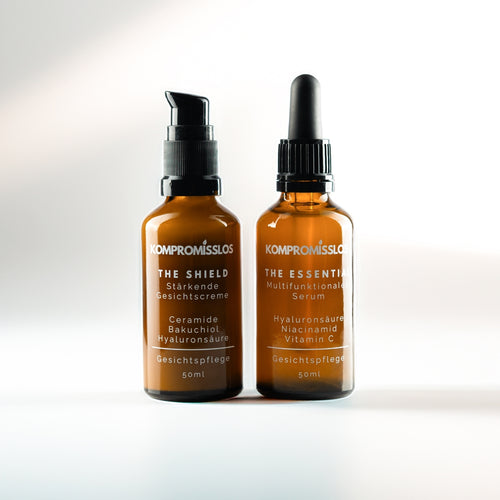
Some of our own customers reach this point too. In her review on Judge.me, Daniela B. writes: ‘As I have rather dry, mature skin, I would like the face cream to be a little richer, so I supplement it with a facial oil from another brand’ (review translated from German). That is a legitimate solution. With The Duo of The Essential and The Shield, though, the first step would still be to adjust the amount and the layering: first 3 to 6 drops of The Essential, then 3 to 6 pumps of The Shield on top, a little more for dry skin. If the tightness persists after that, a few drops of a simple plant oil in the evening are easier than a completely new routine. If the dryness is new, suddenly gets worse, itches or becomes inflamed, it is a matter for a dermatologist.
What do ‘rich’, ‘intensive’ and ‘for dry skin’ mean on the pack?
These terms describe a promise, not a defined formula. None of them comes with a minimum amount of lipids or humectants that a cream has to contain. ‘Rich’ usually means a thicker texture with more oil or wax, but says nothing about which lipids are in it or whether it contains any humectants at all. ‘Intensive’ is a feel-good word with no measurable basis. ‘For dry skin’ means that the manufacturer markets the cream to this group. Two other terms are a little more precise: ‘hydrating’ points to water binders, ‘nourishing’ to lipids. Dry skin needs both. A thick, fragranced cream can call itself ‘intensive’ on the pack, while a lighter emulsion with ceramides, squalane and glycerin may do more for dry skin. Three things on the back tell you more than any adjective: the full INCI list, disclosed concentrations of the active ingredients and the absence of ‘Parfum’ from that list.
How do you read the INCI list of a moisturiser for dry skin?
You read the INCI list from top to bottom, because the ingredients are listed in order of quantity: whatever comes first makes up the largest share. Ingredients present in very small amounts can be listed in any order, so a position right at the end tells you little. For dry skin, check four things in this order:
- Base: what comes first? Usually Aqua, sometimes a plant juice such as Aloe Barbadensis Leaf Juice.
- Humectants: Glycerin, Sodium Hyaluronate, Panthenol or Urea should appear in the first part of the list.
- Lipids: Ceramide NP or other ceramides, Squalane, plant oils such as Simmondsia Chinensis Seed Oil (jojoba) or Helianthus Annuus Seed Oil (sunflower), plus butters or phytosterols.
- Troublemakers: Parfum or Fragrance, Limonene, Linalool, Citronellol, essential oils and Alcohol Denat. near the top.
Two misunderstandings crop up frequently. Ceramides often appear near the end of the list even in good creams, because they are used in small amounts. Near the end therefore does not automatically mean ineffective, but the INCI list alone does not tell you the amount – only a disclosed concentration does. And Cetearyl Alcohol is not a drying alcohol but a fatty alcohol that stabilises the cream and feels nourishing.
With The Duo, I made two deliberate decisions: no fragrance and disclosed concentrations. Fragrance-free, because fragrance does nothing for dry skin and is only an extra risk of irritation. Disclosed, because you can only compare a cream if you know what is in it and in what amount. The percentages on our website apply to The Duo as a whole. There is no figure there for ceramides or squalane, so I do not give one here either. And then the honest limit: with very dry skin, the amount comes first, not a third product. That is why our guide to using the products simply says ‘a little more’ for dry skin, rather than pointing you to an extra product I could sell you.
Frequently asked questions
Is a thicker cream automatically better for dry skin?
No. A thick texture mainly indicates a high oil or wax content, but not whether humectants and skin-like lipids are also present. What matters is the combination – and that you apply enough of it. When a richer texture is still the better choice is covered in Rich vs light moisturiser.
Does urea in a face cream help?
Yes, urea is an effective humectant and can make dry skin look smoother. On the face, however, it can sting, especially on irritated skin. Lodén cites urea, alongside lactic acid, as an example of ingredients whose stinging can put people off using them. Which concentration makes sense on the face is explained in Urea on your face.
Are oils better than creams for dry skin?
No, but they can complement a cream well. An oil supplies lipids and slows down evaporation, but brings no water and no humectants of its own. A cream combines both. For very dry skin, a few drops of oil over your cream in the evening therefore usually work better than an oil on its own.
Should I reapply moisturiser to dry skin during the day?
You can, but a larger amount in the morning usually does more than constantly reapplying over your make-up. The baseline is still twice a day, morning and evening after cleansing. If your skin still feels tight by midday, the amount or the lipid content of your cream is not enough. If your cream has no SPF, you also need a separate sunscreen during the day.
Can a moisturiser for dry skin contain alcohol?
That depends on the alcohol. Alcohol Denat. or ethanol near the top of the list can make dry skin even drier. Fatty alcohols such as Cetearyl Alcohol, on the other hand, are nourishing thickeners and are not a problem for dry skin. The difference is explained in Alcohol in skincare.
Does a fragrance-free moisturiser matter for dry skin?
Yes, it is the safer choice. Fragrance has no skincare benefit, but it can irritate and trigger contact allergies. In the INCI list, look out not only for Parfum or Fragrance but also for declared fragrance allergens such as Limonene, Linalool or Citronellol, and for essential oils. These sometimes turn up even in creams that call themselves ‘natural’ on the front.
Is The Duo rich enough for dry skin?
The Duo is designed for dry skin too. Whether it is enough for you depends mainly on the amount. The Shield combines Ceramide NP, squalane, jojoba oil and hyaluronic acid, while The Essential underneath provides humectants. The application guide recommends 3 to 6 pumps of cream, a little more for dry skin. Both products are fragrance-free. You can try The Duo with a 100-day return policy.
Sources
- Purnamawati S, Indrastuti N, Danarti R, Saefudin T. The Role of Moisturizers in Addressing Various Kinds of Dermatitis: A Review. Clinical Medicine & Research, 2017. Source
- Lodén M. Role of topical emollients and moisturizers in the treatment of dry skin barrier disorders. American Journal of Clinical Dermatology, 2003. Source
- Spada F, Barnes TM, Greive KA. Skin hydration is significantly increased by a cream formulated to mimic the skin’s own natural moisturizing systems. Clinical, Cosmetic and Investigational Dermatology, 2018. Source
- Diepgen TL, Ofenloch R, Bruze M, Cazzaniga S, Coenraads PJ, Elsner P, et al. Prevalence of fragrance contact allergy in the general population of five European countries: a cross-sectional study. British Journal of Dermatology, 2015. Source