Very dry skin on the face: what it’s really missing
SKIN CONDITION
Very dry skin on the face is usually short of lipids, not just water. When ceramides, fatty acids and cholesterol are missing from the outermost layer of the skin, moisture evaporates faster than it can be replaced. You see this as fine flaking, tightness and rough patches. What works, therefore, is a combination of humectants and skin-identical lipids, applied morning and evening.
How is very dry skin different from dehydrated skin?
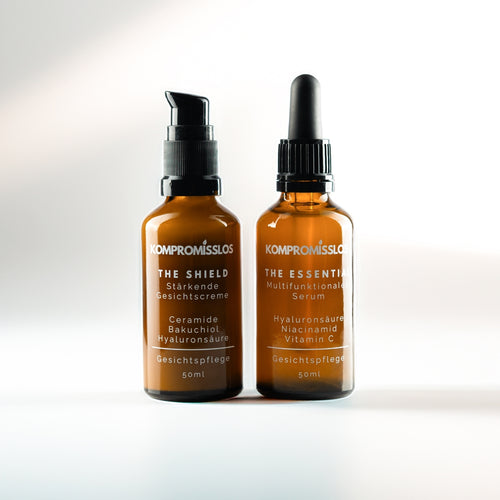
Dry skin and dehydrated skin are two different conditions, even if they feel similar. Dry skin produces too little oil: sebum, ceramides, fatty acids and cholesterol are in short supply, the surface looks dull, flakes finely and feels tight, especially after washing. Dehydrated skin has enough lipids but too little bound water. Skin like this can be shiny and feel rough at the same time, shows fine crinkly lines on the cheeks and reacts quickly to central heating or air conditioning. The difference matters in practice, because the two conditions need different active ingredients: dehydrated skin benefits from humectants such as hyaluronic acid or glycerin, while dry skin also needs skin-identical lipids that slow down evaporation. Very dry skin on the face is often both at once. If you close only one of the two gaps, your skin feels good in the evening and is flaky again by the morning. That is exactly why The Duo of serum and cream combines both levels in one routine.
| Feature | Dry skin (lack of lipids) | Dehydrated skin (lack of water) |
|---|---|---|
| Skin feel | Constantly tight, especially after cleansing. | Tight at times, often in the afternoon or in dry air. |
| What you see | Fine flaking, a dull surface, rough patches. | Fine crinkly lines, a sallow complexion, shine despite roughness. |
| Typical trigger | Genetics, age, cold, overly harsh cleansing. | Central heating, lack of sleep, aggressive exfoliants. |
| What is missing first | Ceramides, fatty acids, cholesterol. | Bound water in the stratum corneum. |
Which lipids is very dry facial skin missing?
Very dry skin is mainly short of the three classes of lipid that make up the layer between the skin cells of the outer layer: ceramides, cholesterol and free fatty acids. According to a review in the International Journal of Cosmetic Science, these three groups together make up most of the lipids between the cells of the stratum corneum and are crucial in stopping water from evaporating unchecked. If one of the three groups is missing, the lipid layers become irregularly arranged and let more water through, even if the other two are present in abundance. On top of that, very dry facial skin often has less sebum, meaning less squalene, wax esters and triglycerides on the surface, which makes the protective film thinner still. So what you are looking for in a product is not individual active ingredients but the combination: ceramides as a building block of the barrier, a skin-identical lipid and a plant oil whose structure is close to the skin’s own sebum. How permeable your barrier is at the moment can be judged from the signs of a weakened skin barrier.
In the Duo, this role is played by ceramides, squalane as a skin-identical lipid and jojoba oil. All three appear on the list without a percentage, because they act as a skincare base rather than as a dosed active ingredient. You can see what else is in it in the full ingredient list.
Why isn’t moisture alone enough for very dry skin?
Moisture alone is not enough, because without a layer of lipids on top, water evaporates faster than it can be replenished. Humectants such as hyaluronic acid draw water into the upper layers of the skin and make it look plumper straight away. Without the lipid layer above it, the skin gives this water back to its surroundings within a few hours, and even faster in dry, heated air. With very dry skin, there is the added problem that the stratum corneum is already more permeable. A systematic review in PLOS ONE describes dry skin in exactly these terms: the stratum corneum can no longer maintain the water gradient towards the surface, water loss through the skin increases and sebum production also falls. In practice, this means moisture first, then lipids on top. A serum with 2% hyaluronic acid and no cream to finish remains only half a solution for very dry skin, however pleasant it feels at the time.
One customer wrote to me that she applied a very rich cream in the evening and still had rough patches on the sides of her nose in the morning. Rich does not automatically mean barrier-like: a cream can contain plenty of oil and still fail to supply the building blocks missing from the stratum corneum. Conversely, a hydrating serum with nothing on top does little. The point is to use both together.
What helps straight away, and what helps in the long term?
What helps straight away is stopping the losses: cleanse more gently, wash with lukewarm rather than hot water, and apply moisture plus lipids directly to skin that is still slightly damp. In the long term, only consistency helps, because the stratum corneum rebuilds itself over several renewal cycles, not over a weekend. During this phase, cut out anything that strips the skin further: grainy scrubs, acids used at short intervals, cleansers that leave your skin squeaky clean, and toners with a high alcohol content. It is better to reduce the number of products and increase regularity, because every additional step is also an additional source of irritation. If your skin reacts to cold, wind or central heating, the order matters more than the amount. And if the dryness has only come on over the years, it is worth reading about dry skin in older age, because other causes play a part there than in younger skin with the same complaint.
- Cleanse with lukewarm water, without pulling at the skin.
- Serum on slightly damp skin, 3 to 6 drops.
- Cream straight afterwards, 3 to 6 pumps, to finish.
- The same morning and evening, even on good days.
Alongside the lipids, the Duo contains 2% hyaluronic acid, 5% niacinamide and panthenol. The percentages always refer to the Duo as a whole, not to the serum or cream individually. How to time the two steps properly is explained in the instructions for use.
When should very dry skin be seen by a professional?
Very dry skin should be seen by a professional if it weeps, bleeds, itches badly, has sharply defined edges or shows no change after weeks of consistent care. Skincare looks after the surface and supports the barrier, but it does not treat skin disease. This distinction is not small print; it is the line between skincare and medicine. If the dryness appears suddenly and with no obvious trigger, spreads to large areas of the body or comes with other symptoms, seeing a dermatologist is the right step. The same applies to the question of whether your body is lacking something internally: deficiencies, diet and medication are a medical matter and cannot be resolved with a cream. Good skincare complements such an assessment; it does not replace it. Keeping the two apart spares you frustration in both directions. The Duo is skincare, not medicine.
For the cream, I deliberately chose squalane and jojoba oil rather than a heavy occlusive film. A thick film feels spectacular on the first night, but it mainly sits on top of the skin instead of supplying the missing building blocks. What mattered more to me was that the texture also works under sun protection in the morning and that you can wear it all year round. That is also why we have no separate winter range. With dry skin, two products used consistently achieve more than four that rotate with the seasons.
Frequently asked questions
What is very dry facial skin lacking?
Very dry facial skin is lacking lipids above all: ceramides, free fatty acids and cholesterol in the stratum corneum, and sebum on the surface. As a result, the skin loses more water than it can hold. Bound water is usually missing too, which is why humectants and lipids together make more sense than either one alone.
What is the difference between dry and dehydrated skin?
Dry skin has too little oil; dehydrated skin has too little water. Dry skin flakes finely, looks dull and feels tight after washing. Dehydrated skin shows fine crinkly lines and can still be shiny. Very dry skin on the face is often both at once, which is why skincare with only one approach falls short.
What is your body lacking if you have dry skin?
Whether your body is lacking something cannot be judged from the outside and is a question for a professional. Dry skin can have many causes, from genetics and climate to medication. From a skincare point of view, what counts is what is missing at the skin’s surface: lipids and bound water. We deliberately do not give advice on deficiencies or diet.
Why does dry skin on the face flake?
Flakes form when the cells of the outer layer no longer shed individually but lift off in clusters. When lipids and water are missing, the enzymes that control this shedding work more slowly. You see this on the sides of the nose, the eyebrows and the chin. Gentle cleansing and a daily supply of lipids work better here than scrubbing the patches away.
Does a facial oil help extremely dry skin?
An oil slows evaporation but supplies neither water nor ceramides. Applied on its own to dry skin, it therefore does less than you might expect. An oil makes sense as a final layer over a layer of moisture. If your cream already contains skin-identical lipids, you usually do not need an extra step.
How often should I moisturise very dry skin?
Twice a day, morning and evening, is the sensible standard for very dry skin. Reapplying more often rarely helps, because the barrier needs time to rebuild rather than constant new layers. More important than the number of applications is that the skincare goes onto slightly damp skin and that you stick with it every day.
Is a rich cream enough on its own?
A rich cream on its own is often not enough, because rich describes only the texture, not the composition. What matters is whether it contains building blocks of the barrier and whether moisture is provided underneath. A combination of serum and cream covers both gaps and is the more reliable option for very dry skin.
Sources