Dry patches on your face: where they come from, when it isn’t dryness and what helps
SKIN CONCERNS
Dry patches on your face are usually local weak spots in the skin barrier: wherever friction, cold, hot water or an overly strong active ingredient hit particularly often, the skin’s outermost layer loses water and lipids more quickly. Typical areas are the sides of the nose, the cheeks, the eyebrows and the chin. What usually helps is cutting out the trigger and using a little more cream on that spot, not adding another product. If a patch has greasy, yellowish scales, weeps, itches badly or lasts longer than two to three weeks, it is one for a dermatologist.
Where do dry patches on your face come from?
Dry patches on your face usually develop where the skin has to put up with more than the rest of your face. The barrier is not under the same strain everywhere: the sides of your nose get rubbed every time you blow it, your cheeks take the brunt of wind and cold, your scarf and hands end up on your chin, and the frame of your glasses presses on the bridge of your nose. Then there are habits that only affect certain areas, such as an acid pad that always sweeps across your forehead first, or a spot gel that gets spread more generously than intended. In these places, the skin’s outermost layer loses water and lipids faster than it can replace them. The skin becomes rough, finely flaky and tight, while the rest of your face looks normal. At its core, this is a damaged skin barrier on a small scale.
Water plays a part too. A study in the Journal of Clinical Medicine involving 50 healthy volunteers found that hot water increased transepidermal water loss more markedly than cold water. The measurements were taken on the hands, not the face. It still works as a rule of thumb: lukewarm is gentler than hot.
Why don’t dry patches go away, even with moisturiser?
Dry patches usually persist despite moisturiser because the trigger is still at work or because the cream is applied too thinly on exactly that spot. Cream gets spread from the centre of the face outwards, and by the time it reaches the edges, the sides of the nose or the skin under the brows, often only a trace is left. A second reason is texture: a light gel with plenty of humectants but few lipids does bind water, but it is poor at keeping it in the skin. Whether you are short of water or of oil is no minor detail here. Dehydrated skin lacks moisture, dry skin lacks lipids, and a single patch can show both. The third reason is the routine itself: if an exfoliant, a retinoid or a strongly foaming cleanser reopens the patch every day, no cream can keep up. And fourth, sometimes dryness simply isn’t the issue at all, but a skin condition that barely responds to skincare. If the patch mainly feels taut without flaking, it is worth reading about tight skin and where the feeling comes from.
Why is the skin around your nose and eyebrows often dry and flaky?
The skin around your nose and on your eyebrows often flakes because two very different things come together there: mechanical strain and lots of sebaceous glands. When you have a cold, the sides of your nose get rubbed dozens of times a day as you blow it, and that alone is enough to leave the skin rough and red. How to care for a sore nose from a cold is covered in a separate article. The eyebrows and the fold between nose and cheek, on the other hand, are areas rich in sebaceous glands. If the skin flakes in exactly those places but looks rather oily at the same time, that is a sign that dryness is not the issue. A review in American Family Physician describes scaling, redness and itching as typical signs of seborrhoeic dermatitis, most commonly on the scalp, face, chest and back. It is diagnosed from the location and appearance of the patches, which is why it belongs in the hands of a dermatologist. A richer cream often does little in this case. Dryness around the mouth, by the way, follows patterns of its own, and there is a separate article on dry skin around the mouth.
When is it no longer dryness, and when should a dermatologist see the patch?
A patch should be seen by a dermatologist if it weeps, itches badly, has sharply defined edges, spreads or stays unchanged after two to three weeks of consistent care. Such patches may be caused by eczema, seborrhoeic dermatitis, psoriasis or a fungal infection. Telling these apart is a job for a professional, not for a blog article and not for a cream. Above all, it matters that you don’t try out products at random during this time: every new product can change how the patch looks and make it harder to get a clear diagnosis.
| What you notice | More likely dryness | Better to get it checked |
|---|---|---|
| Flakes | Fine, whitish, dry | Yellowish, greasy or thick |
| Itching | Mild or none | Severe, including at night |
| Edge of the patch | Blurred, blends into normal skin | Sharply defined or ring-shaped |
| Surface | Rough, feels tight | Weeps, crusts, forms blisters |
| How it develops | Calms down within days with care | Spreads or lasts longer than two to three weeks |
If the patch is mainly red and burns without flaking, it is worth looking at facial redness instead, because the triggers there often lie elsewhere.
How do you care for individual dry patches without overloading your whole face?
The best way to care for individual dry patches is your usual routine plus a second, thin layer of cream on exactly that spot. In most cases, you don’t need a separate product just for that area. What matters is that the cream supplies lipids there and protects the barrier rather than adding new irritants. A review in Clinical Medicine & Research describes moisturising care as a basic building block of daily skincare, especially when the barrier is disrupted and the skin lacks water. At the same time, take away whatever is putting strain on the patch.
- Wash with lukewarm rather than hot water and pat your face dry instead of rubbing it.
- Pause exfoliants, acids and retinoids on the patch until it has calmed down.
- Apply your skincare straight after cleansing so your skin doesn’t dry out unprotected.
- Apply a second, thin layer of cream to the patch, morning and evening.
- Avoid fragrances and essential oils for as long as the patch is irritated.
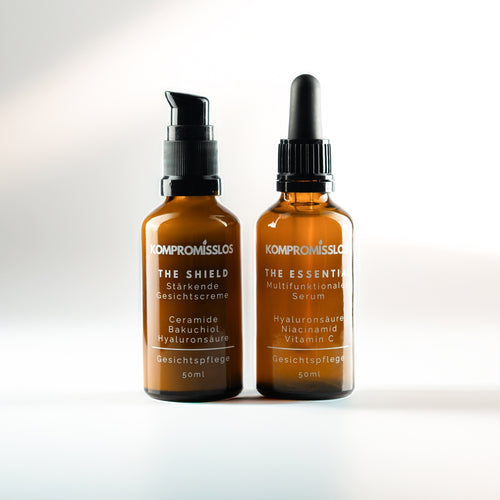
The Duo of Essential serum and Shield cream fits this approach: the Shield cream contains Ceramide NP, squalane and jojoba oil, The Duo also contains panthenol, and both products are fragrance-free. This supports the skin barrier without burdening the patch with an extra step. If it is not just one patch that is dry but your whole face, you are dealing with more than a local weak spot. In that case, read on about very dry skin on the face.
Don’t scratch or pick off the flakes, however tempting it is. Underneath is skin that isn’t ready yet, and that very spot then dries out even faster.
Why do dry patches appear more often in winter?
Dry patches appear more often in winter because cold air outside and heated air indoors dry out the skin twice over. A review in the Journal of the European Academy of Dermatology and Venereology concludes that low humidity and low temperatures generally weaken the skin’s barrier function and make it more susceptible to mechanical stress. On top of that come longer, hotter showers and more frequent nose-blowing during cold and flu season. Which cream suits the colder months is covered in the article on winter face cream.
I deliberately left exfoliants out of our range, and both products are fragrance-free. Dry patches show why: an exfoliant would make the flakes disappear for a moment and then weaken the patch further, and a fragrance would be one more irritant on skin that doesn’t need any right now. On a rough patch, a little more cream tends to help more than another product. If your skin tends to be dry, our guide to using the serum and cream recommends a little more anyway. What the two products cannot do is recognise a skin condition or replace an assessment by a dermatologist. If a patch hasn’t improved after two or three weeks of consistent, gentle care, it needs an appointment, not the next item in your basket.
Frequently asked questions
Does exfoliating help with dry patches?
As a rule, no. An exfoliant does remove the visible flakes, but it also opens up the weakened patch even more, and it then dries out again faster. It is better to keep the flakes supple with cream and give it time. Whether you need to exfoliate your face at all is covered in a separate article. If your face is peeling all over right now after sun, retinol or a peel, you will find more on peeling skin on your face.
Can I put Vaseline on dry patches?
Yes, a thin layer of Vaseline over your cream can slow down water loss overnight on a single dry patch. The article on slugging with petroleum jelly explains who the method suits and who it doesn’t.
Does a facial oil help with dry patches?
A facial oil can help if it goes on as the final layer over your cream and your cream doesn’t supply enough lipids on that spot. On its own, oil doesn’t bring moisture into the skin; it only holds in what is already there. Choose a fragrance-free oil and use just a few drops, targeted at the patch rather than your whole face.
Can cleansing cause dry patches?
Yes, cleansing is one of the most common triggers. Strongly foaming products, hot water and vigorous rubbing with a flannel often hit the sides of the nose, the chin and the hairline hardest. Try a milder cleanser for two weeks, or just lukewarm water in the morning, and see whether the patches calm down.
Can stress make dry patches worse?
Yes, chronic stress can weaken the skin barrier and make existing dry patches more visible. The article on stress and skin explains what lies behind this.
How long does it take for a dry patch to calm down?
Once the trigger is gone, a patch caused purely by dryness usually feels noticeably softer and calmer within a few days. It can take longer before it looks just like the skin around it again, because the skin’s outermost layer first has to renew itself. If hardly anything has improved after two to three weeks of consistent care, have a dermatologist take a look at the patch.
Is The Duo suitable for skin with individual dry patches?
Yes, The Duo is a good fit for skin with individual dry patches, as long as it really is dryness. You care for your whole face as usual with serum and cream and add a second, thin layer of cream to the dry patch. Both products are fragrance-free, and the cream contains Ceramide NP and squalane. More on how The Duo of serum and cream is put together.
Sources
- Herrero-Fernandez M, Montero-Vilchez T, Diaz-Calvillo P, Romera-Vilchez M, Buendia-Eisman A, Arias-Santiago S. Impact of Water Exposure and Temperature Changes on Skin Barrier Function. Journal of Clinical Medicine, 2022. Source
- Clark GW, Pope SM, Jaboori KA. Diagnosis and treatment of seborrheic dermatitis. American Family Physician, 2015. Source
- Purnamawati S, Indrastuti N, Danarti R, Saefudin T. The Role of Moisturizers in Addressing Various Kinds of Dermatitis: A Review. Clinical Medicine & Research, 2017. Source
- Engebretsen KA, Johansen JD, Kezic S, Linneberg A, Thyssen JP. The effect of environmental humidity and temperature on skin barrier function and dermatitis. Journal of the European Academy of Dermatology and Venereology, 2016. Source