Dry skin around the mouth: causes, what helps and when to get it checked
SKIN CONCERNS
Dry skin around the mouth is usually caused by irritants that all meet in this one spot: lip licking, saliva, toothpaste residue, frequent wiping, cold air and skincare products that reach right up to the lips. If it is simply dryness, the answer is to remove these irritants and use a gentle, fragrance-free cream rather than piling on new products. If small bumps or pustules appear, the skin burns, or a narrow strip of skin right along the edge of the lips stays clear, it is time to see a dermatologist.
Why is the skin around my mouth dry?
The skin around your mouth is dry because it is exposed to an unusually large number of mechanical and chemical irritants. It is constantly moving as you eat, drink and talk, saliva wets it and then evaporates, and napkins and the back of your hand wipe across it several times a day. On top of that come toothpaste, mouthwash, lip balm and lipstick, all of which end up in exactly this spot. Each of these irritants is minor on its own. Together, though, they draw moisture and lipids out of the outermost layer of skin, and the area around your mouth starts to feel tight, flake slightly or turn a little red.
Often the area around the mouth is also simply where generally dry facial skin shows up first. If your cheeks and forehead also feel tight and rough, the problem is more likely very dry skin on the face as a whole, not the mouth area alone. And if what bothers you most alongside the dryness is the fine lines around your lips, that is a separate topic: you can read what a cream can and cannot do for upper lip wrinkles in that article.
When is it more than dryness, and when should you see a dermatologist?
It is more than dryness if small bumps, pustules or a burning sensation appear, or if nothing improves after two to three weeks of pared-back skincare. At that point the question is no longer which cream to use, but getting it checked by a dermatologist. One condition that often comes up in this context is perioral dermatitis. A systematic review in the Journal of Cosmetic Dermatology found the strongest evidence that the misuse of corticosteroid creams is the main trigger. If you have ever used a steroid cream on your face, mention this at your appointment. Diagnosis and treatment belong in professional hands. Rosacea or a contact allergy can also show up around the mouth and look similar at first glance.
These warning signs suggest you should stop experimenting on your own:
- Small bumps or pustules around the mouth, nose or chin, not just flaking.
- A narrow strip of skin directly along the edge of the lips that stays clear, while the skin next to it is red.
- Burning or stinging, even with products you normally tolerate well.
- No improvement after two to three weeks of pared-back, gentle skincare.
Which skincare mistakes dry out the skin around the mouth?
The most common skincare mistakes around the mouth are habits that hardly anyone thinks of as skincare: lip licking, flavoured lip balm and active ingredients that end up on the lips as you apply them. Lip licking is the classic. A review in the International Journal of Women’s Dermatology describes it as a compensating reaction to dry, cracked lips that keeps the problem going and often leads to lip-licking dermatitis. Saliva feels moist for a moment, then evaporates and leaves the skin drier than before. Exfoliants, acid toners or retinoids that you meant for your forehead and cheeks, but that travel to the corners of your mouth as you spread them, are just as easy to overlook. And if you keep applying more layers to fight the tightness, you can quickly end up with skincare overload, where your skin responds better to less than to more.
| Habit | What happens | Simple swap |
|---|---|---|
| Moistening your lips with your tongue | Saliva evaporates and takes moisture with it | Keep an unscented lip balm within reach |
| Flavoured or scented lip balm | Fragrances and flavourings can irritate the skin around the mouth | Lip balm without fragrance or flavourings |
| Exfoliating acids and retinoids right up to the lips | The thin skin there comes under extra stress | Leave a gap around the mouth when applying |
| Toothpaste foam left after brushing | Residue dries on the skin | Rinse the area around your mouth with lukewarm water afterwards |
| Frequent wiping with napkins | Friction on skin that is already dry | Dab instead of rubbing |
What can you do about dry skin around your mouth?
For dry skin around your mouth, the first step is to leave things out: reduce the irritants, use a single gentle cream and give your skin two to three weeks. The usual reflex is the opposite, namely a new product made specifically for the mouth area. But if the cause is friction, saliva or an irritating ingredient, an extra cream will not change that. It only adds another variable, and in the end you no longer know what helped and what did harm. It makes more sense to take a quick, honest look at what has come into contact with the skin around your mouth over the past few weeks. A new toothpaste, a new lipstick, a new acid serum or a change in the weather are typical suspects.
- Make a conscious effort to stop licking your lips and use an unscented lip balm instead.
- After brushing your teeth and after eating, briefly rinse the area around your mouth with lukewarm water and pat it dry.
- Keep exfoliants, exfoliating acids and retinoids away from the mouth area for now.
- Cut your facial skincare back to one gentle, fragrance-free cream, morning and evening.
- Introduce new products one at a time so that you can tell what caused a reaction.
If your skin is currently reacting to almost every product, not just around your mouth, it is worth reading about what is going on when your skin suddenly reacts to everything.
Which cream is best for dry skin around the mouth?
For simple dryness, the best cream for the skin around your mouth is a gentle, fragrance-free face cream with skin-identical lipids and humectants, not a specialist cream. As a rule, you do not need a separate cream just for the mouth area. What matters more is that the cream you already use on your face does not bring anything with it that puts extra strain on this sensitive zone. In practice, that means no fragrance and no essential oils, no exfoliating acids such as AHA or BHA and no retinoids in the same product. What a fragrance-free moisturiser actually guarantees is not quite as clear-cut as the label suggests. On the plus side of the list are lipids such as ceramides and squalane, which match the lipid layer of the skin barrier, and humectants such as glycerin or hyaluronic acid.
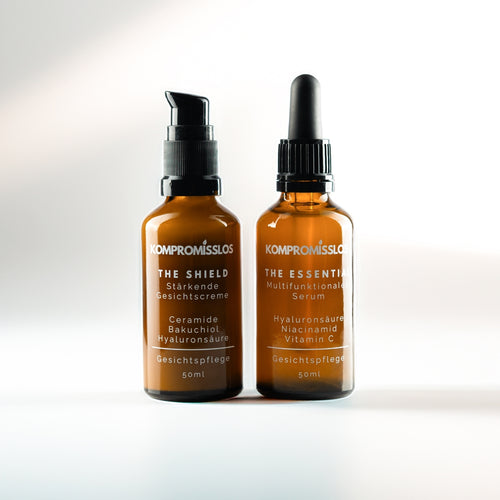
If you want to simplify your skincare while you are at it, The Duo of serum and cream is one option: fragrance-free, without essential oils, with hyaluronic acid in the serum and ceramide NP and squalane in the cream. It is no substitute for getting your skin checked, and it is not a product designed specifically for the mouth area. A well-tolerated cream you already have will do just as well.
Why does the skin around the mouth get so dry in winter?
The skin around the mouth gets particularly dry in winter because cold outdoor air and dry central heating weaken the skin barrier, while the mouth area is exposed to more friction and saliva at the same time. A review in the Journal of the European Academy of Dermatology and Venereology concludes that low humidity and low temperatures lead to a general decrease in barrier function and greater susceptibility to mechanical stress. The skin then also reacts more strongly to irritants and allergens. Around the mouth, this combines with factors found nowhere else: scarves and collars rub, your breath condenses and dries, and cracked lips tempt you to lick them more often. The review on lip-licking dermatitis explicitly names dry, cracked lips as a common problem in the cold winter months. For your skincare, this does not mean more products, but consistency. The same gentle cream morning and evening, a lip balm without flavourings for when you are out and about, and a scarf that does not rub directly against the area around your mouth usually do more than switching to a special winter cream.
In winter, also keep an eye on the air indoors: if your bedroom is heavily heated, the skin around your mouth dries out more overnight. Airing the room and not overheating it are the cheapest fix on this list.
I deliberately cut Kompromisslos down to two products instead of eight and made both of them fragrance-free. Irritated skin around the mouth shows exactly why: every additional product and every fragrance is another potential irritant. With two products, it stays easy to keep track of what actually goes on your skin. But there is an honest limit, too: if you have small bumps, pustules or burning, a new cream is the wrong answer, ours included. That is a job for a dermatologist. How the two products are used day to day is deliberately kept simple, and for simple dryness you do not need anything more than that.
Frequently asked questions
Can toothpaste irritate the skin around the mouth?
Yes, that is possible. A review in the journal Dermatitis describes how contact allergies to toothpaste usually show up as inflammation of the lips, with or without eczema around the mouth. In the past, cinnamon compounds were often the trigger; today a wide range of allergens is reported. If you have recently switched toothpaste, that is a good first suspect.
Can a vitamin deficiency cause dry skin around the mouth?
Rarely. A lack of iron or B vitamins typically shows up as cracked corners of the mouth, not as dry skin all the way around it. If you suspect a deficiency, have it checked by your GP rather than taking supplements on a hunch. For dry skin around the mouth, external irritants such as lip licking, toothpaste or cold weather are the more likely explanation.
Does Vaseline help around the mouth?
For simple dryness, Vaseline can help on the lips and along the lip line, because it slows down evaporation and contains practically no irritants. It does not add moisture itself; it holds it in. If you have small bumps, pustules or burning around your mouth, do not apply thick layers on a hunch; get it checked first.
Does licking your lips dry out the skin around your mouth?
Yes. Saliva evaporates quickly and takes moisture from the skin with it, leaving the skin drier than before. The medical literature describes licking as a compensating reaction that keeps lips dry and can lead to lip-licking dermatitis. Keeping an unscented lip balm within reach makes it easier to break the habit.
How long does it take for the skin around the mouth to calm down?
With simple dryness, you will often notice a difference within a few days once the irritants are gone and you look after your skin consistently. Give it two to three weeks of pared-back, gentle skincare. If it does not improve in that time, or if small bumps, pustules or burning appear, have your skin checked by a dermatologist.
Can lip balm irritate the skin around the mouth?
Yes. A review in the European Journal of Dermatology names cosmetics and personal hygiene products as the most common cause of allergic reactions on the lips. Lip balm with fragrance, flavourings or essential oils is therefore not a good choice for irritated skin around the mouth. Go for a plain version without fragrance and apply it to your lips only.
Can I use The Duo on dry skin around my mouth?
For simple dryness, yes, in the same way you use The Duo on your face according to the instructions: serum, then cream, morning and evening. It is not a specialist product for the mouth area. If you are switching to The Duo, use it to replace your current skincare rather than layering it on top. If you have small bumps, pustules or burning, get your skin checked by a dermatologist first instead of introducing a new product.
Sources
- Searle T, Ali FR, Al-Niaimi F. Perioral dermatitis: Diagnosis, proposed etiologies, and management. Journal of Cosmetic Dermatology, 2021. Source
- Fonseca A, Jacob SE, Sindle A. Art of prevention: Practical interventions in lip-licking dermatitis. International Journal of Women’s Dermatology, 2020. Source
- Engebretsen KA, Johansen JD, Kezic S, Linneberg A, Thyssen JP. The effect of environmental humidity and temperature on skin barrier function and dermatitis. Journal of the European Academy of Dermatology and Venereology, 2016. Source
- de Groot A. Contact Allergy to (Ingredients of) Toothpastes. Dermatitis, 2017. Source
- Collet E, Jeudy G, Dalac S. Cheilitis, perioral dermatitis and contact allergy. European Journal of Dermatology, 2013. Source