Fragrance-free moisturiser: what fragrance-free really guarantees and when it matters for you
BUYING GUIDE SWITZERLAND
You cannot tell a fragrance-free moisturiser by the word ‘fragrance-free’ on the front of the pack, only by its ingredient list: it should contain no Parfum or Aroma, no essential oils and no declared fragrance allergens such as Linalool or Limonene. ‘Fragrance-free’ usually just means that no scent has been added to make the product smell. It does not reliably rule out plant ingredients that carry a scent of their own. This matters most if you have sensitive skin or a known fragrance allergy.
What does ‘fragrance-free’ really guarantee on a face moisturiser?
On a face moisturiser, ‘fragrance-free’ guarantees only one thing: the manufacturer says it has not added any scent to make the product smell. There is no legal definition of the term with a fixed testing procedure, so it works like any other free-from claim on the packaging. If you know what ‘without additives’ really means, you already know the logic: what counts is the declaration, not the marketing copy. An analysis in JAMA Dermatology shows how wide the gap between label and contents can be. The researchers looked at 174 best-selling moisturisers and lotions for the whole body from major US online retailers. Of the products labelled ‘fragrance free’, 18 – that is 45 per cent – contained at least one substance that can cross-react with fragrances, or a botanical ingredient in this category.
That does not mean these products were mislabelled. It means that ‘fragrance-free’ tells you nothing about whether the formula contains plant ingredients with a scent of their own. For you, that means: the word on the front is a hint; the INCI list on the back is the answer.
Fragrance-free, perfume-free, unscented: what is the difference?
Fragrance-free and perfume-free mean the same thing, namely that no scent has been added, whereas ‘unscented’ can, depending on the manufacturer, simply mean that a product smells neutral. The difference in wording is small, but in practice it is considerable. ‘Fragrance-free’ and ‘perfume-free’ describe the formula, regardless of how the product ends up smelling. ‘Unscented’ is often used in the same way, but especially on imported products it can also refer to the result: the product is meant to smell neutral. To achieve that, a manufacturer can cover the natural odour of the raw materials with small amounts of masking substances. So an unscented product may contain fragrance, while a fragrance-free one is allowed to smell distinctly of its raw materials. On top of that come phrases such as ‘sensitive’, ‘for sensitive skin’ or ‘with natural fragrance’, which say nothing binding about scent. The overview below helps you make sense of the terms before you turn the pack over.
| Claim on the pack | What it usually means | What it can still contain | How to check |
|---|---|---|---|
| Fragrance-free, perfume-free | No scent added | Plant extracts with a natural odour | No Parfum, no Aroma, no essential oils in the INCI list |
| Unscented | Smells neutral | Masking substances to cover the natural odour | Parfum, Aroma or individual fragrance substances at the end of the list |
| Sensitive, for sensitive skin | Marketing claim without a fixed standard | Anything, including Parfum | Read the full INCI list |
| With natural fragrance | Scent from plants rather than synthetic | Essential oils and declared fragrance allergens | Plant names with ‘Oil’, Linalool, Limonene and the like |
What are masking fragrances, and why does a fragrance-free cream still smell?
Masking fragrances are meant to cover the natural odour of a formula without making the product smell of perfume afterwards. Many raw materials have a smell: plant oils are slightly nutty or grassy, extracts earthy or bitter, some emulsifiers a little waxy. That is why a cream without any added scent rarely smells of nothing. A manufacturer can either leave this odour as it is or neutralise it with a small amount of fragrance. In the second case, Parfum, Fragrance or Aroma usually appears in the INCI list, sometimes also a single substance whose purpose you would not recognise without looking it up. Conversely, a natural odour is no sign of added fragrance. A fragrance-free cream is allowed to smell of its raw materials, and not everyone likes that smell. That is the honest price of a product in which nothing is covered up.
One customer describes quite precisely what this feels like day to day. In her review on Judge.me, Daniela B. writes: ‘As for the scent, I first had to get used to the lack of freshness. Even so, I see the deliberate decision to leave out fragrance as a big advantage […]’ (review translated from German). In a cream, a fresh note usually only comes from added fragrance.
Linalool, limonene and essential oils: which fragrance allergens appear on the INCI list?
Fragrance allergens such as Linalool, Limonene, Citronellol or Geraniol are listed by name on the INCI list as soon as their concentration exceeds a set threshold. For products that stay on the skin, this threshold is 0.001%, and for rinse-off products it is 0.01%, as a study in the International Journal of Hygiene and Environmental Health on the so-called 26 allergens rule describes. In Switzerland, since cosmetics law was largely aligned with EU law in May 2017, the legislation refers directly to the relevant annex of the EU Cosmetics Regulation for these substances. According to the Cantonal Laboratory of Basel-Stadt, the list of fragrance allergens that must be declared has recently been expanded considerably, although the transition period is still running. Limonene and linalool deserve a second look: on contact with air, they oxidise into hydroperoxides, which are considered potent contact allergens. An analysis in Contact Dermatitis of 6,719 patients tested between 2014 and 2025 in a Danish hospital department of allergy and dermatology found positive test reactions in 1.6 per cent to oxidised limonene and in 3.1 per cent to oxidised linalool.
Essential oils contain such substances naturally – lavender, for example, contains linalool, and citrus oils contain limonene. Why natural skincare in particular can irritate sensitive skin for this reason is explained in the article on essential oils in skincare. For your buying decision, four checks are enough:
- Parfum, Fragrance or Aroma: an umbrella term for added scent, which can stand for a blend of many individual substances.
- Individual fragrance allergens: Linalool, Limonene, Citronellol, Geraniol, Citral, Eugenol, Coumarin or Hexyl Cinnamal, usually at the end of the list.
- Essential oils: fatty oils usually have ‘Seed Oil’ or ‘Kernel Oil’ in their name; with ‘Peel Oil’, ‘Leaf Oil’, ‘Flower Oil’ or a plant name followed by just ‘Oil’, it is worth looking it up.
- Position: a place near the end of the list only means a small amount, not that it is unimportant. In products that stay on the skin, as little as 0.001% is enough to trigger the obligation to declare.
If you want to read the whole list with confidence, the guide on how to read an ingredient list step by step will help.
Which face moisturiser is suitable if you have a fragrance allergy?
If you have a confirmed fragrance allergy, a suitable face moisturiser is one whose INCI list contains no Parfum or Aroma, no essential oils and none of the substances you have tested positive for. That sounds obvious, but it is the decisive step: a fragrance allergy is directed against individual substances, not against ‘fragrance’ in general. Only a patch test carried out by a dermatologist can show which ones apply to you. Such an allergy is not common in the general population. A study in the British Journal of Dermatology tested a random sample of 3,119 adults in five European countries. The conservatively estimated prevalence of clinically relevant fragrance allergy was 1.9 per cent. Women had a contact allergy to fragrances about twice as often as men. If you are affected, you should still read the list for every product. Even a fragrance-free cream does not guarantee that your skin will tolerate it, because plant extracts, preservatives or emulsifiers can also trigger reactions.
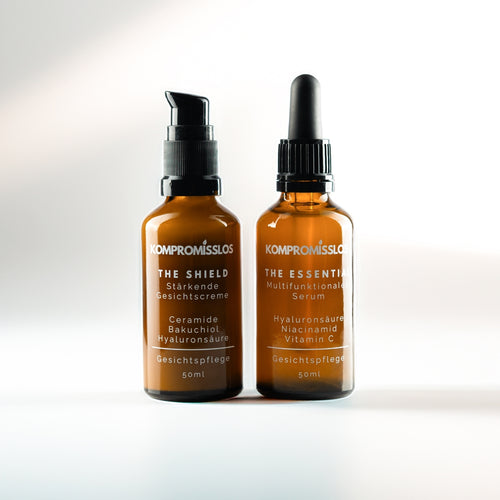
One example of a formula you can check in this way: The Duo of serum and face cream is fragrance-free, and its INCI list contains no Parfum, no essential oils and no Limonene or Linalool. It does, however, contain plant extracts such as edelweiss and gentian root, so if you have a known allergy, check the full list against the substances you react to. Everything that applies to caring for sensitive skin applies here too: few products, few changes and enough time to observe.
If you notice redness, itching or small blisters after starting a new cream, and they last for several days or spread, stop using the product and have it checked. Take the packaging with you to the appointment, because the INCI list on the back is more useful for the assessment than any brand name.
Does ‘fragrance-free’ matter for serum, cleanser and sunscreen too?
Yes, the criterion applies to every product in your routine, but not with the same weight. Serum, face cream and sunscreen stay on the skin for hours, which is why the threshold for declaring fragrance allergens is ten times lower for them than for rinse-off products. A cleanser is only in contact with your skin briefly, so fragrance in it is less of a concern for resilient skin than fragrance in a serum. If you have a known allergy, it still matters, because even brief contact can trigger a reaction. Sunscreen is the step that is most often overlooked: it stays on the skin, is applied to large areas and is often fragranced. Fragrance-free versions exist, and you check them the same way, via the INCI list. A certification label does not do this check for you, because natural skincare certifications mainly assess the origin and processing of the raw materials and allow natural fragrances such as essential oils.
For your morning routine, this means: if you are looking for a vegan day cream for sensitive skin, ‘no fragrance, no essential oils’ belongs on the same list as the active ingredients. Kompromisslos offers a fragrance-free serum and a fragrance-free face cream. We do not sell a cleanser or sun protection, so you choose those separately, using the same criteria.
I deliberately made The Essential and The Shield without fragrance. Scent does nothing for your skin; it is an extra for your nose. At the same time, it is a potential source of irritation, and that matters especially for sensitive skin. The price of this decision is an honest one: the products smell of their raw materials, and not everyone likes that. I could cover it up with a small amount of fragrance, but I choose not to. What I cannot promise you is that your skin will not react to anything, because plant extracts such as edelweiss or gentian do not suit every skin either. That is why the full INCI list of The Duo is openly available on our website for you to check. You do not have to take my word for it – you can read it for yourself.
Frequently asked questions
Is fragrance in skincare harmful?
No, not in principle. For most people, fragrances in the permitted amounts are unproblematic. They are, however, among the well-known triggers of contact allergies caused by cosmetics, and once an allergy has developed, it usually stays. If your skin is resilient, you do not need to avoid fragrance. If you are prone to redness, you lose nothing by going without, because fragrance does not make a cream any more caring.
Do I have to avoid fragrance if I have sensitive skin?
You do not have to, but it is the easiest thing to give up with no downside. Fragrance contributes nothing to skincare but can be an additional source of irritation. If your skin quickly stings or turns red, a fragrance-free face moisturiser is a sensible first step, because it removes one possible cause without you having to give up moisture or protection for your skin barrier.
How can I test whether I react to a fragrance?
A fragrance allergy can only be confirmed reliably with a patch test carried out by a dermatologist. For a new product, you can do a use test at home: apply a small amount to the same spot twice a day for several days, for example in the crook of your elbow, and watch what happens. It shows whether you tolerate this product, but not which substance would be responsible.
Is a fragrance-free cream also alcohol-free?
Not automatically, because fragrance-free and alcohol-free are two separate claims. A fragrance-free cream can still contain Alcohol Denat., and there are also fatty alcohols such as Cetearyl Alcohol, which care for the skin rather than drying it out. Which alcohols do what is explained in the article on alcohol in skincare. The Duo contains no ethanol or Alcohol Denat., but it does contain the fatty alcohol Cetearyl Alcohol.
Can a fragrance-free cream smell of plants?
Yes. Fragrance-free means that no scent has been added, not that the product is odourless. Plant oils, extracts and emulsifiers have a natural odour that can be herbal, nutty or grassy. You should be suspicious if a ‘fragrance-free’ cream smells distinctly of lavender, citrus or rose. In that case, it is worth checking the INCI list for an essential oil or a fragrance allergen.
Is ‘hypoallergenic’ the same as fragrance-free?
No. ‘Hypoallergenic’ is not a quality seal and says nothing about whether a product contains fragrance. In the JAMA Dermatology analysis mentioned above, 15 of the products marketed as hypoallergenic – 83 per cent – contained at least one substance from a standard allergen test series. What tests lie behind such claims is explained in the article on what ‘dermatologically tested’ really means.
Is The Duo really fragrance-free?
Yes. The INCI list of The Duo contains no Parfum or Aroma, no essential oils and no fragrance allergens such as Limonene, Linalool or Citronellol. What you smell is the natural odour of the raw materials. It does contain plant extracts such as edelweiss and gentian root, so if you have a known allergy, check the list. You can find out more about the serum and cream on the page for The Duo, the fragrance-free two-step routine.
Sources
- Xu S, Kwa M, Lohman ME, Evers-Meltzer R, Silverberg JI. Consumer Preferences, Product Characteristics, and Potentially Allergenic Ingredients in Best-selling Moisturizers. JAMA Dermatology, 2017. Source
- Klaschka U. Contact allergens for armpits – allergenic fragrances specified on deodorants. International Journal of Hygiene and Environmental Health, 2012. Source
- Hangartner S. Parfums, Eaux de Toilette und Kölnisch Wasser: allergene Duftstoffe, verbotene und problematische Substanzen. Kantonales Laboratorium Basel-Stadt, 2026. Source
- Botvid S, Søgaard R, Schwensen JFB, Johansen JD. Ten Years of Patch Testing to Hydroperoxides of Limonene and Linalool: Prevalence, Patterns and Clinical Insights. Contact Dermatitis, 2026. Source
- Diepgen TL, Ofenloch R, Bruze M, Cazzaniga S, Coenraads PJ, Elsner P et al. Prevalence of fragrance contact allergy in the general population of five European countries: a cross-sectional study. British Journal of Dermatology, 2015. Source