How to read a skincare ingredient list: what’s really in your cream
SWISS BUYING GUIDE
You read a skincare ingredient list, also known as the INCI list, from top to bottom: the ingredients are sorted by weight in descending order, but only down to the 1 per cent threshold. Whatever comes first forms the base of your cream, usually water, oils and humectants. Below 1 per cent, the order can be arbitrary, and that is often where you find extracts, preservatives and fragrances. What no INCI list reveals is percentages. You only get those if a brand chooses to disclose them.
How do you read a skincare ingredient list properly?
You read an ingredient list properly when you divide it into zones: the first entries as the base, the middle section down to the 1 per cent threshold, and the rest below it, where the order no longer tells you anything about quantities. INCI is the standardised naming system for cosmetic ingredients. A fact sheet from the Cantonal Laboratory of Bern sums up the Swiss requirement like this: under the heading ‘Ingredients’, the list of components must follow a nomenclature such as INCI and appear in descending order of quantity. The legal basis is the Swiss Ordinance on Cosmetic Products, whose reading rules match those of the EU Cosmetics Regulation. For you, this means that every cream sold legally in Switzerland needs a list like this, and you can always read it the same way. If you want to see the full INCI list before you buy, transparent brands show it on the product page or on a dedicated ingredients page. These five steps are enough for a first assessment:
- Read the base: the first few entries usually make up most of the product. This is where you see whether it is built on water, plant juice, oil or alcohol.
- Find the 1 per cent threshold: an ingredient with a legal maximum of 1 per cent shows you the point after which everything else makes up 1 per cent at most.
- Look for the advertised active ingredient: if it is not on the list at all, it is not in the product. If it comes after the 1 per cent threshold, it makes up 1 per cent at most.
- Check for irritation potential: Parfum, Alcohol denat. and essential oils are the entries most likely to cause trouble for sensitive skin.
- Check your personal exclusions: ingredients you do not tolerate or deliberately avoid, such as animal-derived raw materials. What that looks like in practice is explained in the article on how to tell a vegan face cream really contains nothing animal-derived.
What does the order of ingredients tell you?
The order tells you which ingredients dominate in terms of quantity, but only above the 1 per cent threshold. Article 19 of the EU Cosmetics Regulation stipulates that the list is drawn up in descending order of the weight of the ingredients at the time they are added. The phrase ‘at the time they are added’ means that what counts is the raw material as it goes into the formula, not what is left in the finished cream after chemical reactions. That is why a neutralising agent such as Potassium Hydroxide appears on the list, even though it reacts with an acid during manufacture.
In practice, the first entries determine the texture and character. If an oil is in second or third place, the product tends to be rich. If Alcohol denat. is near the top, it feels light and cooling and can strip even more oil from dry skin. What the order does not show is the gaps between ingredients: there may be a huge difference between first and second place, or almost none. That is why you should never judge a single ingredient without looking at its position and the rest of the formula. You can see this clearly with lists of comedogenic ingredients: an oil flagged as problematic there often behaves differently in a finished cream than it did when tested neat.
What is the 1 per cent rule and how does it help you?
The 1 per cent rule states that ingredients at concentrations below 1 per cent may be listed in any order after those above 1 per cent. That is what Article 19 of the EU Cosmetics Regulation says, and according to the Bern fact sheet the same applies under Article 8 of the Swiss Ordinance on Cosmetic Products. For you, the rule is both a help and a trap. A help, because it lets you draw a line: everything listed after an ingredient that may make up no more than 1 per cent is itself present at 1 per cent at most. A useful marker is the preservative Phenoxyethanol, which Annex V of the EU Cosmetics Regulation limits to a maximum of 1.0 per cent. The Federal Food Safety and Veterinary Office (FSVO) states that Swiss law refers to this regulation and that only substances listed in Annex V may be used as preservatives.
A trap, because below the threshold the order no longer means anything. An extract that is prominently advertised on the packaging may appear right after the threshold in a tiny amount, while a preservative present in a slightly larger amount sits at the very end. That is perfectly legal and tells you only one thing: less than 1 per cent. Not every list contains a clear marker, in which case the rule only helps you indirectly. And if the fuss about individual preservatives is on your mind, a level-headed look at parabens in cosmetics is worthwhile before you rule out a product because of a single name.
Why is aqua usually listed first?
Aqua is usually listed first because most creams and serums are water-based emulsions or gels, and water makes up the largest share of their weight. Aqua is simply the INCI name for water. It dissolves water-soluble active ingredients such as niacinamide, gives a light texture and makes the product easy to spread. Water at the top of the list is therefore not a sign of a watered-down product, but of how it is made. Skincare with no water at all would be a balm or an oil, with a completely different feel on the skin. Water has one consequence that you can also see on the list: where there is water, there has to be a preservative, otherwise the product can spoil once it is opened. If a plant juice such as Aloe Barbadensis Leaf Juice comes first instead of Aqua, that is also a watery base, just with the plant’s own accompanying compounds. Whether that makes a difference to your skin depends on the formula as a whole, not on first place alone.
How do you spot fragrance, alcohol and preservatives?
You can spot fragrance by ‘Parfum’ or ‘Aroma’, drying alcohol by ‘Alcohol denat.’ or ‘Alcohol’, and preservatives by names such as Phenoxyethanol, Sodium Benzoate or the ending ‘-paraben’. The umbrella term Parfum can conceal a blend of many individual substances, and the EU Cosmetics Regulation prescribes precisely this collective term. What that means for sensitive skin is covered in the articles on Swiss skincare without additives and on fragrance-free moisturiser. Certain allergenic fragrance substances also have to be named individually, and this requirement applies equally to all brands, with or without a certification, as the article on natural skincare without certification shows.
Marketing claims are no substitute for the list. A study in JAMA Dermatology examined the best-selling body moisturisers at three major US online retailers: of the products marketed as ‘fragrance free’, 45 per cent contained at least one ingredient that can cross-react with fragrances, or a botanical ingredient. With alcohol, a second look is worth it for the opposite reason: Cetearyl Alcohol and Cetyl Alcohol are fatty alcohols that condition the skin and stabilise a cream. The article on which alcohols in skincare dry your skin and which care for it explains the differences in detail.
| Ingredient group | How it appears in the INCI list | What it tells you |
|---|---|---|
| Fragrance | Parfum, Aroma, plus individual names such as Linalool, Limonene, Citronellol | The product is fragranced; the individual names are declared fragrance allergens |
| Essential oils | Latin plant name plus ‘Oil’, such as Lavandula Angustifolia Oil | Scent from the plant, even if ‘Parfum’ is not listed |
| Drying alcohol | Alcohol denat., Alcohol | Near the top, rather unfavourable for dry or sensitive skin |
| Fatty alcohols | Cetearyl Alcohol, Cetyl Alcohol | Conditioning texture agents, no cause for concern |
| Preservatives | Phenoxyethanol, Sodium Benzoate, Potassium Sorbate, Methylparaben | Needed in water-based skincare; maximum amounts are limited by law |
| Colourants | CI plus a five-digit number, such as CI 77891 | Gives the product its colour; may appear at the end in any order |
Which of these ingredients rightly appear on warning lists and which mainly cause panic is the subject of the article on harmful ingredients in skincare.
Can you tell the concentration of an active ingredient from the INCI list?
No, you cannot read the concentration of an active ingredient from the INCI list; at most, you can narrow it down. Legally, the list is a ranking, not a statement of quantities. If an active ingredient comes after a marker such as Phenoxyethanol, you know for certain that it makes up 1 per cent at most. If it comes before it, you only know that it may be more, but not whether that means 1.5 or 10 per cent. The only reliable figure is therefore a disclosed percentage, and disclosing it is voluntary. A brand that advertises an active ingredient without giving a figure is not automatically untrustworthy, but you are then buying on trust rather than on information.
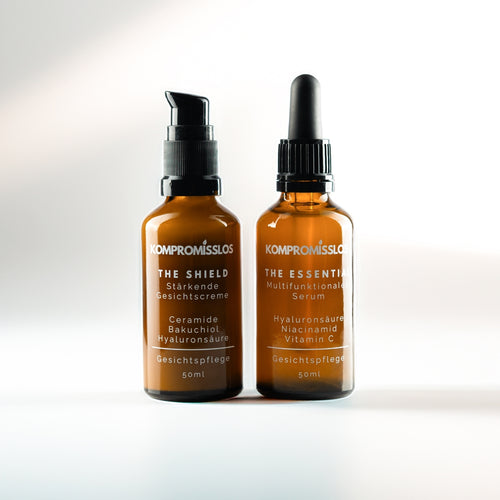
Even so, a figure on its own is not a verdict on quality, because a higher percentage does not automatically mean better. The articles on high-strength niacinamide and on which vitamin C percentage actually makes sense explain why. With The Duo, the figures are out in the open: 5% niacinamide, 2% vitamin C as 3-O-Ethyl Ascorbic Acid and 1% zinc PCA, relating to the Duo as a whole. In a review on Judge.me, J.D. writes: ‘[…] above all, I’m delighted with the serum – and also with the whole concept and the great transparency about ingredients etc.’ (review translated from German).
I disclose the concentrations of the key active ingredients because the INCI list alone does not reveal any percentages. Without a figure, you would have to take my word for it that niacinamide is not just on the list as window dressing. With a figure, you can check it and compare it with other products. When you read our list, you will notice something else: in first place is Aloe Barbadensis Leaf Juice, in other words aloe vera juice, ahead even of water. It is the base of both products. That first place alone does not make a cream any better, though; aloe juice is a watery base too, just a different one. What an open list cannot do is guarantee that your skin will tolerate every ingredient. All it does is make a product verifiable. So that you do not have to look up every name yourself, we explain all our ingredients from A to Z.
Frequently asked questions
What does INCI stand for?
INCI stands for International Nomenclature of Cosmetic Ingredients, an internationally standardised naming system for cosmetic ingredients. That is why glycerin has the same name in Zurich, Lausanne and Milan, and you can compare lists across languages and borders. The names are mostly English or Latin, and chemical substances go by their technical names.
Are there INCI lists in German?
As a rule, no, because the list of ingredients follows a standardised nomenclature, which in practice means INCI with English and Latin names. Other mandatory information, such as warnings, must appear in at least one of Switzerland’s official languages. Some brands offer a translation of the INCI names on a dedicated ingredients page.
Are long INCI lists bad?
No, the length of an INCI list says little about quality or how well a product is tolerated. A long list can consist of mild emulsifiers, plant extracts and humectants, while a short one can contain Parfum and plenty of alcohol. What tells you more is what comes first and whether there are ingredients you personally want to avoid.
What do CI numbers in the INCI list mean?
CI numbers denote colourants; CI stands for Colour Index. The EU Cosmetics Regulation allows colourants to be listed in any order after the other ingredients, which is why they usually appear at the end of the list. CI 77891, for example, is titanium dioxide, a white pigment that is also found in mineral sunscreens.
Why are plants listed in Latin?
Because INCI names plant ingredients by their botanical name plus the part of the plant used, such as Simmondsia Chinensis Seed Oil for jojoba oil. That makes it clear which plant and which part are meant, regardless of regional names. An unfamiliar Latin entry is therefore often just an oil or extract you have known for ages.
Do apps help you read INCI lists?
Apps save you looking up individual names, but their ratings are based on their own criteria and usually do not know how much of an ingredient a product contains. How reliable skincare ingredient apps are is covered in a separate article.
Where can I find the INCI list for The Duo?
You can find the full INCI list before you buy on our ingredients page, where every component is explained, and on the packaging. On top of that, the concentrations of the key active ingredients in The Duo are stated openly. You will look in vain for Parfum and Alcohol denat. on the list, but you will find the conditioning fatty alcohol Cetearyl Alcohol.
Sources
- Verordnung (EG) Nr. 1223/2009 des Europäischen Parlaments und des Rates über kosmetische Mittel, Artikel 19 (Kennzeichnung). Amtsblatt der Europäischen Union, 2009. Source
- Verordnung (EG) Nr. 1223/2009 über kosmetische Mittel, Anhang V: Liste der in kosmetischen Mitteln zugelassenen Konservierungsstoffe. Amtsblatt der Europäischen Union, 2009. Source
- Kantonales Laboratorium Bern. Kennzeichnung von Kosmetika. Merkblatt KL 3.1.25, Version 2, 2021. Source
- Bundesamt für Lebensmittelsicherheit und Veterinärwesen (BLV). Geregelte Stoffe in kosmetischen Mitteln. Source
- Xu S, Kwa M, Lohman ME, Evers-Meltzer R, Silverberg JI. Consumer Preferences, Product Characteristics, and Potentially Allergenic Ingredients in Best-selling Moisturizers. JAMA Dermatology, 2017. Source