Vitamin C percentage: which concentration actually makes sense
ACTIVE INGREDIENT: VITAMIN C
What vitamin C percentage makes sense depends mainly on the form. For pure L-ascorbic acid, a range of 8 to 20 per cent is considered effective; above 20 per cent, the benefit does not increase any further. That scale does not apply to stable derivatives such as 3-O-ethyl ascorbic acid, where single-digit figures are normal. The number on its own says little about the result.
What percentage of vitamin C makes sense in skincare?
For pure L-ascorbic acid, the sensible range is 8 to 20 per cent. Below around 8 per cent, dermatological reviews describe no reliable effect on the skin; above 20 per cent, the benefit no longer increases while the likelihood of irritation goes up. That is why most serious vitamin C serums sit between 10 and 20 per cent. This range, however, applies only to the pure, unstable form and cannot be transferred to derivatives. It also only describes how much of the active ingredient is in the bottle, not how much of it reaches your skin. If you first want to know what the ingredient does at all, the overview of what vitamin C does for your skin is a better starting point than chasing the highest number on the label. A percentage is a clue, not a verdict on quality.
It also matters what the number refers to. Some brands state the proportion of the raw material, others the proportion of the pure active ingredient within a raw-material solution. The two figures can differ by a factor of two to five without anything in the formula changing. As long as a brand does not say which form and which reference it means, the percentage is barely comparable.
Why a higher percentage doesn’t automatically mean a stronger effect
Beyond a certain point, a higher percentage of vitamin C does not produce a stronger effect, because the skin’s capacity to absorb it is limited. In an absorption study on pig skin, maximum uptake of L-ascorbic acid was reached at a concentration of 20 per cent; higher concentrations did not produce higher levels in the tissue. After three daily applications, tissue levels were saturated, and the half-life in the tissue was around four days. So your skin does not behave like a sponge that keeps soaking up more, but like a container with a lid. Anything beyond that stays on the surface or oxidises before it can do anything. At the same time, the likelihood of irritation rises with the concentration, because pure L-ascorbic acid needs a pH below 3.5 to get into the skin at all. You will recognise this pattern from other ingredients, for instance when high-strength niacinamide tips over beyond a certain percentage.
Why the form of vitamin C changes what the percentage means
The form determines which percentages can be compared at all, because the various vitamin C molecules differ in stability and in how they get into the skin. Pure L-ascorbic acid is the most thoroughly researched version, but it oxidises quickly on contact with air and needs an acidic environment with a pH below 3.5. 3-O-ethyl ascorbic acid carries an ethyl group at one position of the molecule that slows down precisely this oxidation. A pharmaceutical characterisation study determined its pKa as 7.72, which means it remains uncharged in the pH range close to that of skin and does not need a strongly acidic environment. There is no validated conversion factor between the two forms, in either direction. Two per cent of a derivative can therefore be read neither as an equivalent nor as a fraction of a given percentage of L-ascorbic acid. So only compare percentages within the same form; otherwise you are comparing two different scales. How the stable form behaves in detail is explained in our article on 3-O-ethyl ascorbic acid as a form of vitamin C.
What different vitamin C concentrations stand for
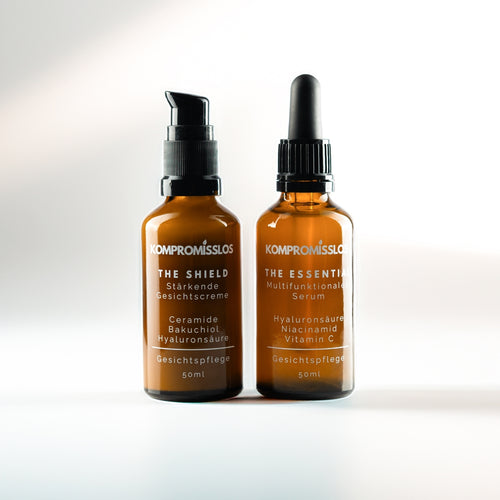
Percentages can only be put into context together with the form, the pH and the packaging. The overview below sums up what the common figures mean and what you should bear in mind with each of them. It is no substitute for advice on your particular skin, but it helps you place a label in a few seconds and tell a marketing number from a formulation fact. What stands out most is how often high numbers are sold as a mark of quality, even though beyond a certain point they only increase the likelihood of irritation. Conversely, a low number for a derivative says little, because a different scale applies. If you want to know which concentrations we chose ourselves and why, you will find them set out openly for the serum and cream in the Duo and in the overview of our ingredients and their percentages.
| Figure | Form | What it means | What to bear in mind |
|---|---|---|---|
| below 8% | pure L-ascorbic acid | Below the effective range described in reviews. | Check whether other antioxidants support the formula. |
| 10 to 20% | pure L-ascorbic acid | The usual range for seriously formulated serums. | Needs a pH below 3.5 and is more likely to irritate. |
| above 20% | pure L-ascorbic acid | No additional benefit over 20% has been shown. | Higher likelihood of irritation with no proven added value. |
| 2% | 3-O-ethyl ascorbic acid | The concentration used in the Duo. | Not comparable with figures for L-ascorbic acid. |
How to tell how much vitamin C is really in a product
You can tell whether a percentage is reliable from four points on the packaging and the INCI list. First, the form must be named: Ascorbic Acid, 3-O-Ethyl Ascorbic Acid, Sodium Ascorbyl Phosphate and Ascorbyl Glucoside are four different raw materials. Second, it should be clear whether the figure refers to the raw material or to the pure active ingredient. Third, the position in the INCI list gives you an order of magnitude, because ingredients above one per cent are listed in descending order of quantity. Fourth, the packaging counts: pure L-ascorbic acid belongs in an opaque, low-air container, and a clear glass bottle with a dropper is a bad sign for this form. There is also an everyday test: if a serum containing pure L-ascorbic acid changes from colourless to yellow or brown within a few weeks, part of the active ingredient has already oxidised, and the number on the label no longer describes what you are applying. Our article on top-rated vitamin C serums in tests explains which criteria comparison tests actually check and which they don’t.
When skincare is no longer enough
Skincare works on the appearance of your skin, not on a diagnosis, and that is exactly where every debate about percentages reaches its limit. If your skin is constantly burning, weeping, flaking or very red, the right vitamin C concentration is the wrong question. Sharply defined dark spots that change should also be checked by a professional rather than treated with a stronger serum. A dermatologist can tell whether a reaction comes from an active ingredient, from the barrier function or from something else entirely. Cosmetic skincare can still make sense afterwards, but it comes in the right order: first a medical assessment, then a routine. No percentage, however high or low, replaces that step. If your skin generally reacts quickly without anything acute going on, our article on sensitive skin and its triggers will help you more than any percentage.
For the Duo at CHF 109.90, I deliberately chose 2 per cent 3-O-ethyl ascorbic acid rather than the highest possible figure of pure L-ascorbic acid. The reason is simple: a serum that needs a pH below 3.5 and turns brown after a few weeks is of no use to anyone with sensitive skin who wants a reliable routine morning and evening. I wanted a formula that stays stable in the pH range close to that of skin and that you can use in the same way over two to four months. If your skin is robust and you deliberately want maximum concentration, a classic high-percentage product will serve you better.
Frequently asked questions
What percentage of vitamin C is sensible for beginners?
If you are starting out with pure L-ascorbic acid, 8 to 10 per cent is a reasonable level. That is where the effective range begins, and the likelihood of irritation is lower than at 20 per cent. This scale does not apply to stable derivatives such as 3-O-ethyl ascorbic acid; with those, single-digit figures are the norm and not a sign of a weak formula.
Is 20 per cent vitamin C better than 10 per cent?
Not necessarily. Maximum absorption of L-ascorbic acid into the skin was measured at 20 per cent; above that, the benefit does not increase any further. Between 10 and 20 per cent, the difference lies mainly in how well your skin tolerates it. For sensitive skin, the lower figure is usually the wiser choice.
Why does the Duo contain only 2 per cent vitamin C?
Because the Duo uses 3-O-ethyl ascorbic acid rather than pure L-ascorbic acid. This form is more stable and works in the pH range close to that of skin, so it follows a different percentage scale. Comparing it with the 10 to 20 per cent of classic serums is not scientifically valid, because there is no validated conversion factor.
Can too much vitamin C harm your skin?
High concentrations of pure L-ascorbic acid can irritate the skin, because they need a pH below 3.5. Burning, redness or a feeling of tightness straight after application are typical. No lasting damage can be inferred from this, but the benefit does not keep rising above 20 per cent. Less is often more practical here.
How can I tell if my vitamin C serum has gone off?
By the colour. Fresh pure L-ascorbic acid is colourless to slightly yellowish and turns dark yellow or brown as it oxidises. By then, part of the active ingredient has already been converted. Stable derivatives show this colour change much less, which also makes it harder to judge by eye.
Does the percentage have to be on the packaging?
No, there is no obligation in Switzerland to declare the concentration of active ingredients. What is mandatory is the full INCI list, in descending order for ingredients above one per cent. A percentage stated voluntarily is therefore a sign of transparency, but it is only meaningful if the form and the reference are stated as well.
How long does it take for a vitamin C concentration to work?
Visible changes in your complexion usually take several weeks of regular use. Within the skin itself, things happen faster: in an absorption study, tissue levels of L-ascorbic acid were saturated after three daily applications. With vitamin C, regular use clearly matters more than the level of concentration.
Sources
- Al-Niaimi F, Chiang NYZ, Topical Vitamin C and the Skin: Mechanisms of Action and Clinical Applications, Journal of Clinical and Aesthetic Dermatology, 2017. Source
- Pinnell SR et al., Topical L-Ascorbic Acid: Percutaneous Absorption Studies, Dermatologic Surgery, 2001. Source
- Iliopoulos F et al., 3-O-ethyl-l-ascorbic acid: Characterisation and investigation of single solvent systems for delivery to the skin, International Journal of Pharmaceutics X, 2019. Source