High-strength niacinamide: when a higher percentage backfires
SINGLE INGREDIENT
High-strength niacinamide usually means 10 per cent or more – and that is precisely where the balance between benefit and irritation tips. The range that has been widely studied in clinical research is 2 to 5 per cent. Higher levels don’t produce a proportionally greater effect, but they do increase the likelihood of redness, stinging and tightness, especially in sensitive skin.
How much niacinamide makes sense in a product?
2 to 5 per cent niacinamide makes sense, and this range covers practically everything the ingredient is used for in cosmetics. Most clinical studies on the look of the skin, a tendency to redness and moisture balance work with exactly these levels. In a twelve-week split-face study with 50 women, published in Dermatologic Surgery, a formula with 5 per cent niacinamide improved the look of fine lines, dark spots, redness and a dull complexion compared with the base without the active ingredient. It was applied twice a day. For the same reason, The Duo of serum and cream is at 5 per cent and no higher. The number on the pack also says little about how much actually reaches the skin. The Cosmetic Ingredient Review safety assessment describes how the proportion absorbed falls as the concentration rises, while the absolute amount only continues to increase more slowly. Ten per cent therefore does not mean twice the effect of five.
| Concentration | What the evidence shows | When it makes sense |
|---|---|---|
| 2 per cent | Effective entry level in research | Very reactive skin, first contact with the ingredient |
| 5 per cent | Most widely studied range, no irritation in use tests | The standard for daily skincare, morning and evening |
| 10 per cent | No stinging in clinical tests, thinner efficacy data | Only for resilient skin that tolerates 5 per cent without problems |
| Several products | Not studied as a total amount | Rarely sensible, because the amounts add up unnoticed |
When does high-strength niacinamide backfire?
High-strength niacinamide backfires where your skin’s irritation threshold is reached, and for many people that threshold lies between 5 and 10 per cent. The Cosmetic Ingredient Review safety assessment states that niacinamide up to 10 per cent did not cause stinging, that use tests up to 5 per cent showed no irritation and that a 21-day test up to 5 per cent remained free of irritation. For levels above that, the data is thinner. Then there is an effect that isn’t printed on any pack: niacinamide is now in cleansers, toners, serums, creams and sunscreens all at once. Each individual amount is harmless; the sum is not. If you suddenly notice stinging, tightness or blotchy redness after applying, you usually don’t have one product that is too strong but too many products. A look at the order and amounts in your routine sorts this out faster than switching to an even stronger serum.
A second reason for sudden redness lies in the product itself. In aqueous solution, niacinamide can hydrolyse to nicotinic acid, and nicotinic acid triggers a brief flush in many people. How quickly this happens depends on pH, heat and time.
Which skin conditions benefit from niacinamide?
Niacinamide is worthwhile above all for sensitive, red or over-treated skin, because it supports the skin barrier without putting extra demands on it. It is water-soluble, odourless and needs no adjustment period, unlike strongly exfoliating active ingredients. With an unsettled complexion prone to blemishes, it can make the skin look visibly more even, and in mature skin it targets dark spots and a dull complexion. The other side belongs here just as honestly: if your skin is calm, looks well hydrated and you are happy with your skincare, you don’t need an extra niacinamide serum. The ingredient doesn’t repair anything that isn’t disrupted. And for very dry skin, niacinamide alone is not enough, because it doesn’t replace the missing lipids. There, ceramides, squalane and plant oils matter more, and niacinamide remains a useful addition rather than the main measure. We have written separately about what this means for blemish-prone skin day to day.
Can you use niacinamide and BHA together?
Yes, niacinamide and BHA can be used together, and the widespread warning against it rests on a study that hardly applies in everyday life. In 1962, Per Finholt and Takeru Higuchi determined in the Journal of Pharmaceutical Sciences how quickly niacinamide hydrolyses across the pH range from 0.4 to 11.3. Measurements were taken at 89.4 degrees Celsius – conditions that have nothing to do with your face. The authors note that the reaction is slow in the usual pharmaceutical range and is at its minimum between pH 4 and 6. A BHA product is usually slightly below that, and contact lasts minutes rather than hours. In practice, this means: apply the acid first, wait until it has absorbed, and put niacinamide on top. If your skin still reacts, in most cases it is due to the acid and not the niacinamide, because exfoliating active ingredients cause irritation far more often.
Do niacinamide and peptides work together?
Niacinamide and peptides work together without any problem, because there is no evidence-based reason to separate them. Both are water-soluble, both work in the neutral to slightly acidic range, and both pursue the same goal: skin that loses less moisture and looks more even. Unlike acids or retinoids, there is no competition over pH here and no known mutual weakening. The more common mistake is a different one: introducing too many new active ingredients at once. If you start niacinamide and peptides together and your skin reacts, you won’t know afterwards what caused it. Introduce new products one at a time and give each two to three weeks before adding the next. That way it stays clear what actually made a difference. The same logic applies to the question of whether vitamin C or niacinamide goes on first.
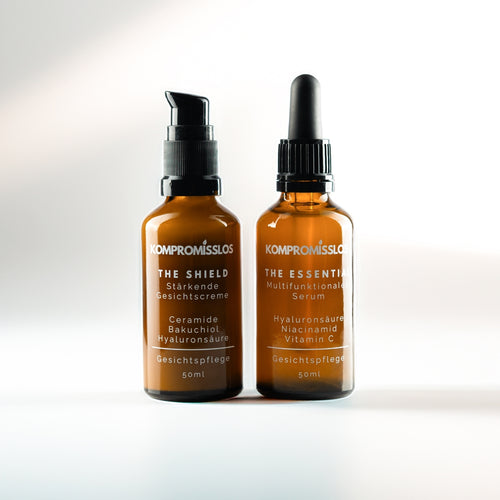
I deliberately chose 5 per cent niacinamide for The Duo, not 10. The reason is simple: 5 per cent is the range covered by the studies I can cite without exaggerating. Ten per cent would have sold better on the pack, but I couldn’t have backed it up with anything except the reflex that more sounds better. On top of that, if you use two products instead of eight, nothing adds up unnoticed. Alongside niacinamide, it contains 2 per cent gentian root extract, and all values apply to The Duo as a whole.
When a specialist is the better port of call
You should see a specialist as soon as persistent redness, flaking, itching, weeping patches or painful inflammation are involved. Cosmetics care for the appearance of healthy skin – nothing more. A dermatologist can establish whether the reaction is caused by a skin condition, a contact allergy or a medication, and no concentration on a bottle can resolve that. An appointment also makes sense if irritation doesn’t subside within two to three weeks of stopping all active ingredients. Until then, the simplest rule applies: reduce rather than add. Cleansing, a calm skincare product, sun protection, and nothing else. This break costs you two weeks and answers more questions than any additional product. You can check what a product actually contains in the full ingredients list, and how other people with sensitive skin get on with it is collected in the reviews.
Frequently asked questions
Is niacinamide suitable for mature skin?
Yes, niacinamide is suitable for mature skin. In the twelve-week study with 5 per cent, the look of fine lines, dark spots and a dull complexion improved compared with the base without the active ingredient. Mature skin also benefits from the fact that niacinamide doesn’t cause sensitivity to light and can be used morning and evening.
Is niacinamide suitable for dry or dehydrated skin?
For dehydrated skin, yes; for very dry skin, only as part of a routine. Dehydrated means a lack of water, and there niacinamide supports the barrier. Dry skin also lacks lipids, and the ingredient doesn’t replace those. Ceramides, squalane and plant oils take care of that.
Is niacinamide suitable for over-treated skin?
Yes, but only after a break. Over-treated skin becomes irritated because too many active ingredients hit it at once. First cut back to cleansing, a simple skincare product and sun protection. Once your skin has calmed down after two to three weeks, niacinamide is one of the better-tolerated active ingredients to start again with.
Is niacinamide suitable for skin prone to redness?
Yes, niacinamide is considered well tolerated by skin prone to redness and can soften the look of redness. The concentration is important: 5 per cent remained free of irritation in use tests; higher levels increase the risk. If redness persists, it needs a dermatological assessment, not cosmetic treatment.
Is niacinamide suitable for combination skin?
Yes, combination skin is a typical use case. Niacinamide is water-soluble and absorbs without an oily film, which feels more comfortable in the T-zone than rich textures. At the same time, it supports the drier areas on the cheeks. You don’t need separate products for two halves of your face. The texture of the product matters more than the concentration of the ingredient.
Is niacinamide suitable for blemish-prone skin?
Yes, with an unsettled complexion and the odd blemish, niacinamide can make your skin look more even. With inflamed or painful acne, it is no substitute for a dermatological assessment. Cosmetics care for the appearance of healthy skin; they don’t treat skin conditions. Also give the ingredient at least eight weeks before you judge it.
How much niacinamide is in The Duo?
The Duo contains 5 per cent niacinamide, and this figure applies to serum and cream together as a complete system, not to a single product. It also contains, among other things, 2 per cent hyaluronic acid, 2 per cent vitamin C as 3-O-Ethyl Ascorbic Acid, 1 per cent zinc and 0.3 per cent bakuchiol.
Sources
- Cosmetic Ingredient Review Expert Panel, Final Report of the Safety Assessment of Niacinamide and Niacin, International Journal of Toxicology 24 (Suppl. 5), 2005. Source
- Bissett DL, Oblong JE, Berge CA, Niacinamide: A B Vitamin that Improves Aging Facial Skin Appearance, Dermatologic Surgery 31, 2005. Source
- Finholt P, Higuchi T, Rate Studies on the Hydrolysis of Niacinamide, Journal of Pharmaceutical Sciences 51, 1962. Source