Niacinamide benefits: what it can do, what it can’t and how long it takes
SINGLE INGREDIENT
The benefits of niacinamide show mainly at the skin barrier: this form of vitamin B3 supports the skin’s own lipid production, softens the look of redness and dark spots and makes the complexion look more even. This typically becomes visible after eight to twelve weeks of daily use, not after a few days.
What does niacinamide do for your skin?
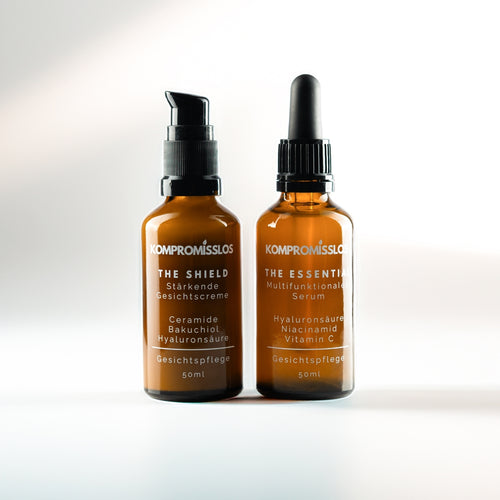
In the skin, niacinamide mainly supports three things: the production of the skin’s own barrier lipids, a more even look where there is pigmentation and redness, and moisture retention in the outer layer of the skin. The background is unspectacular. Niacinamide is the amide form of vitamin B3 and serves as a building block for the coenzymes NAD and NADP, which drive a large part of cell metabolism. A study in the British Journal of Dermatology showed in skin cells that nicotinamide increases the synthesis of ceramides several times over and, when applied topically, reduces water loss through the skin’s surface. A second study in the same journal described how niacinamide slows the transfer of melanosomes to the surface skin cells, meaning less pigment reaches the surface. How clearly this shows in everyday life depends on concentration, formulation and consistency. In our Duo of serum and cream, niacinamide is at 5%.
How quickly does niacinamide work?
Allow eight to twelve weeks for a visible change, not a few days. The most frequently cited clinical study on niacinamide, published in Dermatologic Surgery in 2005, had 50 women with signs of photoageing apply a preparation containing 5% niacinamide to one half of the face twice a day for twelve weeks, and the base formula alone to the other half. The differences in fine lines, dark spots, redness and elasticity emerged over the course of those twelve weeks, not in the first few days. You will notice something else much sooner: after one to two weeks, the skin often feels less tight, because the barrier responds faster than pigmentation. Keeping these two timescales apart saves you from switching products too early – which, in my experience, is the most common reason a good ingredient gets written off as useless.
The overview below sorts the observations people report back to us most often by the period in which they can realistically be expected.
| What niacinamide influences | How you notice it | Realistic timeframe |
|---|---|---|
| Barrier and moisture | Your skin feels less tight after cleansing. | 2 to 4 weeks |
| Look of redness | Red areas are less noticeable. | 4 to 8 weeks |
| Evenness and texture | Your complexion looks more even. | 8 to 12 weeks |
| Look of dark spots | Darker areas stand out less. | 8 to 12 weeks |
These timeframes are based on feedback and on the duration of the study cited. They are not a guaranteed course, because skin responds at different speeds.
Which skin conditions is niacinamide worth using for?
Niacinamide is worth it above all for dehydrated, red, sensitive or unsettled skin, and for skin that has been thrown off balance by too many active products. The reason is how well it is tolerated. Unlike acids or retinoids, niacinamide does not work through targeted irritation but by building up. That is why it is one of the few active ingredients you can keep using even when your skin is overwhelmed. For very dry skin, it helps but is not enough on its own: there you also need lipids such as ceramides and squalane, otherwise the barrier simply lacks the material to rebuild. And if your skin is calm, unremarkable and stable, you do not necessarily need niacinamide. It is an ingredient for a specific concern, not a must for every routine. With an unsettled complexion and blemishes, other triggers also play a part that no cream can resolve on its own, from hormones to sleep. The best way to get a feel for how it works on different skin conditions is to read other people’s experiences.
How can you tell how much niacinamide a product contains?
You can only know the amount reliably if the brand explicitly declares it, because the INCI list does not give percentages. What you can infer from it is a rough order: ingredients present in larger amounts come further up, and below a small share, the order can be chosen freely. If Niacinamide appears near the top of the list, a meaningful amount is present. If it comes after fragrance and preservatives, it is more likely decoration on the packaging. The concentration with the broadest clinical documentation is 5%, and that is exactly where our figure lies for the Duo as a whole. Whether more is always better is a separate question, and it has less to do with effect than with tolerability. A second clue helps you judge: brands that state a figure openly usually also have a reason why it sits where it does. You can check our figures at any time in the full overview of ingredients, where every concentration is given relative to the Duo as a whole.
How should you use niacinamide?
Twice a day on cleansed skin, morning and evening, with the lighter texture first and the richer one afterwards. With us, that means three to six drops of serum, left to absorb briefly, followed by three to six pumps of cream. More product per application gains you nothing; consistency gains you everything. Niacinamide is uncomplicated to combine: it works well with hyaluronic acid, ceramides, panthenol and stable forms of vitamin C. If you are unsure which of the two to start with, the direct comparison of vitamin C and niacinamide will help, and there I also put the common warning against this combination into perspective. What the order looks like in everyday practice is set out on our how-to-use page. In our formula, niacinamide is complemented by gentian root extract, among other things, which plays a similarly calming role in the look of the skin. Neither of them replaces sunscreen in the morning, and without it you are working against your own progress where pigmentation is concerned.
When niacinamide is not the right choice
Niacinamide is no substitute for seeing a doctor, and there are situations in which cosmetics are simply not the right tool. If your skin is weeping, has open areas, is flaking heavily, reacts suddenly with no obvious trigger or if symptoms get worse over weeks, that is one for a dermatologist, not the skincare shelf. The same applies to a diagnosed skin condition: a cosmetic product can provide supportive care, but the treatment is for the specialist to decide. Even without a medical background, there are cases in which this ingredient is not what you need right now. Very dry skin needs lipids first. If you are reacting acutely to a new product, you need a break, not an additional active ingredient. And if you are testing five actives at once, a sixth will not bring you clarity – it will take it away. In that case, leaving things out works better than adding, even if it feels like too little.
I chose 5% niacinamide because it is the concentration with the broadest clinical documentation, not the highest number that can be printed on a label. Going higher would have been easy and would probably have sold better. But I regularly hear from people whose sensitive skin does not react well to very high-dose products, and we make skincare for exactly that kind of skin. For the same reason, we spread the active ingredients across a serum and a cream instead of cramming everything into one product. What is inside is stated openly.
Frequently asked questions
Is niacinamide the same as vitamin B3?
Niacinamide is a form of vitamin B3 – specifically, the amide form. The other form is called nicotinic acid and is hardly used in skincare because it is more irritating. On labels, you will see niacinamide listed as Niacinamide, occasionally also as nicotinamide. They are the same substance.
Can niacinamide irritate the skin?
At normal cosmetic concentrations, niacinamide is very well tolerated. Irritation is most likely with very high-dose products or when you introduce several new active ingredients at the same time. If your skin tingles or turns red, reduce use to once a day and watch it for a week.
How often should you use niacinamide?
Twice a day, morning and evening, is the usual and well-researched frequency. That is exactly how you use our Duo, with three to six drops of serum and three to six pumps of cream. Once a day also works, but tends to take longer to show visible results.
Does niacinamide help with dry skin?
It supports the skin barrier and thereby, indirectly, the skin’s moisture balance, but for very dry skin it is no substitute for lipids. The sensible approach is to combine them: niacinamide for barrier function, plus ceramides, squalane and panthenol as the material. On its own, niacinamide is often disappointing for very dry skin.
At what age does niacinamide make sense?
There is no set age. What matters is the condition of your skin, not the year you were born. With redness, an unsettled complexion or a weakened barrier, niacinamide makes just as much sense at twenty as at sixty. If your skin is calm and stable, you do not need it at any age.
Can niacinamide fade dark spots?
Studies show that niacinamide slows the transfer of pigment to the upper layers of the skin, which can make darker areas look less noticeable. Allow eight to twelve weeks. Without daily sunscreen, however, you are working against yourself, because new pigment forms more quickly.
What happens when you stop using niacinamide?
Your skin does not lose the support overnight, but the changes you have achieved fade over weeks. Niacinamide does not change the skin permanently; it supports it for as long as you use it. That applies to practically every cosmetic ingredient.
Sources
- Tanno O, Ota Y, Kitamura N, Katsube T, Inoue S, Nicotinamide increases biosynthesis of ceramides as well as other stratum corneum lipids to improve the epidermal permeability barrier, British Journal of Dermatology, 2000. Source
- Hakozaki T, Minwalla L, Zhuang J et al., The effect of niacinamide on reducing cutaneous pigmentation and suppression of melanosome transfer, British Journal of Dermatology, 2002. Source
- Bissett DL, Oblong JE, Berge CA, Niacinamide: A B Vitamin that Improves Aging Facial Skin Appearance, Dermatologic Surgery, 2005. Source