Facial redness: what skincare can do cosmetically and where the limit lies
SKIN CONDITION
Facial redness occurs when the fine blood vessels just beneath the surface of the skin widen in response to a trigger: cold, heat, friction, harsh cleansing or too many active ingredients. From a cosmetic point of view, you can soften its appearance with a short, low-irritation routine built on barrier-supporting ingredients. If the redness becomes permanent, or pustules and itching appear, it should be checked by a dermatologist.
What facial redness means from a cosmetic point of view
Facial redness is visible blood flow: the small blood vessels just beneath the surface of the skin widen, more blood flows through them and the skin looks red. Usually this is temporary and fades within minutes, for example after exercise, a hot shower or when you come in from the cold into a heated room. It becomes relevant when the redness no longer fades completely or appears more and more quickly. This is also at the heart of the specialist definition of sensitive skin and how to care for it: unpleasant sensations in response to stimuli that would not normally cause a reaction, while the skin may look normal or reddened. That is how an expert group describes it in Acta Dermato-Venereologica. Redness is therefore an accompanying sign, not a condition in its own right. It belongs to your skin condition, not your skin type, and conditions change. That is exactly why skincare can make any difference at all: it reduces triggers and supports the barrier, but it does not replace a diagnosis.
What usually triggers it
The most common triggers for reddened facial skin are changes in temperature, mechanical friction and cleansing that is too harsh. In everyday Swiss life, that means going from minus five degrees into a heated flat, months of dry central-heating air, the warm foehn wind, hot showers in winter and cleansers that leave your skin feeling tight as you pat it dry. Then there are triggers from skincare itself: alcohol near the top of the ingredients list, fragrances and essential oils, grainy scrubs, high-strength acids or several new active ingredients within a few days. UV exposure without protection counts too, in summer as well as in the snow. What matters for putting this into context: each of these triggers on its own often has no consequences. The problem is the sum of them, because your skin no longer gets a chance to recover between them and the skin barrier weakens faster than it can recover. That is why, with reddened skin, leaving things out almost always achieves more in the first few weeks than adding another product.
What to leave out first when your skin is red
With reddened skin, leaving things out is the most effective first step, because every trigger you remove counts immediately, while a new product takes weeks. For two to three weeks, cut out everything that is mechanically or chemically aggressive: grainy scrubs, cleansing brushes, heavily foaming cleansers, toners with alcohol near the top of the list, high-strength acids and high-strength retinol. Turn the water temperature down to lukewarm when you wash, and pat your face dry instead of rubbing. After that, introduce just one new product and assess it for two weeks before adding the next. Make a note of what you have cut out; otherwise you will not be able to work out later which step was missing. This reduction sounds unremarkable, but it is exactly the point at which many people first see a visible change in their complexion. Only once the triggers are gone can you judge what skincare can contribute.
| Routine element | With redness | Why |
|---|---|---|
| Grainy scrub or cleansing brush | Pause | Friction increases visible blood flow. |
| Heavily foaming cleanser | Replace | Strong surfactants strip the skin’s lipids and leave a feeling of tightness. |
| Alcohol near the top of the ingredients list | Leave out | It evaporates quickly and dries out the uppermost layer. |
| Fragrances and essential oils | Check critically | A common source of irritation for sensitive skin. |
| High-strength retinol or strong acids | Pause | The adjustment phase often comes with redness. |
Which ingredients visibly calm reddened skin
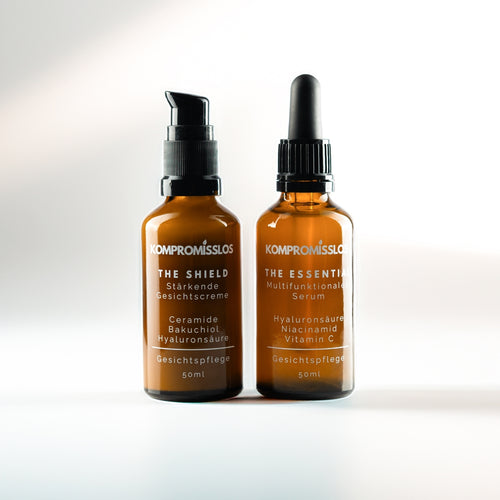
From a cosmetic point of view, reddened skin benefits above all from ingredients that support the barrier and cause little irritation themselves. Niacinamide is one of them: in a twelve-week split-face study with 50 women, a formulation with 5% niacinamide showed, among other things, a visible improvement in blotchy redness compared with the base cream alone. Ceramides and squalane replenish building blocks that a weakened barrier lacks. Panthenol and aloe vera help to calm the skin, and hyaluronic acid plumps up the uppermost layer with moisture. The Duo of Essential serum and Shield cream contains 5% niacinamide, 2% hyaluronic acid, 2% edelweiss extract and 2% gentian root extract, plus ceramides, squalane and panthenol. All percentages refer to the Duo as a whole, not to a single product. What you should not expect, on the other hand, is for a skincare product to make visible thread veins disappear for good. Skincare cannot do that, and any brand that promises it is overstating things.
The form of vitamin C matters too: pure ascorbic acid is formulated at a strongly acidic pH, which is why the Duo contains 2% 3-O-ethyl ascorbic acid instead. If retinol regularly makes your skin red, you may find fewer adjustment reactions with bakuchiol as a gentler alternative. We have broken down separately what niacinamide does for your skin, and the ingredients list for both products is openly available.
What a calm routine for facial redness looks like
A routine for facial redness consists of just a few steps that are identical morning and evening. You cleanse gently, apply the serum to skin that is still slightly damp and finish with the cream. With our products, that means 3 to 6 drops of serum and 3 to 6 pumps of cream, depending on how your skin feels and the season. During the day, in summer and in the snow, sun protection goes on top, because UV exposure is one of the triggers that reliably makes reddened skin worse. You do not need more steps, and every additional product increases the chance that one ingredient won’t suit you. In the first few weeks, deliberately avoid additional active-ingredient products, however well meant. Judge the result after 8 to 12 weeks at the earliest, because the barrier needs time. Depending on how often you use it, a bottle lasts 2 to 4 months.
- In the morning, cleanse with lukewarm water and pat your face dry rather than rubbing.
- Apply 3 to 6 drops of serum to damp skin.
- Follow with 3 to 6 pumps of cream and pat it in gently.
- In sun or snow, apply sun protection.
- In the evening, repeat exactly, with no additional active-ingredient products.
- After 8 to 12 weeks, assess: calmer or not?
Amounts and order are set out on the step-by-step how-to-use page, and feedback can be found in our collected customer reviews.
When facial redness needs a professional
Facial redness should be checked by a dermatologist as soon as it becomes permanent, gets worse or comes with other symptoms. Concrete signals are redness that has not fully faded for several weeks, pustules or small bumps, clearly visible dilated thread veins, burning or itching, flaking, swelling, and redness that appears suddenly shortly after using a new product and does not subside. In these cases, skincare can at best accompany the look of your skin; it cannot identify the cause. A dermatologist can tell whether there is a cause that needs treatment and, if necessary, start therapy. This is not a weakness of skincare but a clear boundary: skincare cares for the skin and influences its appearance, dermatology diagnoses and treats. If you know where this boundary lies, you won’t lose months using the wrong tool, and you can then build your skincare on a clarified basis.
If redness with swelling or severe itching appears shortly after using a new product, stop using it immediately and have it checked by a doctor.
For the Duo, I deliberately chose 5% niacinamide rather than 10%, even though the higher number would look more impressive on the packaging. For reddened, sensitive skin, a well-tolerated dose matters more than the maximum. For the same reason, it contains 0.3% bakuchiol instead of retinol, and we leave out fragrance. When someone writes to tell me their skin stings briefly after applying it, the first thing I ask about is their cleanser, not our product. In most cases, that is where the problem lies. And honestly: if your redness only appears after exercise and is gone after twenty minutes, you don’t need a product for it.
Frequently asked questions
What causes sudden redness on the face?
Sudden redness is usually caused by a specific trigger shortly beforehand: a change in temperature, hot water, friction, exercise, alcohol in a drink or a new skincare product. Make a note of what happened in the two hours before. If the redness disappears again within hours, it is usually harmless.
Can skincare really reduce facial redness?
Skincare can soften the appearance of redness by reducing triggers and supporting the skin barrier. But it changes neither a predisposition to dilated blood vessels nor a dermatological cause. What is realistic is a calmer, more even complexion after several weeks, not the disappearance of visible thread veins.
Which ingredients most often irritate reddened skin?
The most common irritants are fragrances, essential oils, alcohol near the top of the ingredients list, high-strength acids and high-strength retinol. Then there are mechanical irritants such as grainy scrubs and cleansing brushes. Check the first five to seven entries on an ingredients list; that is where the ingredients present in meaningful quantities are listed.
Does niacinamide help with facial redness?
Niacinamide is considered a well-tolerated ingredient for reddened skin. In a twelve-week split-face study with 50 women, a formulation with 5% niacinamide improved, among other things, the appearance of blotchy redness compared with the base cream. The Duo contains 5% niacinamide, based on both products together.
Is bakuchiol better than retinol for redness?
During the adjustment phase, bakuchiol usually causes less redness and flaking than retinol, and for sensitive skin it is often the more pragmatic choice. It is not a replacement with an identical effect, but the gentler route. The Duo contains 0.3% bakuchiol, based on both products together.
How long does it take for reddened skin to look calmer?
Allow 8 to 12 weeks before a change in routine can be reliably assessed. The first effect often shows in the first two weeks and comes from leaving out irritating steps, not from the new product. Always assess in the same light and at the same time of day.
When should I see a professional about facial redness?
See a dermatologist if the redness lasts for several weeks, gets worse or comes with pustules, small bumps, itching, burning, flaking or swelling. The same applies to sudden redness after a new product that does not subside. Skincare can care for your skin, but it cannot make a diagnosis.
Sources
- Misery L, Ständer S, Szepietowski JC et al., Definition of Sensitive Skin: An Expert Position Paper from the Special Interest Group on Sensitive Skin of the International Forum for the Study of Itch, Acta Dermato-Venereologica, 2017. Source
- Bissett DL, Oblong JE, Berge CA, Niacinamide: A B Vitamin that Improves Aging Facial Skin Appearance, Dermatologic Surgery, 2005. Source