What is bakuchiol, and which skin is it worth using on?
SINGLE INGREDIENT
Bakuchiol is a plant-derived active ingredient from the seeds of the babchi plant, used in skincare as a gentler alternative to retinol. Chemically, it is not a vitamin A derivative, but it acts on similar processes in the skin. Typical concentrations range from 0.2 to 1%. It is considered well tolerated, including by sensitive skin.
What is bakuchiol and where does it come from?
Bakuchiol is a meroterpene phenol from the seeds of Psoralea corylifolia, a plant commonly known as babchi. According to a systematic review in the Journal of Cosmetic Dermatology, the substance bears no structural resemblance to retinoids but can work through a retinol-like regulation of gene expression. For skincare, it is isolated and purified so that the finished product contains a defined amount rather than an extract of uncertain composition. That matters more than it sounds: the seeds naturally also contain furocoumarins, compounds that can make the skin more sensitive to light. Cosmetic-grade bakuchiol is processed so that these accompanying substances are practically no longer present. You can see exactly what your skincare contains in our full overview of all ingredients. If you are only given the name of a plant extract rather than a pure substance, you do not know what you are putting on your skin.
Bakuchiol or retinol: what is the difference?
The decisive difference is chemical. Retinol belongs to the retinoid group and is a derivative of vitamin A; structurally, bakuchiol has nothing to do with this group. That is precisely what earned it the label “retinol-like substance”, which advertising quickly shortens to “works like retinol”. The best-known direct comparison is a twelve-week randomised double-blind study published in the British Journal of Dermatology. 44 people used either 0.5% bakuchiol twice a day or 0.5% retinol once a day. Both groups showed a comparable improvement in wrinkle surface area and dark spots, with no statistical difference between the two substances. However, flaking and stinging were reported more often in the retinol group. That is the real point behind all the hype: not a stronger effect, but better tolerability with a comparable result – in this one study.
| Feature | Bakuchiol | Retinol |
|---|---|---|
| Origin | Plant-derived, from the seeds of Psoralea corylifolia. | Vitamin A derivative, usually made synthetically. |
| Chemical group | Not related to retinoids. | Is itself a retinoid. |
| Tolerability in the comparative study | Fewer reports of flaking and stinging. | Flaking and stinging reported more often. |
| Typical use | Can be used morning and evening. | Usually limited to the evening. |
| Body of evidence | Thinner and methodologically weaker. | Widely studied over decades. |
How much bakuchiol should a product contain?
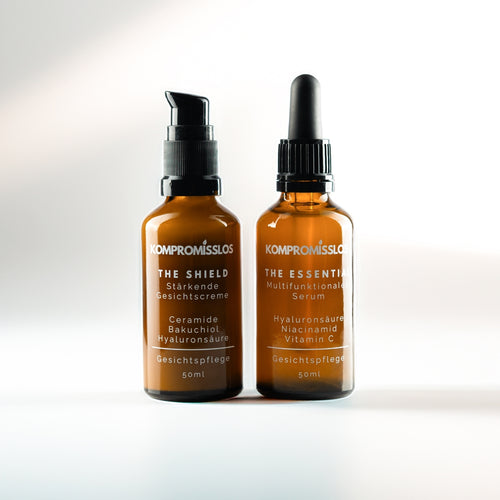
In cosmetic products, typical concentrations range from about 0.2 to 1%, and most published application studies use 0.5%. In our Duo of serum and cream, it is 0.3%, relative to both products together. This figure is deliberately below the study dose; I explain why below. Either way, you need to interpret it with caution: a systematic review in the Journal of Drugs in Dermatology analysed fifteen clinical studies, twelve of them unblinded and without a control group, and ten using combination formulas. Bakuchiol is almost never used on its own, which makes product comparisons difficult. What sits alongside it therefore matters more than the percentage. For us, these include 5% niacinamide, 2% hyaluronic acid and plant extracts, whose role we have put into context using the example of gentian root extract and its effects. If a brand gives no figure at all, that tells you more than a low number does.
Which skin conditions is bakuchiol worth using for?
Bakuchiol is worth it above all if you would in principle be willing to try retinol, but your skin already responds to mild active ingredients with tightness, stinging or redness. It is not an ingredient for a particular skin problem, but one for a particular way of treating your skin: slowly, consistently, without an irritation phase. That is why asking about your skin type is of little help here. The more useful question is what condition your skin is in right now, because that changes with the seasons, stress and your skincare routine. If your barrier is currently weakened, you first need calm, moisture and lipids – not an additional active ingredient. And if you have just introduced three new products at once, you cannot tell which one had which effect anyway. The following six assessments cover the conditions people ask about most often, by some distance, in connection with this ingredient.
Sensitive skin
This is where bakuchiol really makes sense. If retinol has made your skin flake, it is the obvious alternative.
Skin prone to redness
Well tolerated, but not a remedy for redness. If redness is the main issue, the focus should be on its triggers.
Dry and dehydrated skin
Dry skin produces little oil; dehydrated skin holds too little water. Both need lipids first.
Over-treated skin
If your skin reacts with irritation to many products, less is the answer. Cut back first, then reassess.
Combination skin
Usually no problem, because bakuchiol does not strip oil. Pay more attention to the texture than to the ingredient.
Blemish-prone skin
Not an ingredient for blemishes. If they are your main concern, our article on blemish-prone skin and its causes is the better place to start.
How often should you use bakuchiol, and what if your skin reacts?
Bakuchiol is usually applied twice a day, morning and evening, and that is exactly how our routine is built: three to six drops of serum, followed by three to six pumps of cream from our two products. That sets it apart from retinol, which in most formulations is limited to the evening. You will find how to put the order into practice on our how-to-use page. Bakuchiol is no substitute for sun protection, so during the day you also need sunscreen. If your skin still reacts with stinging, itching or sudden redness, the same rule applies as with any active ingredient: stop using it, spend two weeks cleansing gently and replenishing lipids, then reintroduce products one at a time. If the reaction returns, it is down to this substance or another component, and further experimenting is not worth it. A genuine intolerance is rare, but it does happen.
Where does skincare end, and when should you see a professional?
Bakuchiol is a cosmetic ingredient, and cosmetic ingredients change the appearance of the skin, not its medical condition. This boundary is no formality. If you have inflamed patches that do not heal, if redness persists, if itching keeps you awake at night or if a mole changes, that belongs with a dermatologist, not in a skincare routine. The same applies if you are already using prescribed treatments: check any new active ingredients with your doctor before adding them. What skincare can offer is consistency. It supports the skin barrier, keeps moisture in the skin and, over weeks, can soften the look of fine lines. What it cannot do is treat a skin condition, and even a well-researched ingredient does not change that. Any brand that claims otherwise is crossing a line that exists for good reason.
I dosed bakuchiol at 0.3%, even though the best-known comparative study used 0.5%. That is a deliberate decision, not a cost-cutting measure. Our Duo is used morning and evening and also contains 5% niacinamide, 2% vitamin C as 3-O-Ethyl Ascorbic Acid and 2% hyaluronic acid. I did not want to build a product that would mean an irritation phase for some of the women using it, just so a higher number could appear on the packaging. If you look after your skin over months, you gain more from tolerability than from dose. What I do not claim is that 0.3% does the same as 0.5%. That would be dishonest.
Frequently asked questions
Is bakuchiol the same as retinol?
No. Retinol is a vitamin A derivative and belongs to the retinoid group; chemically, bakuchiol has nothing to do with it. Both act on similar processes in the skin, hence the constant comparison. Even so, they cannot be treated as equivalent – the evidence behind them is too different.
How much bakuchiol is in The Duo?
0.3%, relative to the serum and cream together. That is below the 0.5% used in most published studies. We deliberately chose the lower dose because the Duo is used twice a day and together with other active ingredients.
Can I use bakuchiol in the morning?
Yes. Unlike retinol, bakuchiol is usually used twice a day, morning and evening. It is no substitute for sun protection, so during the day you also need sunscreen. That applies regardless of which other active ingredients are in your routine, and whatever the season.
What should I do if my skin does not tolerate bakuchiol?
Stop using the product, cleanse gently for two weeks and use a replenishing moisturiser. Then reintroduce it on its own, without starting anything else new at the same time. If your skin reacts again, leave it out. A genuine intolerance is rare, but it does happen.
Is bakuchiol safe during pregnancy?
Bakuchiol is often mentioned as an alternative because retinoids are avoided during pregnancy. However, there is hardly any robust safety data for bakuchiol in pregnancy. That is why this is a question to discuss with your doctor, not one to settle on the basis of a product page.
How long does it take to see results?
Allow four to eight weeks of consistent use before you can meaningfully judge your complexion. Hydration effects show sooner; changes in fine lines come much more slowly. If you switch products every two weeks, you will never find out what actually made a difference.
Can you use bakuchiol with niacinamide and vitamin C?
Yes, this combination is common in modern formulations, and it is exactly how our Duo is put together. If you are interested in the order of application and the question of vitamin C, our comparison of vitamin C and niacinamide will help. You do not need to wait between steps.
Sources
- Dhaliwal S. et al., Prospective, randomized, double-blind assessment of topical bakuchiol and retinol for facial photoageing, British Journal of Dermatology 2019. Source
- Puyana C., Chandan N., Tsoukas M., Applications of bakuchiol in dermatology: Systematic review of the literature, Journal of Cosmetic Dermatology 2022. Source
- Fanning J.E., McGee S.A., Ibrahim O.I., Human Clinical Trials Using Topical Bakuchiol Formulations for the Treatment of Skin Disorders: A Systematic Review, Journal of Drugs in Dermatology 2024. Source