Pregnancy-safe skincare: which ingredients to pause and which you can keep
ROUTINE
Pregnancy-safe skincare mainly means pausing ingredients from the retinoid family – retinol, retinal and prescription vitamin A acids – along with hydroquinone and high-strength acid peels. Most skincare ingredients, such as niacinamide, vitamin C, hyaluronic acid, ceramides and glycerin, work on the surface of the skin and, as far as we know today, can stay. Where data is missing, as with bakuchiol, you decide not on the basis of marketing claims but together with your gynaecologist or midwife.
Which skincare ingredients should you pause during pregnancy?
During pregnancy, you pause retinoids, hydroquinone and strong acid peels, and you discuss anything on prescription with your doctor. This short list is more honest than the long lists of banned ingredients that circulate online. A review from the Motherisk Program in Canadian Family Physician concludes that most skincare products act locally and that only minimal amounts enter the body. As exceptions, it names hydroquinone, which is absorbed to a comparatively high degree, and tretinoin, for which the evidence is disputed. The same precautionary principle applies to retinol and retinal, because the skin converts part of them into retinoic acid – the very substance that is the active ingredient in tretinoin. Many other substances on warning lists, by contrast, are there as a precaution or because they can irritate, not because of a proven risk to the baby. Before you clear out your entire bathroom cabinet, it is therefore worth checking which warning lists about harmful ingredients actually hold up.
- Retinoids: retinol, retinal, retinyl esters and the prescription-only tretinoin, adapalene and isotretinoin.
- Hydroquinone, as used in lightening products for dark spots.
- Chemical peels with a high acid concentration, as offered in salons or clinics.
- Any skin, acne or pigmentation treatments you were prescribed before your pregnancy.
| Ingredient | During pregnancy | Reason | Ask a professional? |
|---|---|---|---|
| Retinol, retinal, retinyl esters | Pause | Vitamin A derivatives, precautionary principle | Yes, if you have been using them |
| Tretinoin, adapalene, isotretinoin | Only on your doctor’s decision | Prescription-only; the tablet form is proven to harm the unborn baby | Yes, without exception |
| Hydroquinone | Pause | Comparatively high absorption into the body | Yes |
| Salicylic acid in skincare products | Usually acceptable in standard cosmetics | Only a small share enters the body | For peels or use over large areas |
| Fruit acids (AHAs) such as glycolic acid | Usually acceptable at low strengths | Adverse effects only in animal studies with very high doses | For peels |
| Azelaic acid | Described as a medical option | Named in reviews as a first-line option for acne | Yes, it belongs in medical hands |
| Niacinamide, vitamin C, hyaluronic acid, ceramides | Can stay | Work on the surface; vitamins or substances found naturally in the skin | Only if you are unsure |
| Bakuchiol | No data available | Oestrogen-like activity in cell studies | Yes |
| Essential oils | Better left out | Little data, irritation potential, no skincare benefit you actually need | If you are unsure |
Why are retinol and other retinoids off limits during pregnancy?
Retinoids are off limits during pregnancy because the tablet form is proven to cause severe birth defects, and a residual risk cannot be ruled out with certainty when they are applied to the skin. The evidence on the tablet form comes from a study in the New England Journal of Medicine: it analysed 154 pregnancies with exposure to isotretinoin and found a relative risk of 25.6 for a group of selected major malformations. For creams and gels, the picture is considerably calmer. A meta-analysis in the British Journal of Dermatology covering 654 pregnant women who had used topical retinoids in the first trimester found no significant increase in major malformations. The authors themselves note, however, that the statistical power is not sufficient to justify use during pregnancy. The review in Canadian Family Physician also cites four case reports of birth defects after topical use, set against two prospective studies that found no increased risk.
For you, this means two things. If you used retinol before you knew you were pregnant, the data gives no reason to panic, but it is worth raising at your next appointment. From the moment you get a positive test, leave out retinol, retinal and retinyl esters. Prescription retinoids belong in medical hands anyway. Which strength to come back to later, and when to start retinol again, is something you can work out calmly once pregnancy and breastfeeding are behind you.
Are salicylic acid, AHAs and other acids safe during pregnancy?
Salicylic acid in ordinary skincare products and mild fruit acids are considered acceptable during pregnancy, whereas high-strength peels are something to discuss beforehand. The Motherisk review puts the absorption of salicylic acid through healthy skin at anywhere from undetectable to 25 percent, depending on the base, pH, concentration and amount. Because only a relatively small share enters the body, the authors consider a risk unlikely. Up to 27 percent of glycolic acid, the best-known fruit acid, is absorbed into the skin. Adverse effects on reproduction are known only from animal studies using doses far above anything found in cosmetics; there are no studies in pregnant women. What matters, then, is the amount per area and over time: a cleansing gel you rinse off after a minute is a different matter from an acid peel left on over a large area. A review in the Journal of the American Board of Family Medicine names azelaic acid as a first-line option for acne during pregnancy, but as a treatment prescribed by a doctor. How salicylic acid works inside the pore and which skin it suits is covered in our guide to salicylic acid: what it does and who it suits.
Which skincare ingredients are considered safe during pregnancy?
Skincare ingredients that work on the surface of the skin and are already familiar to the body are considered safe: hyaluronic acid, glycerin, ceramides, squalane, panthenol, niacinamide and vitamin C. Hyaluronic acid and ceramides are natural components of the skin, niacinamide is a form of vitamin B3, and you know vitamin C from your diet. Even so, there are no dedicated pregnancy studies on topical use for most of these substances. Put honestly, safe here means there are no signs of a risk and no plausible route by which a facial skincare product could carry relevant amounts of them to the baby. That is an assessment, not a guarantee.
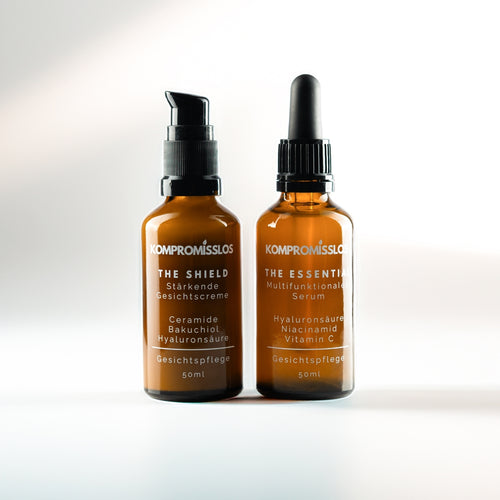
One example of a routine without retinoids or fragrance is The Duo of serum and cream, with 5% niacinamide, 2% vitamin C as 3-O-Ethyl Ascorbic Acid and hyaluronic acid in three molecular sizes. One point needs saying openly, though: the cream contains bakuchiol, and there is no data on bakuchiol during pregnancy. That is why we do not call The Duo pregnancy-safe, and instead recommend that you go through the ingredient list with your gynaecologist.
How much of an ingredient actually gets through the skin into the blood?
With most skincare ingredients, only a small part gets through the skin into the bloodstream, and how large that part is depends heavily on the substance. The outermost layer of the skin is an effective barrier, especially against large or water-loving molecules. The same review shows the range: only 5 percent of benzoyl peroxide is absorbed through the skin, and it is then completely broken down into benzoic acid, whereas for hydroquinone the figure is 35 to 45.3 percent. These figures show why blanket lists of banned ingredients are of little help. What counts is how much of a substance is absorbed, how large the area is and how often you apply it. More gets in when the skin is broken or badly irritated, when a product is covered with an airtight layer or when you use it over large areas of the body. A few drops of serum on your face, by contrast, are a small amount on a small area. With retinoids, caution is still justified, because the same class of substances carries a proven risk in tablet form, so even small amounts are weighed differently.
How does your skin change during pregnancy, and what does it really need now?
The hormonal changes of pregnancy often visibly change the skin: many women notice darker patches on the face, drier or more sensitive skin, and some develop breakouts they never had before. The Motherisk review itself opens with a question from general practice: patients complaining of breakouts and other skin problems that only appeared with pregnancy. Dark, patchy areas on the forehead, cheeks or upper lip may be melasma. That calls for a check-up with a dermatologist, not a do-it-yourself experiment with lightening products. What the skin needs during this time is surprisingly little. You can do without experiments with new active ingredients, constantly switching products and anything else that adds irritation.
- Cleanse gently: water or a mild cleanser that leaves no film and no feeling of tightness.
- Add moisture: a serum with humectants such as hyaluronic acid or glycerin.
- Support the barrier: a cream with lipids such as ceramides or squalane.
- Use sunscreen every day: it matters more now than any active ingredient, because UV light increases the tendency to develop dark spots.
Before your next appointment, take photos of the ingredient lists of the products you use every day. That way, your gynaecologist or midwife can tell you in a few minutes what can stay, instead of you having to work your way through forums and apps.
Do the same rules apply while breastfeeding as during pregnancy?
While you are breastfeeding, the question shifts: it is no longer about the development of the baby in the womb, but about whether a substance passes into breast milk or reaches the baby directly through the skin. For facial skincare with niacinamide, vitamin C, hyaluronic acid or ceramides, this changes little. With retinoids, the simplest approach is to extend the break until you stop breastfeeding and to discuss restarting earlier with your doctor or a breastfeeding adviser. The same applies to hydroquinone, strong peels and prescription treatments. One practical rule is added while breastfeeding: everything you apply stays where it belongs. Keep your breasts and any areas of skin where your baby feeds or rests their face free of products with active ingredients. And because lack of sleep and hormonal changes often make the skin more sensitive after the birth, a short, calm routine is worth more than new experiments here too.
For the cream, I deliberately chose bakuchiol over retinol, and The Duo is fragrance-free and contains no essential oils. It would be easy to turn that into a “pregnancy-safe” label. That is a promise I deliberately do not make. There is no data on bakuchiol during pregnancy, and in cell studies the substance shows oestrogen-like activity. What that means when it is applied to the skin has not been studied. That is why we disclose not only the concentrations but also the full ingredient list, so that you can go through it with your doctor. And because the cream has no SPF, you need a separate sunscreen during the day. During pregnancy, when the skin is more prone to dark spots, that matters more than any serum.
Frequently asked questions
Should I change my skincare if I am trying to get pregnant?
If you are actively trying to get pregnant, it makes sense to drop retinoids now, because the first few weeks often go unnoticed. A review in the Journal of the American Board of Family Medicine describes retinoids in tablet form as absolutely contraindicated for women who are pregnant or planning a pregnancy. If you take medication like this, talk to your doctor before you stop using contraception. The rest of your skincare does not need an overhaul.
Can I use niacinamide during pregnancy?
Niacinamide is considered unproblematic during pregnancy. It is a form of vitamin B3 and works on the surface of the skin. Dedicated pregnancy studies on topical use are lacking, but there are no signs of a risk. If your skin is currently more sensitive than usual, a lower concentration may feel more comfortable. If you are unsure, simply take the product along to your next appointment.
Is bakuchiol a safe retinol alternative during pregnancy?
Bakuchiol cannot be described as a safe retinol alternative during pregnancy, because there are no studies in pregnant women. In cell studies, bakuchiol also shows oestrogen-like activity whose significance for use on the skin has not been investigated. Read up on what bakuchiol is and what the studies show, and make the decision with your doctor or midwife.
Which sunscreen is suitable during pregnancy?
A suitable sunscreen is one with a high SPF that you are happy to apply every day, because the skin is more prone to dark spots during pregnancy. Which filters you prefer is explained in our comparison of mineral or chemical sunscreen.
Are essential oils a problem during pregnancy?
There is little good data on essential oils in facial skincare during pregnancy, and they offer hardly any skincare benefit you cannot get in other ways. Because the skin often reacts more sensitively during this time, fragrance-free skincare is the calmer choice. Why plant-based fragrances can irritate is explained in our article on essential oils in skincare. Discuss aromatherapy or oils taken by mouth separately with your midwife.
What can I do about dark patches on my face during pregnancy?
Dark, patchy areas on the face during pregnancy may be melasma. Have them checked by a dermatologist rather than experimenting with lightening products yourself, and protect your skin consistently from UV light every day. What skincare can soften cosmetically, and what it cannot, is covered in our article on dark spots on the face.
Can I use The Duo during pregnancy?
That is best decided together with your gynaecologist. The Duo contains no retinoids, no salicylic acid, no essential oils and no hormones. The cream does, however, contain bakuchiol, for which there is no data during pregnancy. That is why we do not describe The Duo as pregnancy-safe. Take the full ingredient list along to your next appointment so that your doctor can give you a specific assessment.
Sources
- Bozzo P, Chua-Gocheco A, Einarson A. Safety of skin care products during pregnancy. Canadian Family Physician, 2011. Source
- Lammer EJ, Chen DT, Hoar RM, Agnish ND, Benke PJ, Braun JT et al. Retinoic acid embryopathy. New England Journal of Medicine, 1985. Source
- Kaplan YC, Ozsarfati J, Etwel F, Nickel C, Nulman I, Koren G. Pregnancy outcomes following first-trimester exposure to topical retinoids: a systematic review and meta-analysis. British Journal of Dermatology, 2015. Source
- Chien AL, Qi J, Rainer B, Sachs DL, Helfrich YR. Treatment of Acne in Pregnancy. Journal of the American Board of Family Medicine, 2016. Source
- Lim SH, Ha TY, Ahn J, Kim S. Estrogenic activities of Psoralea corylifolia L. seed extracts and main constituents. Phytomedicine, 2011. Source