When to start retinol: what really decides it and why 50 isn’t too late
SKIN OVER 30
When to start retinol depends less on your age than on the condition of your skin and what you want to achieve. For first fine lines, uneven texture or sun-induced dark spots, starting in your late twenties or your thirties usually makes sense. There is no upper limit: in one study, retinol even improved the skin of people whose average age was 87. What matters more than timing is a slow start at a low strength.
When should you start using retinol?
Retinol makes sense as soon as you have a goal that retinol can actually achieve, and for most people that is the case from their late twenties at the earliest. This means visible signs of photoageing: fine lines, a rough or uneven surface, dark spots and declining firmness. Retinol is a precursor of retinoic acid and is gradually converted into the active form in the skin. A review in Clinical Interventions in Aging notes that many retinoids produced visible and histological improvements in studies on skin ageing, and that retinol and retinal are considerably less irritating than the prescription drugs tretinoin (retinoic acid) and tazarotene. That is precisely why retinol is the usual way into this group. If you are wondering whether the next step up would suit you better, you will find the comparison in retinal vs retinol.
In your mid-twenties and without any visible signs, on the other hand, retinol adds little. At this age, daily sun protection is the more important step, because it slows photoageing at its source instead of leaving you to correct it later. The broader question of the right age for anti-ageing skincare is covered in our article on when to start anti-ageing skincare. Here, the only question is when the active ingredient retinol comes in.
Is it your age or your skin’s condition that decides?
Your skin’s condition decides; age is only a rough guide. Two women of 35 can be starting from completely different places: one has worked outdoors for years without sun protection and already has dark spots, while the other has resilient skin with hardly any sun damage. For the first, retinol makes sense now; for the second, it can wait for years. Conversely, a 30-year-old with irritated, slightly reddened skin may get on worse with retinol than a 60-year-old with a stable barrier. Three things therefore count for more than the number in your passport: how much sun your skin has had, how resilient your skin barrier is right now and what exactly you want to change.
| Starting point | What retinol can do | Sensible way in |
|---|---|---|
| Mid-twenties, no visible signs | Little added benefit | Daily sun protection, retinol later |
| Late twenties onwards, first lines or dark spots | Well-researched benefit for photoageing | Low strength, two to three evenings a week |
| Blemish-prone skin or acne at any age | Retinoids are a cornerstone of acne therapy | With acne, see a dermatologist first |
| Sensitive skin that reddens easily | A benefit, but the adjustment phase is often tough | Calm the barrier first or choose a gentler alternative |
| 50 and over, drier skin | Still effective, including on fine wrinkles | Start very slowly, with a rich cream alongside |
Is it still worth starting retinol at 50?
Yes, at 50 it is not too late for retinol – and not at 60 or 70 either. The clearest study on this appeared in the Archives of Dermatology: in 36 people from two residential care facilities, with an average age of 87, study staff applied a lotion containing 0.4% retinol to one arm up to three times a week for 24 weeks, and a base without active ingredients to the other arm. Fine wrinkles improved significantly on the retinol side and hardly at all on the control side. In tissue samples from a small subgroup, the researchers found more glycosaminoglycans – moisture-binding building blocks – and more procollagen. The study was small and looked at skin on the arm, not the face. But it shows that even very old skin responds to retinol.
What changes with age is not how well retinol works, but how well your skin tolerates it. Mature skin is usually drier and thinner, and the barrier recovers more slowly. That is why, from 50, you start even more cautiously and pair retinol with a cream that replenishes lipids. What to look for is explained in our guide to face cream for over 50s. Expectations need to stay honest, though: retinol will not make deep wrinkles or sagging contours disappear.
What strength of retinol should you start with?
Start with a product labelled as low-strength or for beginners, not with the highest strength you can find. More retinol mainly means more irritation, not automatically more effect. A comparative study in the British Journal of Dermatology illustrates this well: 44 people used either 0.5% bakuchiol twice a day or 0.5% retinol once a day for twelve weeks. Both reduced wrinkle area and pigmentation with no statistically significant difference between them, but the retinol group reported flaking and stinging more often. So even 0.5% once a day is not a gentle start for many people’s skin.
How often you apply it matters more than the percentage: at first, two to three evenings a week are enough, and you only increase once your skin stays calm. How much retinol a face product is allowed to contain in the first place, and what test rankings actually tell you, is covered in our look at the best retinol serum in Switzerland. Mild redness and fine flaking are common in the first few weeks. When that becomes a reason to pause is explained in the article on retinol side effects.
How long does retinol take to show results?
Expect at least twelve weeks of regular use before you see a difference in fine lines, and give the ingredient six months before you judge it. What you feel in the first few weeks is usually the adjustment phase, not the effect. A study in the Journal of Cosmetic Dermatology found a thicker epidermis and increased activity of collagen genes in tissue samples after four weeks of retinol, while image analysis showed the reduction in facial wrinkles after twelve weeks. The comparative study with bakuchiol also ran for twelve weeks, and the study on very old skin for 24 weeks. This leads to a simple rule: if you give up after three weeks because nothing is happening, you have never really tested retinol. If, after three months of patience, all you see is irritation, you can honestly say that the ingredient does not suit your skin.
What should you check before starting retinol?
Before you start, there are three main things to check: whether your skin is resilient right now, whether you wear sun protection consistently and which other active ingredients are already in your routine. These points will help you decide:
- Set a goal: do you want to tackle fine lines, texture or dark spots? Without a specific goal, the adjustment phase is hardly worth it.
- Check your barrier: if your skin already burns, feels tight or turns red, calm it down first. With rosacea, eczema or severe acne, the decision belongs with a dermatologist.
- Consider your stage of life: if you are pregnant, breastfeeding or planning a pregnancy, talk to a doctor about retinol first. Retinoids are generally advised against during this time. What else to pause during pregnancy and what you can keep is covered in our guide to pregnancy-safe skincare.
- Sort out sun protection: retinol goes on in the evening, and during the day you need a separate sunscreen – every day.
- Thin out your routine: acid peels and other strong active ingredients do not belong on the same night as retinol.
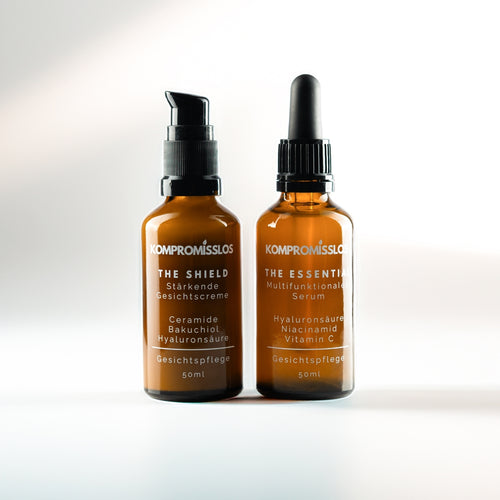
If your skin reacts sensitively or you simply do not want an adjustment phase with redness and flaking, there is another route: niacinamide and vitamin C first for a more even complexion, with bakuchiol as a gentler option. Whether bakuchiol is enough for you is discussed in the article on bakuchiol or retinol for sensitive skin. That is exactly how The Duo of serum and cream is designed. In her review on Judge.me, Carmen writes: ‘I tolerate the serum very well, even though I am very sensitive’ (review translated from German). For resilient skin with a clear goal, retinol is still a good choice.
I deliberately used bakuchiol rather than retinol in The Shield. Not because retinol is bad. Retinol is well researched for visible signs of skin ageing, and if you have resilient skin, you are not doing anything wrong by using it. But retinol often causes redness and flaking, especially in the first few weeks, and I did not want that in a cream that goes on sensitive skin morning and evening. The honest downside: bakuchiol is not retinol, and there is less research on it. If you specifically want to use retinol, you will not find it in our range and will need a separate product for it. The role bakuchiol plays alongside niacinamide, vitamin C and ceramides is set out on our page of active ingredients with disclosed concentrations.
Frequently asked questions
Is 25 too early for retinol?
It is not off-limits, but it is usually unnecessary. At 25, with no visible signs of photoageing, there is little for retinol to improve, and daily sun protection is the more important step. It is a different matter if you have a specific goal, such as blemishes or first dark spots. Then a low-strength start can make sense – with acne, after speaking to a professional.
Does retinol still work after 60?
Yes. In a study in the Archives of Dermatology, a lotion containing 0.4% retinol significantly improved fine wrinkles on the arm after 24 weeks in people with an average age of 87. From 60, it is mainly tolerance that changes: start more slowly and support your barrier with a richer cream.
Can I start retinol earlier if I have blemish-prone skin?
Yes, with blemish-prone skin an earlier start can make sense. The acne guidelines of the American Academy of Dermatology make a strong recommendation for topical retinoids in acne therapy. Whether a cosmetic retinol is enough for mild blemishes is not something they answer. With inflammatory acne, the choice therefore belongs in a dermatologist’s hands.
Can I start retinol in summer?
Yes, as long as you wear sun protection consistently. Retinol goes on in the evening, and during the day you protect your skin with a separate sunscreen. Many people still prefer to start in autumn, because the adjustment phase goes more smoothly with less UV exposure and no beach holidays. It is not a must, though.
Is retinol suitable for sensitive skin?
To a degree. Sensitive skin can often tolerate retinol if you start at a very low strength and on only a few evenings a week. If your skin is already irritated or prone to rosacea, leave retinol out for now and have it checked by a doctor. Bakuchiol is a gentler alternative.
Do I really need sun protection with retinol?
Yes. UV radiation is the main driver of photoageing – exactly what retinol is supposed to improve. Without daily sun protection, you are working against yourself. Apply retinol in the evening and a separate sunscreen in the morning, even on cloudy days and in winter.
Can I combine The Duo with retinol?
In principle, yes. The Duo itself contains no retinol, and niacinamide, hyaluronic acid and ceramides are considered well-tolerated companions. Even so, introduce retinol slowly and only in the evening. How to fit retinol in alongside vitamin C and bakuchiol is explained in the article on what to mix with retinol. The Duo also contains no sun protection, so you need that separately during the day.
Sources
- Kafi R, Kwak HS, Schumacher WE, Cho S, Hanft VN, Hamilton TA, et al. Improvement of naturally aged skin with vitamin A (retinol). Archives of Dermatology, 2007. Source
- Dhaliwal S, Rybak I, Ellis SR, Notay M, Trivedi M, Burney W, et al. Prospective, randomized, double-blind assessment of topical bakuchiol and retinol for facial photoageing. British Journal of Dermatology, 2019. Source
- Mukherjee S, Date A, Patravale V, Korting HC, Roeder A, Weindl G. Retinoids in the treatment of skin aging: an overview of clinical efficacy and safety. Clinical Interventions in Aging, 2006. Source
- Kong R, Cui Y, Fisher GJ, Wang X, Chen Y, Schneider LM, et al. A comparative study of the effects of retinol and retinoic acid on histological, molecular, and clinical properties of human skin. Journal of Cosmetic Dermatology, 2016. Source
- Reynolds RV, Yeung H, Cheng CE, Cook-Bolden F, Desai SR, Druby KM, et al. Guidelines of care for the management of acne vulgaris. Journal of the American Academy of Dermatology, 2024. Source