What age to start anti-ageing skincare: when it actually makes sense
SKIN OVER 30
When to start anti-ageing skincare depends less on your age than on the condition of your skin. Daily sunscreen is worth it straight away, because it slows down the largest part of skin ageing that you can actually influence. Skincare with active ingredients such as niacinamide, vitamin C or bakuchiol makes sense as soon as the first signs appear, such as dehydration lines, a dull complexion or an uneven skin tone. For many people, that happens towards the end of their 30s, earlier with a lot of sun exposure. There is no fixed age to start.
At what age does an anti-ageing cream make sense?
An anti-ageing cream makes sense when your skin gives you a concrete reason, not when a particular birthday comes round. Typical reasons are skin that often feels dry despite your skincare, fine lines that no longer fully disappear after you apply cream, a complexion that looks duller than it used to, or the first dark spots in areas that catch a lot of sun. How these signs show up and how to recognise them early is explained in the article on the first signs of skin ageing. For many people they become more noticeable towards the end of their 30s, and often earlier with a lot of sun, smoking or very fair skin. Before that, a good moisturiser and daily sunscreen are usually enough. The ‘30+’ or ‘40+’ on the packaging is therefore more a way of sorting the shelf than a recommendation for your skin.
If you are around 30 right now, the honest answer is usually: a solid basic routine rather than an arsenal of active ingredients, and what a face cream in your 30s needs to do is fairly limited. At 40, the skin barrier and moisture move further into the foreground; what to look for in a cream at that point is covered in the article on face cream in your 40s.
What does anti-ageing actually mean in skincare?
In skincare, anti-ageing does not mean stopping the ageing process, but slowing down the part of it you can influence and improving how your skin looks. Skin ageing has two components: an intrinsic one that depends on genes and time and that no cream can change, and an extrinsic one caused mainly by UV radiation, smoking and environmental stress. Cosmetics work almost exclusively on the second. In practical terms, anti-ageing therefore means three things: protecting against UV, keeping the skin barrier and moisture levels stable, and using active ingredients that can visibly improve skin tone, hydration and texture. Promises such as erasing wrinkles or rebuilding deeper layers of skin go beyond what skincare can achieve on the skin’s surface. Why many people now prefer to replace the term with long-term skin health is explained in the article on skin longevity.
Whether a good moisturiser is enough for you or an anti-ageing cream would do more depends on the active ingredients, not the label. This is covered in detail in the article on whether anti-wrinkle creams actually work.
Which step comes first: sunscreen, antioxidants or a retinoid?
Sunscreen comes first, followed by a stable basic routine with antioxidants and supporting ingredients, and only at the very end, if at all, a retinoid. This order is not a ranking of effectiveness but a sequence in time: each step builds on the one before, and none makes much sense if the previous one is missing. A retinoid on unprotected skin is fighting against UV exposure that comes back every single day. A randomised trial in the Annals of Internal Medicine involving 903 adults under the age of 55 in Australia showed how much difference sunscreen alone makes: in the group using sunscreen daily, there was no detectable increase in skin ageing after 4.5 years, and skin ageing was 24 per cent lower than in the group that used sunscreen at their own discretion.
- Straight away: daily sunscreen on your face, even if nothing is visible yet.
- From the first signs: a basic routine with moisture, barrier lipids and active ingredients such as niacinamide or vitamin C that visibly support skin tone and hydration.
- When lines and texture bother you more: a gentle start with bakuchiol or, for resilient skin, a retinoid.
- When skincare is no longer enough: advice from a dermatologist.
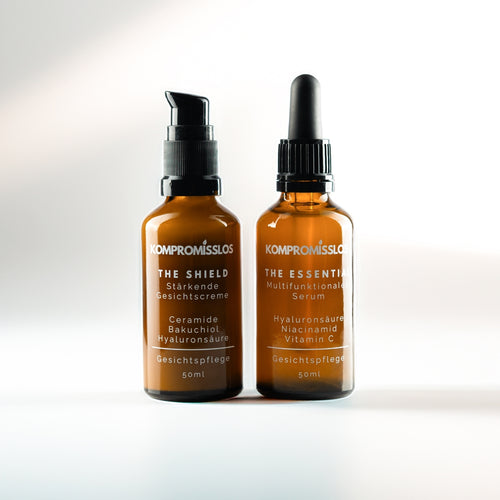
The Duo of serum and cream is designed for step two and a gentle start to step three: niacinamide and vitamin C in the serum, bakuchiol and ceramides in the cream, without you having to work your way through eight products. A small randomised trial in the British Journal of Dermatology suggests that bakuchiol can be a gentler option: 44 people used either a cream with 0.5% bakuchiol or one with 0.5% retinol for twelve weeks. Both reduced wrinkle surface area and hyperpigmentation with no statistically significant difference, while the retinol group reported scaling and stinging more often. Whether and when a classic retinol is added is a separate decision; what matters there is explained in the article on when to start retinol. Which other habits matter besides sun protection is covered in the article on how to slow down skin ageing.
What decides when to start anti-ageing skincare: age, skin condition or goal?
The decision depends first on the condition of your skin, second on your goal and only last on your age. Two people aged 35 can have very different skin: one has spent a lot of time outdoors for years without consistently protecting her skin, the other works indoors and has fair, rather dry skin. For the first, pigmentation and skin tone take priority; for the second, it is more about moisture and the skin barrier. Age only gives you a rough probability, while a look in the mirror gives you a concrete answer. Your goal then decides how far you want to go. If you want your skin to look cared for and even, you need less than someone who wants to visibly soften pronounced lines. And this is a legitimate choice too: nothing but sunscreen and a good moisturiser, as long as nothing bothers you.
| Starting point | Sensible start | What can wait |
|---|---|---|
| No visible signs, skin feels good | Sunscreen and a mild moisturiser | Active serums and retinoids |
| Skin often feels tight, first dehydration lines | Strengthening moisture and the barrier, for example with ceramides and niacinamide | Retinoids |
| Dull complexion, uneven tone, first dark spots | Consistent sunscreen plus vitamin C or niacinamide | Highly concentrated acid peels |
| Lines stay visible even when your face is relaxed | Gradually adding bakuchiol or a retinoid | Several strong active ingredients at once |
| Sensitive skin that reddens quickly | Calming the barrier first, with few products | New active ingredients until the skin has settled |
Introduce new active ingredients one at a time and give each one a few weeks before you judge it. That way, if your skin reacts, you know what caused it, and you do not buy three products for a problem that one would have solved.
Can you start anti-ageing skincare too early?
You can start too early with active ingredients, but not with sunscreen. Too early means that skin with no need for them is given acids, retinoids and several serums at once and reacts with redness, stinging or scaling, without there being anything to improve. An extreme example comes from a study in the journal Pediatrics. It analysed 100 TikTok videos in which children and teenagers aged 7 to 18 showed their skincare routines. On average, 6 products were used, the 25 most-viewed videos contained an average of 11 potentially irritating active ingredients, and only 26.2 per cent of the videos included sunscreen. The researchers came to a clear conclusion: little benefit for this age group, but a risk of irritation and allergic contact dermatitis. The same principle applies to adults: anyone following a five-step anti-ageing routine in their mid-20s usually gains nothing from it but risks an irritated skin barrier. Starting early is worth it, then, but with the right step: protection rather than a collection of active ingredients.
Is it too late for anti-ageing skincare at 50 or 60?
No, it is not too late for anti-ageing skincare at 50 or 60; only the expectations shift. Prevention moves into the background, while keeping skin cared for and protected moves to the front. Mature skin produces less sebum and loses moisture more easily, so good barrier care often makes a more noticeable difference at this age than at 30. Sunscreen also remains worthwhile. A study in Dermatologic Surgery followed 32 people who applied a broad-spectrum SPF 30 sunscreen to their face every day for a year. All the signs of photoageing that were assessed improved compared with the baseline, with texture, clarity and pigmentation improving most, by 40 to 52 per cent from baseline. The study was small and had no comparison group, so the result should be read with caution. It does, however, suggest that protection is worthwhile even for skin that has already had a lot of sun.
A realistic expectation matters more than the perfect timing. In her review on Judge.me, Nicole B. writes: ‘The little wrinkles don’t go away, which isn’t really the idea anyway […]’ (review translated from German). That is exactly the honest framework: skincare can make skin look more cared for, plumper and calmer, but pronounced wrinkles will not disappear. If you want more than that, you are better off seeing a dermatologist than buying another jar.
I chose bakuchiol rather than retinol for The Shield, because a starter routine should not begin with weeks of redness and flaking. In my view, if you are noticing your first lines, you do not need an active ingredient that puts your skin under strain before it does anything for it. The cream also deliberately contains no SPF. At first glance that looks like a gap, but it is a conscious stance: the most important anti-ageing step is a separate sunscreen that you apply generously, not the most expensive jar on the shelf, ours included. Serum and cream take care of moisture, the skin barrier and the look of your skin; the sunscreen takes care of protection. How much serum and cream to use morning and evening, and in which order, is explained in the instructions for use. In the morning, sunscreen goes on as the final step.
Frequently asked questions
Does an anti-ageing cream make sense at 25?
At 25, you generally do not need an anti-ageing cream. Daily sunscreen plus a mild moisturiser that suits your skin is more effective. Exceptions are specific reasons such as pigmentation marks after a lot of sun or very dry skin, in which case a targeted active ingredient is worth it. A full anti-ageing programme with no reason mainly costs money and can irritate your skin.
At what age do I need a serum?
You do not need a serum from a certain age, but as soon as your cream no longer covers a specific concern such as pigmentation, tightness or a dull complexion. When it is worth it and when it is not is explained in the article on serum in your 30s.
Is it still worth starting anti-ageing skincare at 40 with no previous experience?
Yes, starting at 40 with no previous experience makes sense and is no disadvantage. You simply begin with the first two steps: daily sunscreen and a basic routine with moisture, barrier lipids and a well-tolerated active ingredient. Introduce new products one at a time. Starting this way, you often make fewer mistakes than someone who has been layering too many products for years.
When do I need daily sunscreen to prevent skin ageing?
Daily sunscreen to prevent skin ageing is worth it straight away, regardless of your age, because UV radiation is the most important external factor. How much SPF your face needs day to day and how it fits with serum and cream is explained in the article on sunscreen for your face.
Do men need anti-ageing skincare later?
Not as a rule; for men, too, it is the condition of the skin that decides, not age. Men’s skin is on average slightly thicker and oilier, so some signs become noticeable later. UV radiation, however, has exactly the same effect, so the same applies to men: daily sunscreen first, then active ingredients if needed. The order of the steps is the same.
Are anti-ageing creams harmful for young skin?
Not automatically, but they are unnecessary and, depending on what is in them, irritating. The main problems are retinoids, acids and combinations of several strong active ingredients on skin that has no reason for them. The risks are redness, stinging and a disrupted skin barrier. A rich cream without strong active ingredients, on the other hand, does young skin no harm; it just usually offers little extra benefit.
From what age is The Duo suitable?
The Duo has no fixed starting age. It is designed mainly for demanding, sensitive, dry or mature skin and is a good fit as soon as the first signs appear, roughly from your mid to late 30s. Serum and cream cover moisture, the skin barrier and the look of your skin, and bakuchiol replaces a harsh start with retinol. You add sunscreen separately. You can see exactly what is in it on the page for The Duo of serum and cream.
Sources
- Hughes MC, Williams GM, Baker P, Green AC. Sunscreen and prevention of skin aging: a randomized trial. Annals of Internal Medicine, 2013. Source
- Dhaliwal S, Rybak I, Ellis SR, Notay M, Trivedi M, Burney W, et al. Prospective, randomized, double-blind assessment of topical bakuchiol and retinol for facial photoageing. British Journal of Dermatology, 2019. Source
- Hales M, Rigali S, Paller A, Liszewski W, Lagu T. Pediatric Skin Care Regimens on TikTok. Pediatrics, 2025. Source
- Randhawa M, Wang S, Leyden JJ, Cula GO, Pagnoni A, Southall MD. Daily Use of a Facial Broad Spectrum Sunscreen Over One-Year Significantly Improves Clinical Evaluation of Photoaging. Dermatologic Surgery, 2016. Source