Do anti-wrinkle creams actually work? Proven ingredients and what a cream can really do
ACTIVE INGREDIENTS
Whether an anti-wrinkle cream actually works depends on its ingredient list, not on the word ‘anti-wrinkle’ on the jar. The best evidence is for retinoids, followed by niacinamide and vitamin C. Humectants such as hyaluronic acid mainly make fine lines look flatter by adding moisture. A realistic result is visibly softer fine lines after eight to 24 weeks. No cream smooths out deep wrinkles or sagging contours, and daily sunscreen slows the formation of new wrinkles more effectively than any skincare product.
Do anti-wrinkle creams actually work?
An anti-wrinkle cream works if it contains at least one well-researched active ingredient in a meaningful amount and you use it consistently for months. Everything else is mainly moisture. That is not worthless, but it is a different effect from the one the packaging often implies. ‘Anti-wrinkle’, ‘anti-ageing’ and ‘lifting’ are not protected terms with fixed minimum requirements. Even a plain moisturiser can carry these labels, because more moisture alone makes fine lines less visible.
It therefore helps to distinguish between two effects. The first is immediate: well-hydrated skin looks plumper and fine lines appear flatter. This effect lasts as long as you keep applying cream and disappears when you stop. The second takes weeks to months: in studies, active ingredients such as retinol or niacinamide change the appearance of the skin over a longer period. The price tells you nothing about either effect. An expensive jar with fragrance and no declared active ingredients can achieve less than a simple cream with openly stated concentrations.
Which anti-wrinkle ingredients have the best evidence?
The best evidence is for retinoids, that is vitamin A derivatives such as retinol, followed by niacinamide and vitamin C, with peptides and bakuchiol well behind. For prevention, sunscreen comes before everything else. This ranking reflects the number and quality of studies, not marketing. In a study in the Archives of Dermatology, 36 elderly people with an average age of 87 had a lotion with 0.4% retinol applied to one arm up to three times a week for 24 weeks, and a lotion without the active ingredient applied to the other. On the retinol side, fine wrinkles improved significantly. For niacinamide, a split-face study in Dermatologic Surgery found fewer fine lines and wrinkles and better elasticity in 50 women after 12 weeks of 5% niacinamide applied twice a day. The other benefits of niacinamide are covered in a separate article.
| Active ingredient | What studies measured | Limitations | In The Duo |
|---|---|---|---|
| Retinol and other retinoids | Fewer fine wrinkles after 24 weeks | Can irritate, needs a period of adjustment | No |
| Niacinamide | Fewer fine lines, better elasticity after 12 weeks | Moderate effects | Yes, 5% in The Duo of serum and cream |
| Vitamin C | Denser skin microrelief, less pronounced deep furrows after six months | Study used pure ascorbic acid; derivatives are less well researched | Yes, 2% as 3-O-Ethyl Ascorbic Acid |
| Hyaluronic acid | More moisture and elasticity; reduced wrinkle depth only with small molecules | Works mainly through moisture | Yes, in three molecular sizes |
| Peptides | Plausible mechanisms, few independent studies | Unclear how much reaches the skin | No |
| Bakuchiol | Early, smaller studies on fine lines | Much narrower evidence base than retinol | Yes, in the cream |
| Sunscreen | Fewer new signs of skin ageing over years | Prevents, smooths nothing | No, separate product |
For vitamin C, a placebo-controlled study in Experimental Dermatology found that a cream with 5% vitamin C, used for six months, produced a denser skin microrelief and less pronounced deep furrows, measured on the décolletage and arms. For stable derivatives such as 3-O-Ethyl Ascorbic Acid, wrinkle studies of comparable length are lacking. With peptides the gap is wider: the mechanisms sound convincing, but the independent data are thin, as the article on peptides in skincare shows. Incidentally, the fact that the retinol study was carried out on very elderly people shows that it is rarely too late. When it makes sense to begin is explained in the article on when to start retinol.
What can an anti-wrinkle cream measurably do, and where does skincare stop?
An anti-wrinkle cream can measurably improve moisture, elasticity and the appearance of fine lines. Deep wrinkles, sagging contours and lines caused by muscle movement stay largely as they are. A study in the Journal of Drugs in Dermatology illustrates this well: over 60 treatment days, 76 women aged between 30 and 60 applied a hyaluronic acid cream around one eye and a cream without the active ingredient around the other. All versions improved moisture and elasticity. Reduced wrinkle depth, however, appeared only with the two smallest molecular sizes. So even a well-researched active ingredient changes the surface rather than visible furrows.
One customer describes where the limit lies rather aptly. In her review on Judge.me, Nicole B. writes about The Duo: ‘The fine lines don’t go away, which isn’t really the idea […], but your overall expression becomes softer’ (review translated from German). That is exactly the realistic scope of skincare. In this sense, there is no such thing as a cream for deep wrinkles: deep wrinkles are caused by loss of volume, degraded connective tissue and gravity, and no emulsion can fill that in from the outside. Daily sunscreen is the bigger preventive lever: in a randomised trial in the Annals of Internal Medicine, skin with daily sunscreen showed 24 per cent less ageing over four and a half years than skin with sunscreen used at the participants’ discretion. There is more on this in the article on how to slow down skin ageing.
Is a moisturiser enough, or do you need an anti-ageing cream?
For fine lines that are mainly caused by dryness, a good moisturiser is often enough. For wrinkles that remain even when the skin is well hydrated, you also need an active ingredient backed by studies. The difference between the two product groups is smaller than the shelves suggest. At its core, an anti-ageing cream is a moisturiser with one or more active ingredients added. Whether you need these active ingredients in your cream depends on what the rest of your routine provides. If your serum already contains niacinamide or vitamin C, your cream does not need to do the same job again. Its main task is then to protect the skin and hold in moisture.
As a rough rule of thumb, lines that become noticeably flatter after you apply cream have a lot to do with moisture, while lines that stay just as deep on well-cared-for skin are more likely to be related to the skin’s structure. A separate article with a self-test shows how to tell dehydration lines from wrinkles.
What works for wrinkles without Botox?
Without Botox, the options most likely to help are retinoids, consistent sun protection and, for deeper wrinkles, professional treatments such as laser, microneedling or chemical peels. A cream advertised as a Botox alternative does not relax muscles. Botulinum toxin is injected and blocks the signals to the facial muscles, which is why it smooths forehead and frown lines caused by facial expressions. Cosmetic peptides, which are often sold with this promise, have not shown a comparable effect in independent studies. A realistic breakdown looks like this:
- For fine lines: moisture plus an active ingredient with good evidence, such as niacinamide or retinol, for at least three months.
- For more pronounced wrinkles: prescription retinoids such as tretinoin, after an assessment by a dermatologist.
- For deep wrinkles and loss of volume: laser, microneedling, chemical peels or fillers at a dermatology practice.
- For everything that has not appeared yet: daily sunscreen and not smoking.
The honest part of this list: the deeper the wrinkle, the less a product from your bathroom cabinet can do. That is not a failure of skincare, but its limit.
What should you look for when buying an anti-wrinkle cream?
When buying an anti-wrinkle cream, look first for declared active ingredients with stated concentrations, and only then at promises, packaging and price. Many products list ten plant extracts and not a single figure. That does not make them bad, but it does make them impossible to check. These points will help you sort through the options:
- At least one active ingredient with good evidence is on the ingredient list, ideally with a percentage on the packaging or the website.
- The active ingredients complement your serum instead of duplicating it.
- For sensitive skin: no fragrance or essential oils, which can cause additional irritation.
- The promise stays realistic. ‘Visibly softer’ is realistic; ‘wrinkles disappear’ is not.
- You allow at least twelve weeks before you judge.
Before you start, take a photo in daylight by a window, and after twelve weeks take another in the same place at the same time of day. The mirror will not reveal small changes, because you see yourself every day.
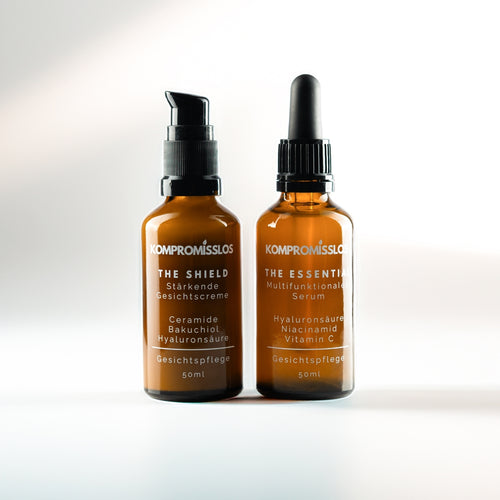
I deliberately put bakuchiol in The Shield rather than retinol. Retinol is the better-researched wrinkle ingredient, and I say so openly. But it often needs a period of adjustment and quite often irritates sensitive skin, and I did not want to go down that route for a cream that goes on your skin morning and evening. Just as deliberately, the cream has no sun protection factor. A good sunscreen for your face is a product in its own right and does more against new wrinkles than any skincare cream, ours included. And what an injection or a laser can achieve, no jar can – not even one of ours. You can check which active ingredients are in it, and at what concentration, on our page listing all our active ingredients and their concentrations.
Frequently asked questions
What is the difference between expression lines and age-related wrinkles?
Expression lines are caused by repeated muscle movements, for example on the forehead, between the eyebrows or at the corners of the eyes. At first they are only visible when you move your face; as elasticity declines, they remain even at rest. Age-related wrinkles are caused more by sun, loss of volume and gravity. Typical examples are the nasolabial folds between the sides of the nose and the corners of the mouth. A cream can smooth the surface in both cases, but it does not relax muscles.
Does hyaluronic acid help with wrinkles?
Hyaluronic acid mainly makes fine lines look flatter by adding moisture; in the study in the Journal of Drugs in Dermatology, reduced wrinkle depth appeared only with the two smallest molecular sizes. How it differs from a genuine wrinkle ingredient is explained in the comparison hyaluronic acid or retinol.
Is retinol the most effective treatment for wrinkles?
Among over-the-counter active ingredients, retinol has the best evidence; prescription retinoids such as tretinoin and treatments at a dermatology practice are more powerful. Whether you need it, or whether a humectant is enough for you, is covered in the article on how hyaluronic acid and retinol differ.
Does bakuchiol work for wrinkles?
In early, smaller studies, bakuchiol shows effects on fine lines, but the evidence base is much narrower than for retinol, which makes it a gentler option rather than an equivalent replacement with the same level of evidence. When it is the better choice is explained in the comparison bakuchiol or retinol for sensitive skin.
Do peptides do anything for wrinkles?
Peptides may help, but there is hardly any evidence for it. The mechanisms are plausible, yet the clinical studies are mostly small, and how well the molecules penetrate the skin remains an open question. If your routine already includes an active ingredient with good evidence, you do not need an additional peptide serum.
How long does it take for anti-wrinkle skincare to show results?
You see the moisturising effect immediately, but changes from active ingredients take at least eight to twelve weeks. In the studies, niacinamide was tested over twelve weeks and retinol over 24 weeks. If you switch products after three weeks, you are mainly judging the moisture, not the active ingredient.
What can The Duo do for wrinkles, and what can’t it do?
The Duo provides moisture, supports the skin barrier and can soften the appearance of fine dehydration lines. It contains 5% niacinamide, 2% vitamin C as 3-O-Ethyl Ascorbic Acid, bakuchiol, ceramides and hyaluronic acid in three molecular sizes. It contains no retinol and no sun protection factor, and it does not smooth out deep wrinkles. You can see exactly what is in it on the page for The Duo with serum and cream.
Sources
- Kafi R, Kwak HS, Schumacher WE, Cho S, Hanft VN, Hamilton TA, et al. Improvement of naturally aged skin with vitamin A (retinol). Archives of Dermatology, 2007. Source
- Bissett DL, Oblong JE, Berge CA. Niacinamide: A B vitamin that improves aging facial skin appearance. Dermatologic Surgery, 2005. Source
- Humbert PG, Haftek M, Creidi P, Lapière C, Nusgens B, Richard A, et al. Topical ascorbic acid on photoaged skin. Clinical, topographical and ultrastructural evaluation: double-blind study vs. placebo. Experimental Dermatology, 2003. Source
- Pavicic T, Gauglitz GG, Lersch P, Schwach-Abdellaoui K, Malle B, Korting HC, et al. Efficacy of cream-based novel formulations of hyaluronic acid of different molecular weights in anti-wrinkle treatment. Journal of Drugs in Dermatology, 2011. Source
- Hughes MC, Williams GM, Baker P, Green AC. Sunscreen and prevention of skin aging: a randomized trial. Annals of Internal Medicine, 2013. Source