Hyaluronic acid or retinol: how the two ingredients differ and when you need which
COMBINING ACTIVE INGREDIENTS
Hyaluronic acid or retinol is not a question of better or worse, because the two ingredients do different jobs. Hyaluronic acid binds water in the upper layers of the skin: your skin looks plumper and feels less tight straight away, but the effect only lasts as long as you keep applying it. Retinol is a vitamin A derivative that stimulates skin renewal and can soften fine lines over several months, but it causes irritation more often. Dry skin needs moisture first; retinol is the step for skin that is stable.
Hyaluronic acid or retinol: what is the difference?
The difference lies in their job: hyaluronic acid is a humectant, while retinol is an active ingredient that intervenes in the renewal of skin cells. Hyaluronic acid occurs naturally in the skin and holds on to water there. When you apply it in a cream or serum, most of it stays in the upper layers, where it binds moisture and cushions the surface. Retinol, on the other hand, is a retinoid, part of the family of vitamin A derivatives. In the skin, it is gradually converted into retinoic acid, the form that docks onto cells and changes how they behave. That is why you feel hyaluronic acid within minutes but only see results from retinol after months. Asking which one is better is essentially like comparing a glass of water with a training plan: one helps straight away, the other changes something in the long term, but it demands patience and skin that is willing to play along.
How the two get on in the same routine is covered in our guide on what to mix with retinol. This article is about the decision that comes before that: which of the two ingredients actually addresses your concern.
| Criterion | Hyaluronic acid | Retinol |
|---|---|---|
| Type of ingredient | Humectant, naturally present in the body | Retinoid, vitamin A derivative |
| Main job | Binding water, cushioning the surface | Stimulating renewal, refining the complexion |
| When results show | Immediately after application | After several months in studies |
| Tolerability | Well tolerated by almost every skin type | Burning, flaking and redness possible, especially at the start |
| Typical reason to use it | Tightness, fine dehydration lines, dull skin | Fine lines on stable, well-hydrated skin |
What does hyaluronic acid do in the skin, and what can it not do?
Hyaluronic acid supplies the upper layers of the skin with moisture, which makes the skin look smoother and plumper; as a skincare product, however, it cannot fill in wrinkles or remodel the structure of the skin. Its effect is well documented, but limited. In a study in the Journal of Drugs in Dermatology, 76 women aged between 30 and 60 applied creams containing hyaluronic acid of different molecular sizes around one eye twice a day for two months, and a cream without the active ingredient around the other eye. All the hyaluronic acid creams measurably improved skin hydration and elasticity. Wrinkle depth, by contrast, only decreased significantly in the two groups with the smallest molecules. That is an important pointer: all the creams contained the same amount of hyaluronic acid, so the difference in wrinkles came down to molecular size alone. The reasons for this are explained in detail in our guide on what hyaluronic acid really does for skin.
What hyaluronic acid does not do: it does not intervene in cell renewal, and its effect depends on continued use. If you stop, your skin loses the extra cushion of water again. That is not a flaw – it is exactly what dry or tight skin needs day to day.
What does retinol do in the skin, and what can it not do?
Retinol stimulates skin renewal and can visibly soften fine lines over several months, but it does not provide moisture you can feel straight away. One of the best-known studies on this was published in the Archives of Dermatology: 36 older people with an average age of 87 had 0.4% retinol applied to one arm up to three times a week, and a lotion without the active ingredient applied to the other arm. After 24 weeks, the fine wrinkles on the retinol side had improved significantly more. Tissue samples from a small subgroup also showed more glycosaminoglycans, which bind a lot of water, and more collagen precursors. Two points belong in an honest assessment: the result took six months, and it comes from the arm, not the face. So retinol is not a quick fix but a slow rebuild.
What retinol does not do: it does not provide direct moisture, and it does not soothe. A review in Clinical Interventions in Aging notes that irritation such as burning, flaking or dermatitis limits how well people accept retinoids. According to the same review, however, retinol and retinal are considerably less irritating than tretinoin and tazarotene, the stronger forms prescribed by doctors. For an overview of which ingredients have any evidence behind them for wrinkles and where skincare stops, see do anti-wrinkle creams actually work.
When is hyaluronic acid the better choice, and when is retinol?
Hyaluronic acid is the better choice if your skin feels tight, looks dry or quickly turns dull; retinol is the better choice if your skin is stable and you want to work specifically on fine lines and skin texture. The decision depends less on your age than on the condition of your skin. Skin at 55 that stings after every cleanse benefits first from moisture and calm. Skin at 35 without any sensitivities often tolerates retinol without any problems. Whether retinol is worth it at your age in the first place is answered in our guide on when to start retinol. As a rough guide:
- Hyaluronic acid first: tightness, dry patches, tired-looking skin and fine lines that become less visible once you have moisturised.
- Consider retinol: fine lines that remain even when your skin is well hydrated, an uneven surface and skin that is used to active ingredients.
- Neither as a first step: if your skin is currently red, irritated or flaky. In that case, calm and the skin barrier come first.
A simple test before you decide: give your skin consistent hydration for two weeks. If the lines that bother you disappear, they were dehydration lines, and you do not need retinol. If they remain, retinol is a question genuinely worth considering.
When should you hold off on retinol for now?
You should hold off on retinol for now if your skin is currently sensitive, irritated or has a weakened barrier, and if you are pregnant or breastfeeding, discuss retinoids with your doctor first. On very dry skin, the typical early reactions such as flaking and tightness hit skin that is already short of moisture. Retinol is not off limits here, but it is the wrong place to start. With redness that does not go away, rosacea, perioral dermatitis or atopic eczema, the question of retinoids belongs in a dermatologist’s consulting room, not on the shelves at the chemist’s. On pregnancy, a review in Canadian Family Physician states that most skincare ingredients only act locally, but that the evidence on the retinoid tretinoin is disputed. Given this unclear evidence, holding back on retinoids during this time is the cautious choice. And if you do not use sun protection during the day, change that first, before retinol goes into your routine.
Is there a third way between hyaluronic acid and retinol?
Yes – for many sensitive and mature skin types, the third way consists of good hydration, a stable barrier and a gentler active ingredient instead of retinol. Moisture comes from hyaluronic acid, the barrier is supported by ingredients such as ceramides and squalane, and bakuchiol, a plant-based active that is not chemically a retinoid, is often named as a gentler alternative to retinol. In a twelve-week study in the British Journal of Dermatology with 44 participants, bakuchiol and retinol reduced wrinkle surface area with no statistically significant difference between them, although the retinol group reported flaking and stinging more often. That said, 44 people is a small basis – more on this in our article bakuchiol or retinol for sensitive skin.
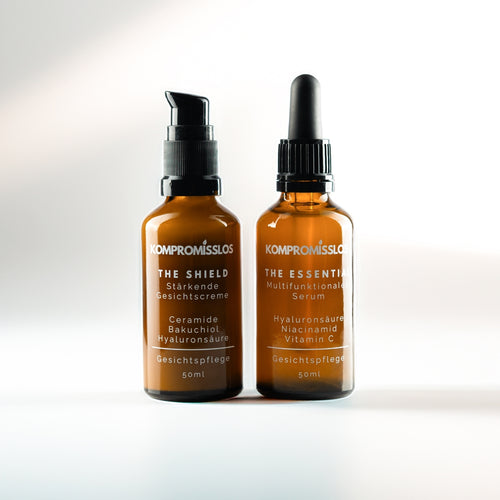
The Duo is built on this principle: the serum provides hyaluronic acid in three molecular sizes, and the cream adds hyaluronic acid, ceramides, squalane and bakuchiol. It is not a retinol treatment and does not try to be one. It is the route for skin that needs moisture and calm and does not get on with retinol.
For the Duo, I deliberately decided against retinol and put bakuchiol in the cream instead. Many of our customers have sensitive, dry or mature skin, and that is exactly the kind of skin most likely to react to retinol with burning and flaking. Hyaluronic acid in three molecular sizes went into the serum, because moisture is what almost every skin needs first. But I will also say this clearly: bakuchiol is not a like-for-like replacement for retinol. If you tolerate retinol well and want to work specifically with a retinoid, the Duo cannot do that, and I do not claim that it can. Exactly what is in it, and what each ingredient is for, is set out openly on the page all the active ingredients in the Duo explained.
Frequently asked questions
Does hyaluronic acid in a cream fill in wrinkles?
No, hyaluronic acid from a cream does not fill in wrinkles. It binds water in the upper layers of the skin, which makes the surface look plumper and fine dehydration lines less visible. Deeper wrinkles remain, because they form in deeper layers that a skincare product does not reach. Even in the study in the Journal of Drugs in Dermatology, measured wrinkle depth only decreased with the two smallest molecular sizes.
Is retinol suitable for dry skin?
Retinol is only suitable for dry skin if you use it with caution. The typical early reactions such as flaking and tightness weigh more heavily on dry skin. If you want to try it, start with a low concentration, use it on just a few evenings a week and pair it with a rich cream. If your skin already feels tight without retinol, moisture is the better first step.
How can I spot hyaluronic acid and retinol on the ingredient list?
Hyaluronic acid usually appears on the ingredient list as Sodium Hyaluronate, Hyaluronic Acid or Hydrolyzed Hyaluronic Acid. You can recognise retinoids by the names Retinol, Retinal, Retinyl Palmitate or Retinyl Acetate. Retinyl esters are considered the mildest level, while retinal is one conversion step closer to the active retinoic acid than retinol. How these levels differ is explained in our comparison retinal vs retinol.
Are hyaluronic acid fillers the same as hyaluronic acid cream?
No, they are two completely different things. With fillers, cross-linked hyaluronic acid is injected under the skin to build volume. That is a medical procedure and belongs in a doctor’s hands. A cream or serum, by contrast, works in the upper layers of the skin and provides moisture there. No skincare product can replace the effect of fillers.
How quickly does hyaluronic acid work compared with retinol?
Hyaluronic acid works immediately, while retinol takes months. As soon as you apply hyaluronic acid, your skin feels smoother and less tight. Retinol, on the other hand, changes your skin slowly: in the well-known study in the Archives of Dermatology, the effect on fine wrinkles was measured after 24 weeks. If you give up on retinol after three weeks, you have hardly given it a chance.
Does The Duo contain hyaluronic acid or retinol?
The Duo contains hyaluronic acid, but no retinol and no other retinoids. Hyaluronic acid is in the serum, in three molecular sizes, and in the cream as well. On the ingredient list it appears as Sodium Hyaluronate. Instead of retinol, the cream contains bakuchiol, a gentler plant-based active that is not a like-for-like replacement for retinol. You can see how the two products complement each other on the page for The Duo with serum and cream.
Sources
- Pavicic T, Gauglitz GG, Lersch P, Schwach-Abdellaoui K, Malle B, Korting HC, et al. Efficacy of cream-based novel formulations of hyaluronic acid of different molecular weights in anti-wrinkle treatment. Journal of Drugs in Dermatology, 2011. Source
- Kafi R, Kwak HS, Schumacher WE, Cho S, Hanft VN, Hamilton TA, et al. Improvement of naturally aged skin with vitamin A (retinol). Archives of Dermatology, 2007. Source
- Mukherjee S, Date A, Patravale V, Korting HC, Roeder A, Weindl G. Retinoids in the treatment of skin aging: an overview of clinical efficacy and safety. Clinical Interventions in Aging, 2006. Source
- Dhaliwal S, Rybak I, Ellis SR, Notay M, Trivedi M, Burney W, et al. Prospective, randomized, double-blind assessment of topical bakuchiol and retinol for facial photoageing. British Journal of Dermatology, 2019. Source
- Bozzo P, Chua-Gocheco A, Einarson A. Safety of skin care products during pregnancy. Canadian Family Physician, 2011. Source