Retinal vs retinol: what the difference means for sensitive and mature skin
ACTIVE INGREDIENTS
Retinal vs retinol: retinal is the stronger of the two forms of vitamin A, because your skin converts it into active retinoic acid in a single step, whereas retinol needs two. In studies, retinal was well tolerated at low concentrations, but stronger also means more potential for irritation. For beginners and for sensitive skin, retinol is usually the gentler start. Retinal is more worthwhile once you already tolerate retinol well and want to go one step further.
What is the difference between retinal and retinol?
The difference between retinal and retinol lies in where they sit in the conversion chain: retinal is one step further along and therefore closer to the form that actually does the work in the skin cell. Both are derivatives of vitamin A, known as retinoids. In the end, it is retinoic acid that acts on the receptors of the skin cells. Your skin first has to convert retinol into retinal and then turn that into retinoic acid. Retinal, chemically retinaldehyde, skips the first of these steps. A review from the Geneva university dermatology department in the journal Dermatologic Therapy therefore classes retinal, retinol and retinyl esters as cosmetic retinoids: they are converted into retinoic acid in a controlled way, whereas retinoic acid itself is used as a medicine.
In practice, this means that the fewer conversion steps a retinoid needs, the more directly it reaches the cell and the more noticeably your skin responds. That applies to the desired effect just as much as to dryness and flaking. A second difference lies in the bottle itself. Retinal is an aldehyde and is sensitive to light and air. With a retinal product, formulation and packaging therefore play an even bigger part in how much of it stays active down to the last drop.
Is retinal stronger than retinol?
Yes, retinal is stronger than retinol in terms of its biological activity in the skin. A Geneva study in the Journal of Investigative Dermatology compared how strongly different forms of vitamin A trigger a typical retinoid signal in the skin, namely the binding protein CRABP-2. Retinoic acid came first in the ranking, followed directly by retinal, with retinol some way further behind. The review in Dermatologic Therapy reaches a similar conclusion. It describes retinol and retinyl esters as non-irritating but only moderately effective, and retinal as fairly well tolerated and the most effective cosmetic retinoid. In a study in the Journal of the American Academy of Dermatology involving 125 people with sun-damaged facial skin, 0.05% retinal and 0.05% retinoic acid both measurably reduced wrinkles and roughness after 18 weeks, and retinal was the better tolerated of the two.
What is missing are large head-to-head comparisons of retinal against retinol over many weeks. ‘Stronger’ is therefore a sound classification, but not a figure you can transfer one-to-one to your own face. Concentration, formulation and how often you apply it matter at least as much as the rung on the ladder.
What concentration of retinal makes sense?
Retinal makes sense in the range of 0.05 to 0.1 per cent, because these are precisely the concentrations that were well tolerated on the face in studies. In the Geneva study in the Journal of Investigative Dermatology, 229 patients were given retinal at various concentrations. The 1% preparation was tolerated by up to 70 per cent of those treated, the 0.5% preparation slightly better. Concentrations of 0.1% and 0.05% were well tolerated on the face and, in people with inflammatory skin conditions, allowed use over a period of up to three years. The comparative study in the Journal of the American Academy of Dermatology also worked with 0.05%.
So if a pack says ‘0.1% retinal’, that is not a weak dose but the concentration that was well tolerated on the face in the studies. Comparing the percentage of retinal directly with that of retinol, on the other hand, is misleading, because they are two different substances with different distances to travel to retinoic acid. Higher percentages above all increase the risk of irritation, as the poorer tolerance of the 1% preparation shows. The maximum levels that apply to retinol in facial skincare, and what product tests actually look at, are covered in our guide to retinol serum tests in Switzerland.
Is retinal suitable for beginners?
For most beginners, retinal is not the ideal starting point, even though there is nothing fundamentally against it. The reason is not that retinal is poorly tolerated, but that with your first retinoid you do not yet know how your skin reacts to vitamin A. A study in the journal Dermatology first compared retinol, retinal and retinoic acid in a 14-day test under maximised conditions with six people. Retinol and retinal had an equally low irritation potential, but retinal caused more flaking than retinol, while retinol tended to cause slightly more burning and itching, although this was not statistically significant. In the long-term phase with 355 people, redness, flaking and burning occurred significantly less often with retinal than with retinoic acid; retinol was not tested in this phase.
So retinal is better tolerated than its reputation as a ‘strong retinoid’ suggests, but it is not without its effects. If you are just starting out, a low-dose retinol lets you learn how your skin reacts, and you can move up a rung later. If you already know that retinol does not bother you, retinal is a logical next step. Incidentally, when to start retinol depends less on age than many people think. What to bear in mind when easing in, and when combining it with niacinamide, vitamin C or acids, is covered in what to mix with retinol.
How can you spot retinal and retinol in the ingredient list?
You can spot retinal and retinol in the ingredient list by exactly these two names, regardless of what it says on the front of the pack. Terms such as ‘vitamin A complex’ or ‘retinoid technology’ say little; the INCI list on the back tells you more:
- Retinal: listed as ‘Retinal’, and also referred to as retinaldehyde in product descriptions.
- Retinol: listed as ‘Retinol’.
- Retinyl esters: ‘Retinyl Palmitate’ or ‘Retinyl Acetate’, the mildest rung of the ladder.
- Retinoic acid: ‘Tretinoin’ belongs in prescription medicines, not in over-the-counter cosmetics.
- Bakuchiol: not a retinoid but a plant compound that is often mentioned in the same breath. Find out more about what bakuchiol is and where it comes from.
Retinoids almost always appear far down the list because they are used in very small amounts. Their position alone therefore tells you little. A percentage stated by the manufacturer is more revealing. Without one, you cannot tell whether you are holding a product with 0.1% retinal or just a trace of it. And if you are not yet sure whether a retinoid should be the first thing you add to your routine, weighing up vitamin C or retinol will help.
What does the retinoid ladder mean for sensitive and mature skin?
For sensitive and mature skin, the retinoid ladder means one thing above all: every rung up brings more activity and more potential for irritation, and you do not have to reach the very top for a routine to be worthwhile. Mature skin is often drier, and sensitive skin is quicker to react with redness. Both are reasons to choose your rung according to how well your skin tolerates it, not according to the strength on the label.
| Rung | Name in the INCI list | Steps to retinoic acid | How it compares |
|---|---|---|---|
| Retinyl esters | Retinyl Palmitate, Retinyl Acetate | three | very mild, only moderate effect |
| Retinol | Retinol | two | common starting point, well researched |
| Retinal | Retinal | one | most active cosmetic form, more flaking possible |
| Retinoic acid | Tretinoin | none | medicine, prescribed by a doctor, the most irritating |
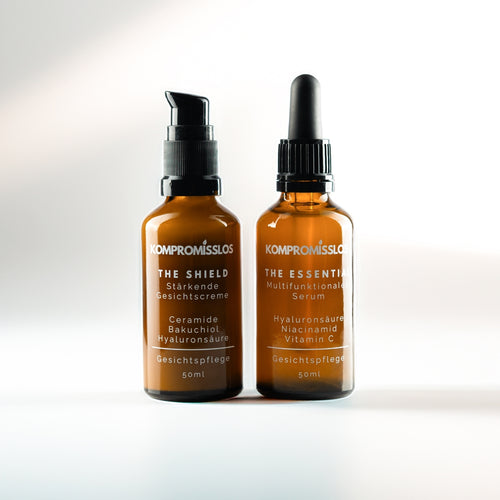
For many sensitive faces, retinol is the sensible rung. Retinal can work if you start with two to three evenings a week and your skin barrier is stable. If you would rather avoid the adjustment phase with redness and flaking altogether, bakuchiol is an option outside the ladder, because it is not a retinoid; how to weigh this up for sensitive skin is explained in bakuchiol or retinol for sensitive skin. That is exactly why the cream in The Duo contains bakuchiol rather than a retinoid.
Retinoids belong in your evening routine, and sunscreen during the day goes with them, whichever rung you are on. If you are pregnant or breastfeeding, check any retinoid with your doctor first.
I deliberately decided against a retinoid in the Duo – neither retinol nor retinal. Not because I think retinoids are bad. They are among the best-researched active ingredients in skincare, and if your skin tolerates them well, you should use them. But the Duo is made for skin that is sensitive, dry or mature and has no appetite for weeks of redness and flaking. That is why the cream contains bakuchiol instead of retinol. It is a decision in favour of tolerability, not a promise that bakuchiol replaces a retinoid. If you want retinal, you need a separate product for it, and I would rather say that openly. You can see what is in it instead in our active ingredients with disclosed concentrations.
Frequently asked questions
Does retinal work faster than retinol?
Possibly, but it has not been reliably shown. Retinal needs one conversion step fewer and, in measurements, triggered a stronger retinoid response in the skin than retinol. However, studies that compare the two directly over several weeks with the same application are rare. With either, expect several weeks to months before you can fairly judge any change in your complexion.
Does retinal have more side effects?
Not necessarily. In a small test under maximised conditions in the journal Dermatology, retinol and retinal had an equally low irritation potential, but retinal caused more flaking. Dryness, redness and flaking are possible with both, especially in the first few weeks. What is normal and when to stop is covered in retinol side effects.
Is retinal allowed in Switzerland?
Yes, retinal is available in Switzerland as a cosmetic ingredient and is found in over-the-counter serums and creams. You only need a prescription for retinoic acid itself, such as tretinoin. When buying, a clear percentage and packaging that keeps out light and air matter more than the question of whether it is allowed.
Can I use retinal in the morning?
Better not. Retinal is sensitive to light, and the evening is the usual, calmer time for retinoids. Apply it after cleansing in the evening. In the morning, add a separate sunscreen, because skin on retinoids can be more sensitive to the sun.
Is retinal better for spots?
That has not been shown. The review in Dermatologic Therapy does describe an effect of retinal on the skin’s bacterial flora, but direct comparisons with retinol for spots are lacking. For the occasional blemish, retinal may be worth a try. Acne, especially with inflamed nodules or scarring, should be assessed by a dermatologist, who can also prescribe stronger retinoids.
How should I store a retinal serum?
Cool, dark and tightly closed. Retinal is sensitive to light and air, so opaque airless pumps or tubes are better than clear glass or open jars. Open the pack only briefly and check the PAO symbol on the packaging. If the colour or smell has changed noticeably, replace the serum.
Does The Duo contain retinal or retinol?
No, The Duo contains neither retinal nor retinol, nor any other retinoid. Instead, the cream contains bakuchiol, a plant compound rather than a vitamin A derivative. If you still want to use a retinoid, introduce it separately and gradually in the evening; the Duo then remains your everyday base of serum and cream.
Sources
- Saurat JH, Didierjean L, Masgrau E, Piletta PA, Jaconi S, Chatellard-Gruaz D et al. Topical retinaldehyde on human skin: biologic effects and tolerance. Journal of Investigative Dermatology, 1994. Source
- Sorg O, Antille C, Kaya G, Saurat JH. Retinoids in cosmeceuticals. Dermatologic Therapy, 2006. Source
- Fluhr JW, Vienne MP, Lauze C, Dupuy P, Gehring W, Gloor M. Tolerance profile of retinol, retinaldehyde and retinoic acid under maximized and long-term clinical conditions. Dermatology, 1999. Source
- Creidi P, Vienne MP, Ochonisky S, Lauze C, Turlier V, Lagarde JM et al. Profilometric evaluation of photodamage after topical retinaldehyde and retinoic acid treatment. Journal of the American Academy of Dermatology, 1998. Source