Retinol side effects: redness, flaking, stinging – what’s normal and when to stop
ACTIVE INGREDIENTS
The typical side effects of retinol on the skin are redness, dryness, fine flaking, tightness and a burning sensation when you apply it. They usually appear in the first few weeks, during what is known as the adjustment period or retinisation, and often ease once the dose is adjusted. Mild discomfort that fades over time is normal. Weeping skin, swelling, blisters or severe pain are not: in that case, stop using retinol and have your skin looked at by a professional.
What side effects does retinol have on the skin?
On the skin, retinol mainly causes irritation: redness, dryness, flaking, a feeling of tightness, and burning, stinging or itching where you apply it. A review in Clinical Interventions in Aging names burning, scaling and dermatitis as the irritant reactions that make retinoids hard for many people to tolerate. The same review also puts this into perspective, however: with tretinoin and tazarotene, which are prescription retinoids, these reactions are considerably more pronounced, whereas retinaldehyde and retinol are much less irritating. That matters, because many of the experiences shared online come from tretinoin users and are then applied to over-the-counter retinol.
Two more things are worth knowing. First, the odd spot can appear in the early weeks – more on that below. Second, your skin is more sensitive to the sun at the start, which is worth taking seriously day to day. How strong all of this turns out to be depends less on the label than on three factors you can adjust: concentration, frequency and the state of your skin barrier before you start. Skin that already feels tight and stings simply has less of a buffer.
Why does retinol make skin burn and flake?
Retinol makes skin burn and flake because it speeds up the renewal of the epidermis, and the skin barrier becomes temporarily more permeable during the adjustment period. In the skin, retinol is converted in several steps into retinoic acid, the form that is actually active. Retinoic acid binds to receptors in skin cells and changes how quickly cells divide and how the outermost layer of the skin is built up. As a result, dead skin cells shed faster and become visible as fine flakes, and the skin loses more water to the outside. According to the review in Clinical Interventions in Aging, this retinoid reaction is probably triggered by the release of pro-inflammatory signalling molecules, which fits with the redness and itching.
The burning often has a second trigger too: products you normally tolerate without any problem suddenly sting, because they penetrate the weakened outer layer more easily. This happens particularly often straight after a thorough cleanse, on skin that is still damp, or when acids or an exfoliant are added on the same evening. Which active ingredients have no place on the same night, and how to increase the dose step by step, is covered in detail in our guide on what to mix with retinol. Here, one rule of thumb is enough: burning is a sign of too much at once, not of the product working especially well.
How long do redness and flaking last at the start?
Redness and flaking typically appear in the first few weeks and should gradually ease if you keep your use steady rather than stepping it up. The review in Clinical Interventions in Aging notes that the retinoid reaction generally shows up within the first few weeks of use. There is no fixed number of days after which it is all over. What counts is the trend: if the flakes get finer from week to week and the stinging on application passes more quickly, your skin is on the right track.
What almost always drags out the adjustment period is impatience. If you double the concentration or frequency straight after a calm week, you set the irritation off again. Cold weather, dry heated air and long hot showers also push the timeline back. If the skin on your face starts peeling over larger areas, you will find the right care for exactly that moment in peeling skin on your face. And if things get worse rather than better after a few weeks, that is no longer an adjustment period but a reason to change your approach.
Is it still the adjustment period or already a reaction?
It is the adjustment period if the symptoms stay mild, are limited to the areas where you apply retinol and lessen over time; it is a reaction if they increase, spread or leave the skin raw. So the key measure is not whether your skin reacts, but which direction things move in over the weeks. Slight redness the morning after an application that fades by midday is quite different from redness that settles in and makes every product sting. It helps to jot down for two weeks when you applied retinol and how your skin looked the next day. That way you spot a pattern instead of going by gut feeling.
| Sign | More likely the adjustment period | More likely a reaction or overload |
|---|---|---|
| Course | Gets weaker over the weeks | Stays just as strong or gets worse |
| Location | Only where you apply retinol | Spreads to the eyelids, neck or untreated areas |
| Flaking | Fine, dry flakes | Rough, raw or cracked patches |
| Burning | Brief, on application | Persistent, even with otherwise mild products |
| Spots | Occasional, in your usual places | Lots of new ones in unusual places |
In the early weeks, the occasional blemish in your usual places can be part of what is known as purging, caused by faster skin renewal, whereas lots of new spots in unusual places point more towards an intolerance. How to tell the two apart reliably, and how long you can wait, is explained in the article skin purging or a reaction.
Which warning signs mean you should stop retinol straight away?
Stop using retinol straight away if your skin weeps, swells, blisters or is very painful. These signs are no longer part of the normal adjustment period; they point to marked irritant dermatitis or an allergic reaction, which only a professional can reliably tell apart. In this situation, waiting it out or trying to counteract it with even more skincare products only prolongs the strain on your skin.
- Weeping: the skin becomes moist or sticky, or forms crusts.
- Swelling: your eyelids, cheeks or lips swell, even if you have not applied any retinol there.
- Blisters: small or larger blisters on reddened skin.
- Severe pain: a burning sensation that does not fade after a few minutes but persists and interferes with your day.
In these cases, leave out all active products, cleanse only with lukewarm water and see your dermatologist – promptly if your face is swelling. Take the product or a photo of the ingredient list with you, as that makes it easier to assess. Only once your skin has completely settled and a professional gives you the green light is another attempt even worth considering.
What options do you have if you can’t tolerate retinol?
If you can’t tolerate retinol, you have four options: take a break and strengthen your barrier, lower the dose, switch to a milder form of vitamin A or choose a different active ingredient. Which one suits you depends on how strong the reaction was and what you actually wanted retinol for. The order matters: the recovery phase comes first, and only then the decision about what to do next.
- Take a break and look after your barrier: two steps instead of ten, a mild cleanser and a cream with lipids such as ceramides and squalane plus humectants such as panthenol. It is worth knowing beforehand how to recognise a damaged skin barrier.
- Lower the dose: a lower concentration or just two evenings a week is enough for a lot of skin that became irritated with daily use.
- Choose a milder form: retinyl esters such as retinyl palmitate are weaker precursors and usually irritate less, but their effect is also more modest. Retinal, on the other hand, is closer to retinoic acid; what that means for your skin is explained in retinal vs retinol.
- Switch to a different active ingredient: bakuchiol or niacinamide, for example, work without vitamin A, each with its own profile.
On bakuchiol, there is a randomised double-blind study in the British Journal of Dermatology with 44 participants, in which 0.5% bakuchiol twice daily and 0.5% retinol once daily reduced wrinkle surface area and hyperpigmentation with no statistical difference between them, although the retinol group reported more scaling and stinging; what this means for your skin is covered in bakuchiol or retinol for sensitive skin. Bakuchiol is not entirely free of irritation either, though; what to do if you don’t tolerate it is explained in our guide to what bakuchiol is. Devices such as an LED face mask are often marketed as an irritation-free alternative; whether red light can replace retinol is covered in our guide to the LED face mask at home.
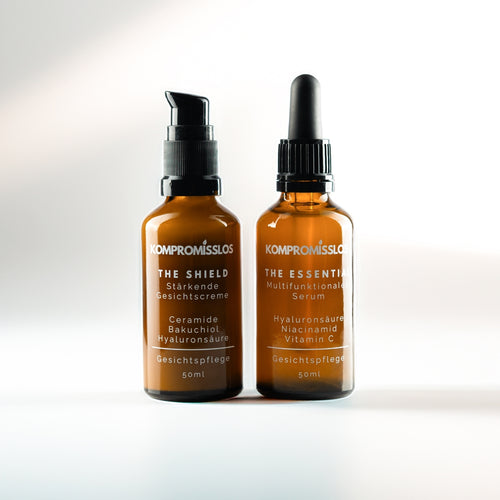
For the recovery phase itself, you don’t need specialist products, just a few that work well together. The Duo, made up of The Essential serum and The Shield cream, is one such two-step routine: the cream contains Ceramide NP, squalane and jojoba oil, and the Duo also contains panthenol and hyaluronic acid, which provide moisture and support the skin barrier. It contains no retinoids.
The Shield contains bakuchiol instead of retinol, and that was a deliberate decision. Retinol often causes redness and flaking, especially during the adjustment period, and a cream you use morning and evening shouldn’t put your skin to the test for weeks on end. To be honest, though, bakuchiol is not a retinol clone. Chemically, it is not a retinoid, and if you are specifically looking for what a retinoid does, you won’t find it with us. If you tolerate retinol well and are happy with it, you don’t need to switch. What I can offer you is a calm base without retinoids and without fragrance. Which active ingredients are in the Duo, and in what concentration, is set out openly on our page covering all our active ingredients.
Frequently asked questions
Does retinol thin your skin?
No, research tends to point the other way. In a study in the Journal of Cosmetic Dermatology, four weeks of retinol increased the thickness of the epidermis. Skin feels thinner during the adjustment period because dead skin flakes shed faster and the surface is more sensitive. That is a temporary sensation, not a breakdown of the skin.
Can I use retinol under my eyes?
Yes, but more cautiously than on the rest of your face, because the skin there is thin and reacts more quickly. Apply it sparingly to the area over the bone, not up to the lash line and not on the mobile eyelids. According to the review in Clinical Interventions in Aging, applying it too close to the eye can occasionally irritate the conjunctiva. If your eyelids swell, stop using it there straight away.
Does retinol make your skin sensitive to the sun?
Yes, especially at the start. According to the review in Clinical Interventions in Aging, sensitivity to light with retinoids normally occurs at the beginning of use and returns to normal after a few months. So apply retinol in the evening and use a separate sunscreen every day, even in winter.
Does a moisturiser help with retinol irritation?
Yes, a cream with lipids and humectants can noticeably cushion dryness and tightness. But it does not replace adjusting the dose: if your skin keeps burning despite good care, you are using too much retinol or using it too often. Fragrance-free products without added acids are the gentler choice during this phase.
Can I start using retinol again after a break?
Yes, once your skin has fully calmed down, meaning no redness, burning or flaking. Don’t pick up where you left off, though; start at a lower strength and less often. If you had weeping, swelling or blisters, check with a professional before starting again.
Does skin react more strongly to retinol in winter?
Often, yes. Cold air outside and dry heated air indoors draw extra moisture from the skin, and a barrier already made more permeable by retinol reacts more sensitively to this. That is why many people use it less often in winter or switch to a richer cream. Long, hot showers dry the skin out even further, and are easy to keep shorter at this time of year.
Can I switch to The Duo after retinol irritation?
Yes, you can, ideally once the acute irritation has died down. The Duo contains no retinoids; the cream relies on bakuchiol, Ceramide NP and squalane. It is not a like-for-like replacement for retinol, but a calm two-step routine in which the Duo cares for your skin morning and evening.
Sources
- Mukherjee S, Date A, Patravale V, Korting HC, Roeder A, Weindl G. Retinoids in the treatment of skin aging: an overview of clinical efficacy and safety. Clinical Interventions in Aging, 2006. Source
- Dhaliwal S, Rybak I, Ellis SR, Notay M, Trivedi M, Burney W, et al. Prospective, randomized, double-blind assessment of topical bakuchiol and retinol for facial photoageing. British Journal of Dermatology, 2019. Source
- Kong R, Cui Y, Fisher GJ, Wang X, Chen Y, Schneider LM, et al. A comparative study of the effects of retinol and retinoic acid on histological, molecular, and clinical properties of human skin. Journal of Cosmetic Dermatology, 2016. Source