Do LED face masks work? What red light can and can’t do for your skin
ROUTINE
LED face masks do work, but the effect is smaller than the advertising promises. In studies, red and near-infrared light can measurably improve fine lines and skin texture, but the research is small, short and in some cases funded by manufacturers. Blue light for spots is less well supported than many people think. A mask is therefore an optional extra, not a foundation. Your daily basics remain moisture, a well-supported skin barrier and a separate sunscreen.
What can an LED face mask really do for your skin?
Going by current evidence, an LED face mask can smooth fine lines slightly and make skin texture look more even – but nothing more. It replaces neither sun protection nor skincare, and it does not work overnight. At-home masks use light-emitting diodes that emit light at specific wavelengths: usually red, often combined with invisible near-infrared, and on some models blue or yellow as well. The light does not injure the skin, which is why there is no downtime as there is after laser treatment. And that is precisely the catch: such a gentle method also has gentle effects. A systematic review in Lasers in Surgery and Medicine assessed 31 randomised controlled trials on LEDs in dermatology and gave skin rejuvenation only a grade C recommendation. As weaknesses, the authors list small numbers of participants, a lack of blinding, a lack of sham treatment and widely varying device settings.
So what has been shown is that something happens. How much, for whom and with which device remains an open question. If you want the full picture, the overview of which anti-wrinkle ingredients are actually proven covers the options that have been well studied for years. In that picture, a mask is at most an add-on.
How does red light work on the skin, and what about near-infrared?
According to current understanding, red and near-infrared light work through light receptors in the cells’ powerhouses, not by injuring the skin. Experts call this photobiomodulation. An educational review in the Journal of the American Academy of Dermatology describes the process as follows: red light in the range of 620 to 700 nanometres and near-infrared from 700 to 1440 nanometres are absorbed by, among other things, the enzyme cytochrome c oxidase in the mitochondria. This changes the cell’s energy metabolism, the formation of reactive oxygen species and its calcium balance. In turn, this sets off signalling pathways that influence cell division, cell migration and cell differentiation. Near-infrared is invisible to the eye, which is why many masks combine it with visible red – as does the mask study described below.
It is important to distinguish this from UV: red and near-infrared light are not part of UV radiation, they do not tan your skin and they are not the light that sunscreen protects you from. The same review stresses that the effect depends heavily on the parameters, meaning energy dose, treatment time and power output. Two masks with the same colour on the box can therefore deliver very different amounts of light to the skin. When comparing, look at wavelength and power, not at how many LEDs a mask has.
What do studies show about LED masks for wrinkles, and how reliable are they?
Studies show measurable improvements in fine lines, but they are small, short and in some cases funded by manufacturers. A frequently cited South Korean study in the Journal of Photochemistry and Photobiology B treated one side of the face in 76 people with facial wrinkles, twice a week for four weeks, using 830 nanometres, 633 nanometres, a combination of both or a sham light. In the three treatment groups, measured wrinkles decreased by up to 36 per cent from baseline, and skin elasticity increased by up to 19 per cent. In tissue samples, the researchers found more collagen and elastic fibres. That sounds impressive, but in each case it is the best result compared with the starting point, not the difference from the sham treatment. What is more, the treatment was given with clinical LED devices, not with a mask for the bathroom.
Closer to home use is a randomised, double-blind study published in Medicine in 2025. Sixty people aged between 30 and 65 used either a mask with 630-nanometre red and 850-nanometre near-infrared light or a sham device with heavily dimmed light, for 9 minutes, five times a week over 12 weeks. From week 8, independent assessors rated the crow’s feet in the mask group as significantly better than in the control group. However, the study was funded by the company that makes the device tested, and all participants were of Asian descent. That does not make the result wrong. But it is one data point for one device, not proof for every mask on the market.
Red, blue or yellow: which light colour is meant for what?
Red and near-infrared are meant for wrinkles and skin texture, blue for spots, and yellow is mostly marketed for redness. Of these, red is the best studied. For acne, a meta-analysis in the Annals of Family Medicine assessed 14 studies on blue light with 698 participants. Most were small, short and at high risk of bias, and there was no significant difference from the comparison group in the number of inflammatory or non-inflammatory spots. Physician assessments came out more favourably in some studies, but according to the authors the evidence is not strong enough for firm conclusions. For home devices, yellow light has been studied even less. Acne and rosacea are skin conditions, and light therapy for them belongs with a dermatologist, who decides on the device, the dose and any accompanying treatment. What skincare can do alongside is covered in the articles on rosacea skincare and on breakouts in your 40s. Whether the light from your phone screen harms your skin, incidentally, is a different question and has little to do with an LED mask.
| Light colour | Range | Marketed for | How well supported |
|---|---|---|---|
| Red | 620 to 700 nanometres | Fine lines, skin texture | Small controlled studies with measurable, modest effects |
| Near-infrared | 700 to 1440 nanometres, invisible | Wrinkles, elasticity | Often studied together with red; its effect on its own tested in only a few small studies |
| Blue | Visible blue | Spots | Small, short studies; no significant difference in the number of spots |
| Yellow | Visible yellow | Redness, “glow” | Hardly any reliable data for home devices |
How often and for how long should you use an LED face mask?
Use an LED face mask as often and for as long as your device’s instructions say, and no longer. The studies used very different schedules, from twice a week over four weeks to five 9-minute sessions a week over three months. There is no universal dose, because every device emits a different amount of light. More minutes therefore do not automatically mean more effect. What matters more than long individual sessions is sticking with it for weeks, since none of the studies ran for less than four weeks. If you give up after two weeks, you have never given the device a fair test. That applies to light just as much as to creams, as the article on how long skincare takes to work shows.
- Follow the schedule in the instructions: the effect depends on dose, duration and power, not on the feeling that more is better.
- Keep going for at least eight to twelve weeks: in the mask study, differences appeared from week 8.
- Use photos, not the mirror: a photo every two weeks in the same daylight and from the same angle tells you more than a daily glance.
- Protect your eyes: keep them closed and use any eye shields supplied with the mask.
- Pause if your skin turns red: according to the JAAD review, redness is the most common side effect, and it is usually harmless and temporary.
Who should skip an LED face mask, and when does light therapy belong in a clinic?
An LED face mask is not for you if you want to use it to treat a skin condition yourself, if you take medication that makes you sensitive to light, or if you have an eye condition and have not had it checked by a doctor first. In these cases, light therapy belongs in a clinic, where diagnosis, device and dose fit together. For new or changing marks on your skin, too, a dermatologist is the right person to see, not a device. The review in Lasers in Surgery and Medicine describes the side effects of LEDs as mild overall: pigment changes, dryness, redness, flaking and stinging; no serious side effects were reported. So the risk is low – but so is the benefit you can expect.
A mask is also not for anyone who expects a fast, clear-cut result. Laser, HIFU and microneedling are in-clinic procedures with a different mode of action, stronger effects and different risks. Gua sha is a massage technique and has nothing to do with light. If you are torn between these options, compare your expectations rather than the devices.
Is an LED face mask worth it, or are sunscreen and good skincare enough?
For most people, the foundation should come first: daily sun protection and skincare that provides moisture and supports the skin barrier. A mask can complement this, but never replace it. No device makes up for what unprotected sun does to your skin day after day, which is why sunscreen for your face comes before any gadget. The promise of more collagen also means something different for light than for a cream. The fact that red light increased collagen fibres in tissue samples says nothing about whether collagen from a cream can actually get into your skin, and vice versa.
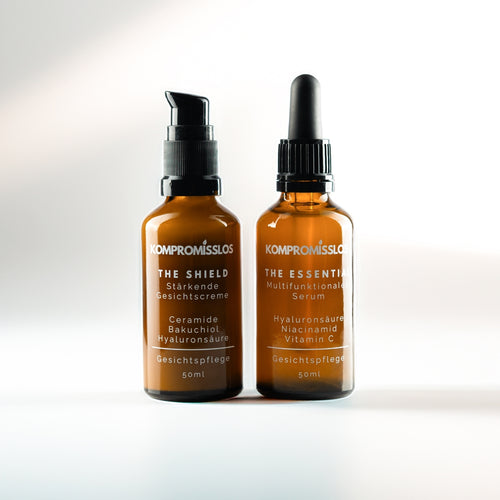
If your foundation is in place and you fancy trying a device, a mask is a reasonable, low-risk experiment, as long as your expectations stay realistic. If it is not, the foundation is the better investment. The Duo of serum and cream covers this skincare in two steps: The Essential with niacinamide, 3-O-Ethyl Ascorbic Acid and hyaluronic acid in three molecular sizes, and The Shield with Ceramide NP, bakuchiol and squalane, with no fragrance and no retinol. In her review on Judge.me, Gabriela K. writes: “just two products that combine well. I really appreciate not having to use umpteen creams” (review translated from German). The same thinking applies to devices: only once every step has a job of its own is it worth adding another.
When buying, look for specific figures on wavelength in nanometres and power output. Without them, the device cannot be compared with any study, no matter how many colours it offers.
I do not sell a device, and I am not going to tell you that a cream replaces light therapy. It does not, and the same is true the other way round. My decision was a different one: two products instead of eight, so that the foundation is in place every day. For the cream, I deliberately chose bakuchiol instead of retinol, because many of our customers have sensitive skin. The cream intentionally has no SPF, which is why a separate sunscreen belongs in your morning routine. If you are thinking about an LED mask, check this foundation first. If it has been running smoothly for a few months, you can try a device as an add-on. If it has not, you are missing exactly what no device can make up for. What the two steps in the morning and evening look like is deliberately kept simple.
Frequently asked questions
Is an LED face mask bad for your eyes?
Red LED light is not UV light, and no serious side effects were reported in the studies reviewed. The light is bright, though, and one skin rejuvenation study recorded eye symptoms as a side effect. Keep your eyes closed during use, use any eye shields provided and follow the instructions. If you have an eye condition or take medication that makes you sensitive to light, check with a doctor before using one.
Does an LED face mask replace retinol?
No. Retinol and LEDs work in completely different ways, and retinol has been studied for far longer and far more widely as an ingredient for photoageing. If your skin does not tolerate retinol, a mask is not an automatic alternative. What you can do when retinol causes redness and flaking is covered in a separate article.
When will I see results from an LED face mask?
Expect two to three months of regular use. In the at-home mask study, measurable differences compared with the sham treatment appeared from week 8, with five sessions a week. If you see nothing after one or two weeks, you have not done anything wrong. Compare photos taken in the same light rather than checking the mirror every day.
Is red LED light the same as UV light or a sunbed?
No. Red light lies in the range of 620 to 700 nanometres, with near-infrared above that, both well away from UV radiation. An LED mask does not tan your skin and is not comparable to a sunbed. By the same token, it does not protect you from UV either, so you still need sun protection during the day.
Does blue LED light help with spots?
The evidence is weaker than the advertising suggests. A meta-analysis in the Annals of Family Medicine found no significant difference in the number of spots compared with the control group, and the studies were small and short. With acne, choosing a therapy – light therapy included – is a matter for a dermatologist.
Can I use an LED face mask every day?
That depends on the device; what counts are its instructions. In the at-home study, the mask was worn five times a week for 9 minutes, while other studies used two sessions a week. More sessions than intended do not automatically achieve more. If your skin turns red or dry, take a break for a few days.
Can I use The Duo with an LED face mask?
Yes, the two do not rule each other out. The Duo is your daily skincare, the mask an optional device, and your device’s instructions determine the order in which you combine them. We do not promise that one boosts the other. The Duo contains no retinol and no fragrance, and you still need sun protection during the day.
Sources
- Jagdeo J, Austin E, Mamalis A, Wong C, Ho D, Siegel DM. Light-emitting diodes in dermatology: A systematic review of randomized controlled trials. Lasers in Surgery and Medicine, 2018. Source
- Maghfour J, Ozog DM, Mineroff J, Jagdeo J, Kohli I, Lim HW. Photobiomodulation CME part I: Overview and mechanism of action. Journal of the American Academy of Dermatology, 2024. Source
- Lee SY, Park KH, Choi JW, Kwon JK, Lee DR, Shin MS, et al. A prospective, randomized, placebo-controlled, double-blinded, and split-face clinical study on LED phototherapy for skin rejuvenation: clinical, profilometric, histologic, ultrastructural, and biochemical evaluations and comparison of three different treatment settings. Journal of Photochemistry and Photobiology B, 2007. Source
- Park SH, Park SO, Jung JA. Clinical study to evaluate the efficacy and safety of home-used LED and IRED mask for crow's feet: A multi-center, randomized, double-blind, sham-controlled study. Medicine (Baltimore), 2025. Source
- Scott AM, Stehlik P, Clark J, Zhang D, Yang Z, Hoffmann T, et al. Blue-Light Therapy for Acne Vulgaris: A Systematic Review and Meta-Analysis. Annals of Family Medicine, 2019. Source