How long does skincare take to work? Realistic timelines instead of one-week miracles
ROUTINE
How long skincare takes to work depends on what you expect from it: you will notice a better skin feel and more moisture from the very first application. Visible changes from active ingredients such as niacinamide or vitamin C, on the other hand, take weeks to months. For planning purposes, 8 to 12 weeks of regular use is realistic, and often longer for dark spots. If you judge a product after one week, you are only judging how your skin feels, not whether it works.
How long does it take for skincare to work?
Skincare works at two speeds: moisture and skin feel change within hours, while a visibly different complexion takes around two to three months. The difference lies in where the product acts. Humectants and lipids work directly in the stratum corneum, the outermost layer of the skin, which is why dry skin feels softer as soon as you apply a cream. Active ingredients meant to soften the appearance of redness, fine lines or uneven texture, by contrast, act on processes that only add up over many days. On top of that, you see your own face every day and barely notice small changes. That is why clinical studies on skincare ingredients do not run for a week but for weeks to months: in the ingredient studies cited here, the first measurable effects appeared after 4 weeks, and assessments continued for up to six months. As a rule of thumb for your planning, that means judging how your skin feels after a few days, and your complexion after eight weeks at the earliest.
| What changes | Realistic timeframe | How you notice it |
|---|---|---|
| Skin feel and suppleness | From the first application, for a few hours | Less tightness, skin feels softer |
| Moisture at the skin’s surface | Hours, stable after a few days of regular use | Fewer flakes, make-up sits more smoothly |
| Pigmentation, blotchy redness, fine lines | 4 to 12 weeks in niacinamide studies | Only when you compare photos with your starting picture |
| Skin texture and pronounced dark spots | Several months | Spots look lighter, not gone |
What do you feel straight away and what takes weeks?
You feel anything that happens on the surface of the skin straight away: moisture, smoothness, less tightness. A study in Clinical, Cosmetic and Investigational Dermatology shows how quickly this happens. In it, measured skin hydration rose significantly after a single application of moisturisers, measured after 2, 4, 6 and 24 hours, while the placebo cream showed no significant increase at any point. This effect is real, but it only lasts as long as you keep using your skincare regularly; it tells you nothing about long-term change. Changes that lie deeper, or that only show up over several renewal cycles of the top layer of the skin, take weeks instead – a more even skin tone, for example, or fine lines that are less visible.
With mature skin, there is another factor. The top layer of the skin renews itself more slowly over the years, and that is exactly why it usually takes longer for skincare to show in the mirror. How this cycle works is explained in the article on skin cell turnover and why it slows with age. If you expect the same pace at 50 as at 25, you will quickly be disappointed, even though your skincare may well be working. Dark spots call for the most patience; what is realistic there is covered in the article on dark spots on the face.
How long do ingredients like niacinamide or vitamin C take to work, according to studies?
According to studies, visible changes from niacinamide appear after 4 to 12 weeks, while vitamin C was assessed after three and six months, depending on what is being measured. In a study in Dermatologic Surgery, 50 women applied 5% niacinamide twice a day to one half of the face for 12 weeks, with measurements taken at 4-week intervals. At the end, there were fewer fine lines, fewer dark spots and less blotchy redness than on the comparison side, among other things. A smaller study in the British Journal of Dermatology with 18 participants found significantly less hyperpigmentation after just 4 weeks with a moisturiser containing 5% niacinamide than with the same base without the active ingredient. For vitamin C, a double-blind study in Experimental Dermatology tested a cream with 5% vitamin C over six months, with assessments after three and six months. However, it was tested on the décolletage and arms, not on the face; at the end, the side treated with vitamin C performed significantly better than the comparison side.
Two things matter here. First, these timeframes refer to the form and concentration that were tested, and a different formulation may work faster or more slowly. Second, ‘significant’ in a study does not mean that every participant saw a clear difference. How the individual ingredients behave is covered in detail in the articles on niacinamide benefits and how long they take and what vitamin C can realistically achieve.
How long should you test a new cream before judging it?
You should use a new cream or serum regularly for at least eight weeks, ideally twelve, before you judge whether it works. Whether your skin tolerates it is something you can decide much sooner: if your skin clearly stings or turns red after the first few applications, you do not need to stick it out for twelve weeks. A fair test follows a few simple rules:
- Take a starting photo: in daylight, in the same place, at the same time of day, without make-up.
- Change only one product at a time, otherwise you won’t know afterwards what made the difference.
- Use it as intended, usually morning and evening, not just on good days.
- Take new photos after 4, 8 and 12 weeks and compare them with your starting photo, not with yesterday.
- Only then decide whether to stay with it or switch.
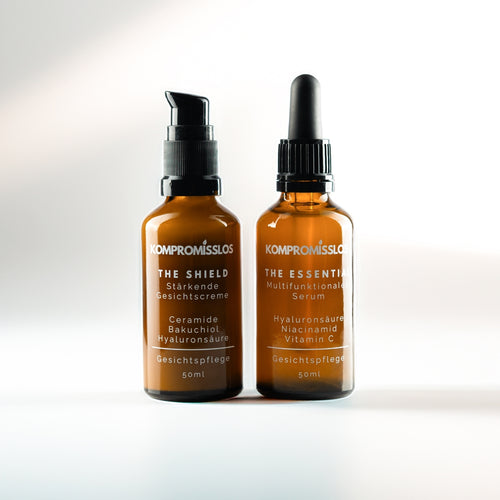
Factor the pack size into your test period as well. One pack of The Duo serum and cream set lasts around two months if you use both products twice a day. For a twelve-week test you will therefore need more than one pack, and the 100-day return policy covers this period. This patience pays off with mature skin in particular; which steps are actually necessary there is described in the article on skincare for mature skin and the routine you actually need.
How can you tell that a skincare product isn’t working?
A skincare product isn’t working for you if your skin doesn’t tolerate it, or if you see no difference in a photo comparison after twelve weeks of consistent use. These are two different situations. Intolerance shows up early: persistent stinging, redness, itching or new flaky patches are not a sign that the product is working, but a sign that it doesn’t suit you. In that case, stop using it; if the reaction does not settle, have it looked at by a dermatologist. A lack of results shows up late, and this is where an honest look at the conditions is worthwhile. Did you really use the product every day? Did you try three other things during the same period? If you keep switching, you never give a product the chance to work and you put additional strain on your skin – a typical route to skincare overload.
Be wary of other people’s experiences, too. When a review says someone’s skin was completely transformed after three days, it usually describes how the skin felt, not the effect of an active ingredient. How to read reports like these is explained in the article on which skincare reviews are worth trusting.
Measure progress against where you started, not against advertising images. If after eight weeks your skin feels less tight, looks calmer and you need to reapply cream less often, that is already a result, even if not a single wrinkle has disappeared.
I decided on a 100-day return policy because active ingredients take weeks. A two-week test would only check how your skin feels, and that would be unfair to you and to the product. For the same reason, I disclose the concentrations: 5% niacinamide, 2% vitamin C as stable 3-O-Ethyl Ascorbic Acid and 1% zinc PCA, as figures for The Duo as a whole. That way you can compare them with studies yourself and also see where the comparison falls short, for example because the vitamin C study above used a different form and concentration. I won’t give you a timing promise, because skin responds at different speeds. The role each ingredient plays is explained on the page about our active ingredients, and the conditions for returns are set out in our return policy.
Frequently asked questions
Does a cream work after just one week?
After one week, you can tell whether your skin feels cared for and whether you tolerate the cream, but nothing more. Moisture works immediately, while in studies visible changes from active ingredients take weeks to months. Judging the effect after seven days is therefore too early, but judging tolerance is not.
Does the season affect how quickly skincare works?
Yes, the season affects what you see. In winter, dry heated air and cold weather put strain on the skin, so some of the progress can be masked by the weather. In summer, a new tan or new pigmentation can cancel out a brightening effect. If you compare across the seasons, keep this in mind and use sunscreen consistently during the day.
Is it normal for skin to get worse at first?
Only with retinoids and acids that speed up skin renewal is there a genuine initial phase with more breakouts, known as skin purging, which is different from a reaction. With all other products, skin getting worse is not your skin adjusting or an initial flare-up, but a sign that the product doesn’t suit you. What to do then is covered in the article on face cream that stings.
How long should I stick with a serum?
Stick with a serum for at least eight to twelve weeks if your skin tolerates it well. That matches the 12-week period over which the niacinamide study in Dermatologic Surgery took its measurements. If you see a difference after that and tolerate it well, there is no reason to switch just out of curiosity.
Do I have to wait longer if I’m sleeping badly or stressed?
Stress and lack of sleep can take a toll on your complexion and mask the progress of your skincare, so you often see less of it during these phases. Skincare can’t make up for that, but you don’t need to switch products because of it either. What happens in your skin is explained in the article on stress and skin.
How do I document changes in my skin?
Most reliably with photos taken under the same conditions every time: daylight by a window, the same time of day, no make-up, from the front and from both sides. Take a starting photo, then a new one every four weeks. Add a brief note on how your skin feels and whether anything has changed in your sleep, the weather or your cycle.
How long does it take to notice a difference with The Duo?
You will notice how your skin feels after serum and cream from the first application. For visible changes from the active ingredients, allow eight to twelve weeks, as with any skincare, using both morning and evening. One pack of The Duo lasts around two months, and the 100-day return policy gives you time for an honest test.
Sources
- Spada F, Barnes TM, Greive KA. Skin hydration is significantly increased by a cream formulated to mimic the skin's own natural moisturizing systems. Clinical, Cosmetic and Investigational Dermatology, 2018. Source
- Bissett DL, Oblong JE, Berge CA. Niacinamide: A B vitamin that improves aging facial skin appearance. Dermatologic Surgery, 2005. Source
- Hakozaki T, Minwalla L, Zhuang J, Chhoa M, Matsubara A, Miyamoto K, et al. The effect of niacinamide on reducing cutaneous pigmentation and suppression of melanosome transfer. British Journal of Dermatology, 2002. Source
- Humbert PG, Haftek M, Creidi P, Lapière C, Nusgens B, Richard A, et al. Topical ascorbic acid on photoaged skin. Clinical, topographical and ultrastructural evaluation: double-blind study vs. placebo. Experimental Dermatology, 2003. Source