Skin cell turnover: how long the cycle really takes and why it slows with age
SKIN OVER 40
Skin cell turnover takes different lengths of time depending on the layer and your age: in young adults, the outermost layer of skin is replaced in roughly two to three weeks, and the epidermis as a whole in a little over five weeks on average. The well-known 28 days are a rounded rule of thumb, not a fixed clock. With age, the cycle becomes measurably longer, especially after 50. For your skincare, this means that changes in your complexion take weeks, and extra exfoliation does not make up for that time.
How long does skin cell turnover take?
In young adults, skin cell turnover takes around two to three weeks for the outermost layer and a little over five weeks on average for the epidermis as a whole. The process is always the same: cells divide in the lowest layer of the epidermis, the basal layer. The new cells move upwards, flatten, lose their nucleus and become corneocytes. These form the stratum corneum, the skin’s protective outer layer, which is eventually shed as tiny, invisible flakes. How long this journey takes depends on exactly what is being measured. A classic study in the Journal of Gerontology marked the skin’s surface with a fluorescent dye and observed how quickly it disappeared. In young adults, it took about 20 days to pass through the stratum corneum. A study in the Journal of Investigative Dermatology tracked cell division using labelled cellular building blocks and arrived at an average turnover time of 39 days for the epidermis as a whole, from the basal layer up to the stratum corneum.
So the figures do not contradict each other; they describe different stretches of the same journey. The one thing to bear in mind is that the surface you see and apply cream to is the final stage of a process that began weeks earlier further down.
| What is measured | Result | Source |
|---|---|---|
| Transit through the stratum corneum, young adults | about 20 days | Journal of Gerontology, 1983 |
| Transit through the stratum corneum, older adults | more than 10 days longer | Journal of Gerontology, 1983 |
| Renewal of the entire epidermis, normal skin | 39 days on average | Journal of Investigative Dermatology, 1984 |
| “Every 28 days” | rounded rule of thumb | no single measurement |
Is the 28-day rule of thumb accurate?
As a rough order of magnitude for young skin, the 28-day rule holds; as a precise figure, it does not. It sits between the value measured for the stratum corneum of young skin and the value for the epidermis as a whole, and it is a good way of explaining why skin does not look different overnight. It becomes a problem when it is treated like a timetable, along the lines of: after four weeks your skin is completely new, so after four weeks every product must show visible results. That is not how skin works. First, the speed varies from person to person. Second, it varies from one part of the body to another, even within the face. Third, it changes with age, and not at an even pace. If you use 28 days as your yardstick at 55, you are counting on a pace your skin often no longer quite reaches. The more honest way of putting it is this: the surface of your skin replaces itself within a few weeks, and in mature skin that is more likely to take a little over a month than three weeks. That is enough to go by, and it takes the pressure off the question of whether everything has to look different after exactly one month.
Why does skin cell turnover slow down with age?
Skin cell turnover slows down with age because the cells in the basal layer divide less often, so fewer new cells come through. The Journal of Gerontology study mentioned above shows this quite directly: in older adults, transit through the stratum corneum took more than ten days longer. Because the number of cell layers in the stratum corneum stayed the same with age, the researchers interpreted this as a sign of reduced cell division. The pattern is striking. According to the analysis, the decline was not spread evenly across adult life; turnover stayed relatively constant in the younger years and dropped markedly after the age of 50. This is the stage of life when many people notice that their skin looks rougher and that minor irritation stays visible for longer.
Slower renewal is only part of the picture, though. Over the decades, UV damage adds up, and the skin becomes thinner and holds on to moisture less well. Which of these factors you can influence is covered in the article on how to slow down skin ageing. Why skin also loses thickness over the years is explained in the article on thin skin on the face.
What does this mean for how your skincare works?
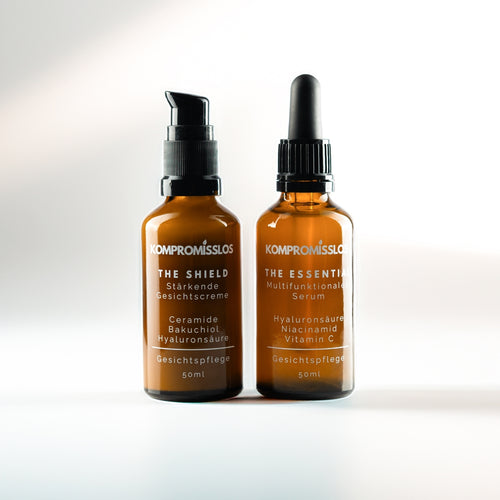
For your skincare, skin cell turnover means one thing above all: part of the effect can be felt immediately, while the visible part only follows over several cycles. Moisture works directly in the stratum corneum. It makes your skin feel softer after you apply it, and this effect lasts for as long as you keep up your routine. Anything that goes beyond the moment, such as a more even or calmer-looking complexion, takes time, because the stratum corneum you apply cream to today is only gradually replaced by new cells coming up from below. That is why it does not show after a week but over several cycles – and in mature skin, those cycles take longer. You will find specific timelines for each active ingredient in the article on how long skincare takes to work. In practice, this means consistency counts for more than quantity. One pack of The Duo lasts around two months when used morning and evening. Even with slower turnover, that is roughly two passes through the stratum corneum – enough time to judge fairly how your skin responds.
Can you speed up skin cell turnover?
Skin cell turnover can be sped up, mainly with retinoids and acids, but faster is not automatically better. Retinoids such as retinol act on cell division in the epidermis. Acids such as AHAs loosen the bonds between the outermost corneocytes so that they shed earlier. Both can make the surface look smoother, but both can also cause irritation, especially on sensitive or dry skin. Acids also make skin more sensitive to UV radiation. If you remove corneocytes faster than new ones come through, you thin out the protective layer instead of renewing it. Particularly after 50, when the supply of new cells is already slower, that is a poor trade.
- Daily sun protection: does not speed anything up, but protects the cells coming through from additional UV damage.
- Retinoids: the best-studied way of influencing turnover, with an adjustment period and some potential for irritation.
- Acids only in moderation: what they do and when you can skip them is covered in the article on the AHA peel.
- Look after your skin barrier: moisture and lipids do not speed anything up, but they make sure the stratum corneum can do its job.
Why does mature skin need patience rather than more exfoliation?
Mature skin needs patience rather than more exfoliation because it replaces lost corneocytes more slowly, so overdoing it stays visible for longer. An exfoliant removes whatever is sitting loosely on the surface. That feels smooth for a short while, but it does nothing to change how quickly new cells are formed further down. If you exfoliate too often or too harshly, your skin loses part of its protective layer, and mature skin takes longer to make up for that loss. Typical consequences are tightness, redness and stinging from products that used to be fine. The article on whether you need to exfoliate your face at all helps you answer that question. For most mature skin, the answer is: rarely or not at all. Realistic expectations help here. In her review on Judge.me, Nicole B. writes: “The fine lines don’t go away, which isn’t really the idea anyway” (review translated from German). That is exactly the right attitude for the pace of mature skin.
If you want to assess a new routine, do not change everything again after two weeks. Keep it the same for at least two cycles – a good eight weeks for mature skin – and compare photos taken in the same light rather than studying your reflection from one day to the next.
I deliberately chose not to include an exfoliant in our range. Not because exfoliants are bad in principle, but because mature skin renews itself more slowly and extra exfoliation does more to irritate it than to move it forward. You do not need an exfoliant alongside The Duo. For the same reason, we offer a 100-day return policy: results take time, and I do not want anyone to have to judge after two weeks, when their skin has not even completed a single cycle. What I cannot do is speed up your skin cell turnover. What the two products do is supply your skin with moisture and barrier care, morning and evening, day after day and without any additional exfoliation. How to use them in everyday life is deliberately kept simple.
Frequently asked questions
How long does skin cell turnover take at 50?
Around 50, skin cell turnover starts to slow down noticeably, but there is no fixed figure for this age. In a study in the Journal of Gerontology, transit through the stratum corneum took about 20 days in young adults and more than ten days longer in older adults. The decline set in mainly after the age of 50. So expect each cycle to take closer to a month than three weeks.
Does retinol speed up skin cell turnover?
Yes, retinol and other retinoids act on cell division in the epidermis and are among the best-studied active ingredients for skin ageing. In a study in the Archives of Dermatology, a lotion with 0.4% retinol, applied to the arm up to three times a week, improved fine wrinkles markedly more than the comparison lotion without the active ingredient after 24 weeks, in people with an average age of 87. Expect an adjustment period, possible irritation and the need for daily sun protection.
Does skin renew itself faster at night?
That has not been clearly established in humans. A study in PNAS showed that the epidermis has its own internal clock and that hundreds of genes are more or less active depending on the time of day, including genes involved in cell division. Whether that means you need separate skincare for the night is covered in the article on night cream.
Does exfoliating help with slow skin cell turnover?
Only on the surface. An exfoliant lifts away loose corneocytes and makes your skin look smoother for a short while, but it does nothing to change the slower cell division underneath. For mature, dry or sensitive skin, an occasional, gentle exfoliation is the most you should do. Exfoliate more often and your skin loses some of its protective layer, which it can only replace slowly.
Why does mature skin look duller?
Mature skin often looks duller because dead skin cells stay on the surface for longer and reflect light less evenly, and dryness adds to the effect. What lies behind it and what makes your complexion look fresher again is covered in the article on dull skin.
Does facial skin renew itself faster than skin on the body?
Partly, yes, but not evenly across the face. A small study in Contact Dermatitis with 20 participants found that the stratum corneum renewed itself most slowly on the forearm and around the nasolabial fold, in both younger and older people. In younger people, the fastest areas were around the mouth and on the chin; in older people, the chin and forehead.
What does skin cell turnover mean for using The Duo?
Above all, it means sticking with it. Use the serum and cream morning and evening, without extra exfoliation, and give them at least two cycles before you judge. Used this way, one pack lasts around two months. You will feel the moisture straight away, while changes in your complexion show over time. Everything about the active ingredients and how to use them is on the page for The Duo.
Sources
- Grove GL, Kligman AM. Age-associated changes in human epidermal cell renewal. Journal of Gerontology, 1983. Source
- Weinstein GD, McCullough JL, Ross P. Cell proliferation in normal epidermis. Journal of Investigative Dermatology, 1984. Source
- Marrakchi S, Maibach HI. Functional map and age-related differences in the human face: nonimmunologic contact urticaria induced by hexyl nicotinate. Contact Dermatitis, 2006. Source
- Kafi R, Kwak HS, Schumacher WE, Cho S, Hanft VN, Hamilton TA, et al. Improvement of naturally aged skin with vitamin A (retinol). Archives of Dermatology, 2007. Source
- Spörl F, Korge S, Jürchott K, Wunderskirchner M, Schellenberg K, Heins S, et al. Krüppel-like factor 9 is a circadian transcription factor in human epidermis that controls proliferation of keratinocytes. Proceedings of the National Academy of Sciences of the USA, 2012. Source