Dull skin: why your complexion looks grey in winter and what makes it look fresher
SKIN CONCERNS
Dull skin in winter is usually caused by a rough, dried-out skin surface that scatters light instead of reflecting it evenly. Cold air and dry central heating weaken the skin barrier, blood flow in the face drops, and over the years the outer layer of the skin renews itself more slowly. Your complexion looks fresher when the surface gets moisture and lipids back, when ingredients such as niacinamide and vitamin C have several weeks to work, and when your sleep and sun protection are right. You do not need frequent exfoliation for this.
What causes dull skin?
Dull skin occurs when the skin’s surface reflects light unevenly and, at the same time, little colour from the blood flow beneath shows through. A fresh complexion is largely an optical effect: a smooth, well-hydrated outer layer of skin reflects light like the calm surface of a lake. If it is rough, flaky or dried out, the light is scattered in all directions and the face looks matt and grey, even though the skin colour itself has not changed. Then there is the colour from below. Skin with good circulation has a slightly rosy undertone, which fades with cold, stress or lack of sleep. Over the years, sun-damaged skin also often takes on a slight yellow tinge, which the specialist literature describes as sallowness.
It is worth drawing a clear line here: dull means evenly matt and colourless, not blotchy. If what bothers you is more a matter of individual darker patches, redness or an uneven skin tone, that is a different topic. For that, our guide on how to even out an uneven skin tone is the better read.
- Surface: a dry, rough outer layer of skin scatters light and looks dull.
- Circulation: less blood flow in the tiny vessels drains the colour from the face.
- Renewal: dead skin cells stay on the surface for longer and dampen the glow.
- Lifestyle: lack of sleep, smoking and spending all day in dry indoor air make all three worse.
Why does skin look duller in winter?
Skin looks duller in winter because cold air outside and dry heated air inside put pressure on the skin barrier at the same time. A review in the Journal of the European Academy of Dermatology and Venereology concludes that low humidity and low temperatures generally weaken the skin’s barrier function and make it more susceptible to mechanical stress. The skin loses more water, the surface becomes rougher, and it is precisely this roughness that you see as a grey veil. In the cold, the tiny blood vessels in the skin also constrict so that the body loses less heat, and this can temporarily drain the colour from your face.
Then there is everyday life between the biting Bise wind and the office: long hours in heated rooms, less time outdoors in the fresh air and often shorter nights. Behind the winter greyness there is often not dry skin but dehydrated skin, which lacks water rather than oil. Mature, dry skin usually lacks both. What a winter face cream then needs to do comes down to one thing above all: slow down water loss without weighing the skin down.
Why does your complexion get duller and greyer after 40?
After 40, the complexion often gets duller because the skin produces fewer lipids of its own, sun damage from earlier years visibly adds up and the outer layer of the skin renews itself more slowly with age. A classic study in the Journal of Gerontology measured this renewal using a marker dye: in young adults, the journey through the stratum corneum took about 20 days, while in older adults it was extended by more than 10 days. According to the authors, renewal stays relatively constant in younger years and slows down markedly above all after 50. Dead cells therefore stay on the surface for longer, and the skin looks duller, even if you take good care of it.
During the menopause, falling oestrogen levels add to this. Many women notice at this stage that their skin becomes drier and thinner and feels tight more quickly. This noticeably intensifies the winter effect, because skin that is already drier has fewer defences against heated air. Dull skin in later life is therefore rarely a single problem, but rather an interplay of dryness, slower renewal and sun damage. Our guide to skincare for mature skin explains which routine is enough for this without you having to stack up seven products.
Which ingredients make dull skin look fresher?
The ingredients that help most are those that smooth the surface and bind moisture, plus two that work on skin tone over several weeks: niacinamide and vitamin C. Humectants such as hyaluronic acid and glycerin work quickly, because a well-hydrated outer layer of skin is smoother and reflects more light. Lipids such as ceramides and squalane help to stop this effect from evaporating by lunchtime. For niacinamide, there is a well-designed study in Dermatologic Surgery: for twelve weeks, 50 women applied 5% niacinamide to one half of their face and a base without the active ingredient to the other. On the niacinamide side, fine lines, spots, redness and the yellowish undertone, among other things, decreased significantly compared with the other half.
According to a review in the Journal of Clinical and Aesthetic Dermatology, vitamin C is one of the most effective antioxidants in the skin and slows down melanin production. We have summarised separately what vitamin C can realistically achieve for your skin and where its limits lie. Incidentally, the two ingredients get on perfectly well together, even though the old myth stubbornly persists: you can combine niacinamide and vitamin C.
| Ingredient | What it does against the grey veil | When you notice it |
|---|---|---|
| Hyaluronic acid, glycerin | Bind water in the outer layer of skin, so the surface is smoother | Immediately to within a few days |
| Ceramides, squalane | Slow down water loss, so skin looks more supple | After a few days to weeks |
| Niacinamide | Can soften a yellowish undertone and redness | After several weeks; the study ran for twelve weeks |
| Vitamin C | Antioxidant, slows down melanin production | After several weeks |
| Sun protection | Prevents new sun damage, even in winter | In the long term |
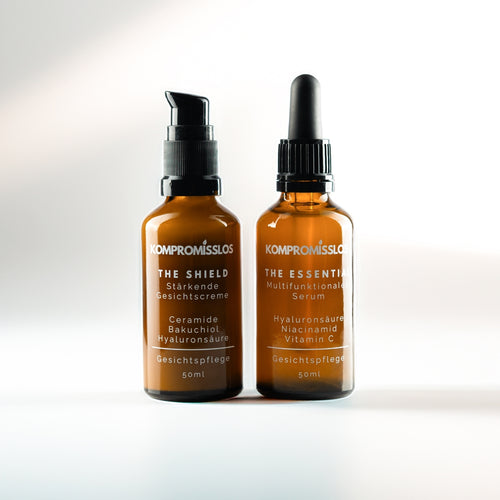
The Duo contains a total of 5% niacinamide and 2% vitamin C in the stable form 3-O-Ethyl Ascorbic Acid, plus hyaluronic acid in three molecular sizes. This can help your skin look more even and fresher, but it will not happen overnight. In a review on Judge.me, Fabian I. writes: ‘My skin already looks fresher and more supple after just one month’ (review translated from German). That is one person’s experience, not a promise.
Does exfoliating help a grey complexion?
Exfoliating can freshen up a grey complexion in the short term, but in winter it is rarely the best first step. It loosens flakes of dead skin, and the skin then looks smoother for a few days. The problem is that in winter the barrier is often weakened already, and exfoliation removes precisely the layer that is supposed to be holding on to water. If you exfoliate too often, you trade the grey veil for tightness, redness and fine flaking – in other words, for the very things that make skin look dull again. It makes more sense to reverse the order: moisture and lipids first, so that the surface becomes smoother on its own, and only if rough patches remain after that, exfoliate occasionally and gently. Whether it is worth it for you depends on your skin, and our guide on whether you need to exfoliate your face at all helps you decide.
Put it to the test yourself: for two weeks, apply your moisturising skincare consistently every morning and evening, with no exfoliation and no extra product. If your complexion already looks fresher after that, the cause was probably dryness rather than a lack of exfoliation.
When is dull skin a sign of a medical problem?
Dull skin points to something medical when the paleness affects more than just your face and comes with tiredness, reduced stamina or other symptoms. A grey winter complexion that improves with skincare and sleep is harmless. It is a different matter if your lips, nail beds and the inside of your eyelids are also pale, if you get out of breath more quickly or if you have felt exhausted for weeks. Iron deficiency or anaemia may then be behind it, and sometimes a thyroid disorder. A yellowish discolouration of the skin together with yellowish whites of the eyes should also be checked by a doctor. This is not a skincare question but one for your GP, where a simple blood test often brings clarity. In these cases, cosmetics can at best support how your complexion looks; they do not address the cause.
For vitamin C, I deliberately chose 3-O-Ethyl Ascorbic Acid, a stable form, and disclosed the concentration: 2% vitamin C, plus 5% niacinamide, both for The Duo as a whole. Pure ascorbic acid sounds stronger on the packaging, but it oxidises quickly, and a serum that turns brown after a few weeks does little for your complexion. An exfoliant, on the other hand, is something I deliberately left out of our range. Most skin does not need one every day, and in winter in particular, too much exfoliation often does more harm than good. If your complexion looks grey, what it usually lacks is moisture, not another step. You can look up the full list of active ingredients and their concentrations in the Duo.
Frequently asked questions
Does vitamin C help with dull skin?
Vitamin C can make a dull complexion look fresher over a few weeks, especially when sun damage and an uneven skin tone play a part. It acts as an antioxidant and slows down melanin production. On its own, however, it does little against a grey veil caused purely by dryness; for that, your skin first needs moisture and lipids.
Does lack of sleep make your skin look dull?
Yes, other people can see lack of sleep in your face; in a study in the journal Sleep, it showed up as a paler complexion and darker circles under the eyes, among other things. What a short night makes visible beyond that, and what skincare can make up for, is covered in the article on sleep deprivation and skin.
How quickly will my complexion look fresher?
You will often see the first difference after a few days, because a well-hydrated skin surface looks smoother straight away. Ingredients such as niacinamide and vitamin C, on the other hand, need several weeks; the niacinamide study mentioned above measured results over twelve weeks. So give a new routine at least a month before you judge it.
Does drinking more water help dull skin?
Drinking more water makes sense if you have been drinking far too little, but you cannot drink your way to a fresher complexion. Drinking alone is no match for dry heated air that draws water out of the skin from the outside. For that, you need skincare that binds moisture in the outer layer of the skin and slows down its loss.
Can smoking make your skin grey?
Yes, smoking narrows the blood vessels and, over the years, often makes skin look grey and dull. Quitting smoking does more for your complexion in the long run than any additional skincare product.
What helps fastest without make-up?
Well-hydrated skin works fastest: a serum with humectants on freshly cleansed skin, followed by a cream that holds in the water. A walk in the fresh air also brings extra colour to your face for a while, because your circulation picks up. Both work within minutes, without you having to cover anything up.
Can The Duo make a dull complexion look fresher?
The Duo can help a dull complexion look fresher and more even. Hyaluronic acid and ceramides keep the surface hydrated and smooth, while a total of 5% niacinamide and 2% vitamin C work on your skin’s appearance over several weeks. You do not need an exfoliant, but you still need a separate sunscreen during the day. You can see how the Duo is put together on the product page.
Sources
- Engebretsen KA, Johansen JD, Kezic S, Linneberg A, Thyssen JP. The effect of environmental humidity and temperature on skin barrier function and dermatitis. Journal of the European Academy of Dermatology and Venereology, 2016. Source
- Grove GL, Kligman AM. Age-associated changes in human epidermal cell renewal. Journal of Gerontology, 1983. Source
- Bissett DL, Oblong JE, Berge CA. Niacinamide: A B vitamin that improves aging facial skin appearance. Dermatologic Surgery, 2005. Source
- Al-Niaimi F, Chiang NYZ. Topical Vitamin C and the Skin: Mechanisms of Action and Clinical Applications. The Journal of Clinical and Aesthetic Dermatology, 2017. Source
- Sundelin T, Lekander M, Kecklund G, Van Someren EJW, Olsson A, Axelsson J. Cues of fatigue: effects of sleep deprivation on facial appearance. Sleep, 2013. Source