Sleep deprivation and skin: what a short night shows on your face and what skincare can make up for
SKIN CONCERNS
Sleep deprivation shows on your skin faster than many people think: after just one sleepless night, your eyes look puffier, your eyelids droop more, your skin looks paler and the fine lines around your eyes are more noticeable. On top of that, your skin barrier recovers measurably more slowly. Most of this reverses as soon as you get enough sleep again. On the morning after, skincare can smooth the surface and support the barrier, but it cannot replace the sleep you missed.
What does a short night show on your face?
After a short night, it is mainly the eye area that gives you away: droopier eyelids, redder and puffier eyes, darker circles under the eyes, plus paler skin, more fine lines around the eyes and more downturned corners of the mouth. These are exactly the features examined in a study in the journal Sleep. Ten young adults were photographed twice, once after eight hours of sleep and once after 31 hours without sleep, following a night of only five hours. Forty people then rated the photos. After sleep deprivation, they rated the faces less favourably on every one of these points. The study itself notes one limitation: when the women photographed were looked at on their own, the difference in paleness was not significant.
It does not even take an all-nighter. In a second study, published in Royal Society Open Science, 25 people slept a little over four hours a night on average for two nights. In the photos taken afterwards, they looked sleepier, less healthy and less attractive to 122 raters. Both studies measure what other people perceive in a face, not what happens in the skin. If your complexion stays grey for weeks even though you sleep well, there is usually more to it, and then it is worth looking at why your complexion looks dull.
Why does your face look puffy and tired after too little sleep?
Your face looks puffy and tired after too little sleep mainly because the eye area, blood flow and facial expression react – things that only partly have to do with the skin itself. Around the eyes, the tissue is loose and the skin is thin. Fluid collects there easily while you are lying down and disperses again over the course of the morning. After a short night, this puffiness is more noticeable because your skin also looks paler and the blood vessels underneath show through more clearly. Drooping eyelids and lower corners of the mouth, on the other hand, are a sign of tiredness, not a change in the skin. No cream can do anything about that.
Whether the dark shadows under your eyes come from lack of sleep at all depends on what type they are. Some disappear after a few good nights, others stay because they are caused by pigment or anatomy. A separate article explains which dark circles depend on sleep. Pronounced eye bags that remain even after restful nights are usually a matter of connective tissue rather than sleep. And if you drank alcohol the evening before, you will often look extra puffy in the morning, which is a topic of its own.
What does sleep deprivation do to your skin barrier?
Sleep deprivation slows down the recovery of the skin barrier, and this has been measured after just a single sleepless night. In a study in the Journal of Investigative Dermatology, eleven healthy women stayed awake for one night. Afterwards, the outermost layer of their skin was gently removed with adhesive tape, a standard method for disrupting the barrier in a controlled way. The researchers then measured how quickly it closed again. After sleep deprivation, this took longer. At the same time, signalling molecules in the blood that are linked to inflammatory processes rose, including interleukin-1beta and tumour necrosis factor-alpha. The researchers suspect that these changes and the slower barrier recovery are connected.
In everyday terms, this means that after a short night your skin is less resilient. It is more likely to feel tight, it stings sooner with products it normally tolerates without any trouble, and it is less forgiving if you also exfoliate or try something new. If this state lasts for weeks, it is worth learning how to recognise a damaged skin barrier rather than adding more and more to your routine. And because lack of sleep often coincides with demanding periods, it also helps to understand what chronic stress does to your skin.
Does long-term sleep deprivation make your skin age faster?
Long-term lack of sleep is linked to more signs of skin ageing, but whether it actually causes them has not been properly established. A frequently cited study on this was published in Clinical and Experimental Dermatology. Sixty healthy women were divided into two groups: poor sleepers, with five hours of sleep or less and an abnormal score on the Pittsburgh Sleep Quality Index, and good sleepers, with seven to nine hours. The good sleepers had lower scores for intrinsic skin ageing, assessed using a clinical rating scale. The poor sleepers were already losing more water through their skin at the start. Seventy-two hours after tape stripping, the good sleepers’ barrier had recovered 30 per cent better, and redness caused by artificial UV light also faded faster for them.
Three points help put this into perspective. The study is a snapshot and shows a correlation, not a cause. People who sleep poorly are often under more pressure in other areas of their lives as well. And it was commissioned by a large cosmetics company, which does not make the results wrong but is a reason to be wary of headlines. When it comes to visible skin ageing, UV radiation remains the far better documented factor. None of this should be confused with sleep wrinkles from your pillow, which come not from too little sleep but from the way you lie.
What can skincare make up for the morning after a short night, and what can’t it?
The morning after a short night, skincare can give the surface of your skin moisture so that it looks smoother and less dull, and it can support the barrier, which is recovering more slowly at the moment. That is all it can do. The puffiness around the eyes, drooping eyelids, dark shadows caused by blood vessels or anatomy and the tired expression stay until you have caught up on sleep. Cold, such as a cool flannel, briefly reduces the puffiness, but no more than that. Eye products with caffeine are marketed for exactly this kind of morning, but how well they work is a separate chapter.
| What you see | Where it comes from | What skincare can do | What helps instead |
|---|---|---|---|
| Tightness, fine dryness lines | The barrier is recovering more slowly | Moisture and lipids smooth the surface | Your usual routine, no experiments |
| Pale, dull skin | Blood flow and tiredness | Well-hydrated skin reflects light more evenly | Sleep, exercise in the fresh air |
| Puffy eyes | Fluid in loose tissue | Hardly anything | Time, a little cold |
| Drooping eyelids, lower corners of the mouth | Tiredness, facial expression | Nothing | Sleep |
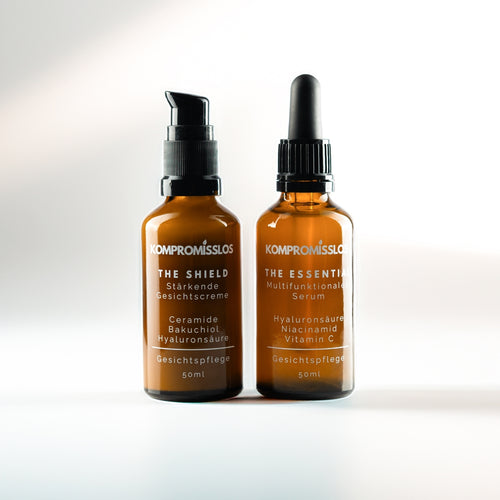
You do not need any extra products for this, just the routine you already have. For us, that is The Duo of Essential serum and Shield cream: first The Essential, with hyaluronic acid in three molecular sizes to provide moisture, plus niacinamide, then The Shield on top, with ceramide NP and squalane to support the skin barrier. During the day, you add a separate sunscreen. In her review on Judge.me, Nicole B. writes: “My skin feels soft and plumper!” (review translated from German). That describes how the skin feels – which is exactly what skincare can realistically contribute on a tired morning.
The morning after a short night is not a good day for an exfoliant, a new serum or an intensive course of acids. Your barrier is slower anyway, and if your skin reacts, you will not know whether it was the product or the night.
How much sleep does your skin need, and does catching up on sleep help?
There is no separate sleep recommendation for the skin, so the general guideline applies: adults should sleep seven or more hours per night on a regular basis. That is how the American Academy of Sleep Medicine and the Sleep Research Society put it in a joint consensus statement. For your skin, the key words are “on a regular basis”. The studies above show that even a single sleepless night or two short nights are visible in your face, and that the barrier recovers less well in women who sleep poorly over the long term. Catching up on sleep helps with the short-term signs: puffiness, paleness and a tired expression fade once you are rested again. None of the studies measured exactly how many nights the skin needs for this. Whether skin regenerates differently at night and whether you need a night cream is a separate question that has little to do with how much you sleep.
What helps more in everyday life than any product:
- Try not to string short nights together, because even two of them show in your face.
- Catch up at the weekend if you cannot manage it during the week, without throwing your rhythm off completely.
- On the morning after, stick to your usual skincare instead of trying to compensate with new products.
- If you have trouble sleeping, snore loudly with pauses in your breathing or feel persistently tired despite spending enough hours in bed, see your GP.
I have not made a special product for short nights, and that is deliberate. No anti-fatigue booster, no exfoliant, no toner, nothing that turns a bad morning into a reason to buy something. After a short night, the same layering applies as always: serum first, then cream, and if your skin is dry, a little more of both. Exactly how much is explained in how to apply the serum and cream. What I do not promise is that a cream can replace lost sleep. None can, ours included. And because The Duo contains no sun protection factor, a separate sunscreen belongs in your daytime routine – even on tired days, when it is easiest to forget.
Frequently asked questions
Is beauty sleep real?
Yes, in the sense that lack of sleep is visible in your face. In a study in the journal Sleep, faces after 31 hours without sleep were rated as more tired, paler and with darker circles under the eyes. There is no evidence, however, that extra sleep beyond a sufficient amount makes you look better. It is about getting enough sleep, not as much as possible.
How quickly does your skin recover after a sleepless night?
The puffiness around the eyes usually subsides over the course of the morning, and the paleness and tired expression go as soon as you have caught up on sleep. Research on sleep deprivation has not measured exactly how many nights this takes or when the barrier returns to its normal pace. A single short night is not a problem for healthy skin; a whole series of them is more likely to be.
Can lack of sleep cause spots?
There is no solid evidence that a single short night triggers spots. However, lack of sleep often coincides with stressful periods, irregular meals and more experimenting with your skin, and all of these can make your complexion worse. If spots persist for weeks or become painful, see a dermatologist.
Does a richer cream help if I am not getting much sleep?
Only if your skin feels tight or looks dry after short nights. In that case, lipids support the barrier, which is recovering more slowly. Extra lipids will not make your skin look any more awake, though. Often it is enough to use a little more of your usual cream rather than buying an additional product.
Should I use an exfoliant or a face mask after an all-nighter?
Preferably not an exfoliant. After sleep deprivation, the barrier recovers more slowly, and exfoliating puts extra strain on it. A hydrating mask does no harm, but it adds little beyond a serum and a cream. If you are short on time, your usual routine is a better choice than a special programme.
What can I do if I always look tired despite getting enough sleep?
In that case, it is usually not down to sleep but to dark circles caused by anatomy or pigment, to eye bags or to a persistently dull complexion. If you feel exhausted despite enough hours in bed, snore loudly or wake up unrefreshed, have it checked by your GP. That is not a skincare question.
Do I need anything extra after short nights if I use The Duo?
No. The serum and cream cover what skincare can do after a short night: moisture for the surface and lipids for the barrier. If your skin feels tight, use a little more of both. During the day, add a separate sunscreen, because The Duo contains no sun protection factor. It does not replace sleep.
Sources
- Sundelin T, Lekander M, Kecklund G, Van Someren EJW, Olsson A, Axelsson J. Cues of fatigue: effects of sleep deprivation on facial appearance. Sleep, 2013. Source
- Sundelin T, Lekander M, Sorjonen K, Axelsson J. Negative effects of restricted sleep on facial appearance and social appeal. Royal Society Open Science, 2017. Source
- Altemus M, Rao B, Dhabhar FS, Ding W, Granstein RD. Stress-induced changes in skin barrier function in healthy women. Journal of Investigative Dermatology, 2001. Source
- Oyetakin-White P, Suggs A, Koo B, Matsui MS, Yarosh D, Cooper KD et al. Does poor sleep quality affect skin ageing? Clinical and Experimental Dermatology, 2015. Source
- Watson NF, Badr MS, Belenky G, Bliwise DL, Buxton OM, Buysse D et al. Recommended Amount of Sleep for a Healthy Adult: A Joint Consensus Statement of the American Academy of Sleep Medicine and Sleep Research Society. Sleep, 2015. Source