What causes dark circles under your eyes – and what skincare can realistically do
SKIN CONDITION
What causes dark circles is usually a combination of three factors: blood vessels showing through the thin skin of the lower eyelid, deposited pigment, and shadows cast by the anatomy of the eye socket. Skincare can soften how they look if dryness or pigment is involved. Cosmetics can do nothing about shadows caused by your anatomy. You can tell which component dominates with two simple tests in front of the mirror.
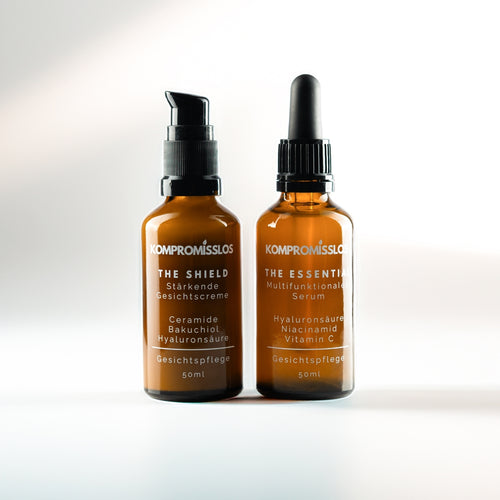
For the part that skincare can influence (dryness, pigment): The Duo – serum & face cream with hyaluronic acid, niacinamide and vitamin C.
What types of dark circles are there?
Dermatology divides dark circles into three basic types: pigmented, vascular and structural. Several of them often occur at the same time. Pigmented dark circles look brownish and are caused by melanin in the skin of the lower eyelid, often after frequent rubbing, sun or ongoing irritation. Vascular dark circles look bluish to purple, because the skin of the lower eyelid is thinner than on the rest of the face and its skin barrier has correspondingly less of a buffer, so the blood vessels underneath show through. Structural dark circles are not a colour problem but a shadow: the hollow between the lower eyelid and the cheek, known as the tear trough, casts a shadow when light comes from above. A review in the Journal of Clinical and Aesthetic Dermatology lists causes including heredity, increased pigmentation, pigmentation after inflammatory skin reactions, swelling, prominent visible blood vessels and shadows caused by skin losing firmness. Which component dominates in your case determines what skincare can realistically achieve.
| Type | Colour in the mirror | How to recognise it | What skincare can do |
|---|---|---|---|
| Pigmented | Brownish to greyish brown | Stays visible when you gently stretch the skin sideways | Can soften the look over months |
| Vascular | Bluish to purple | Becomes noticeably lighter when stretched | Little directly, but a denser barrier disguises it somewhat |
| Structural | Grey, looks like a dent | Almost disappears when the light comes from the front | Nothing – only volume or make-up works here |
Why does more sleep only help with one type of dark circles?
Sleep mainly improves the vascular component, because tiredness and fluid retention change blood flow and swelling in the lower eyelid. Pigment and anatomy are unaffected. That is exactly why so many people find that nothing visible changes despite sleeping better. A study of 200 patients at a dermatology clinic, published in the Indian Journal of Dermatology, classified the most common form as constitutional, meaning inherited, and found a family history in 63 per cent. Too little sleep was a factor in 40 per cent, frequent eye rubbing in around a third. Sleep is therefore one building block among several, not the main switch. If you look noticeably darker in the morning than in the evening and it improves over the course of the day, that points to a fluid and blood-vessel component. If the discolouration stays constant all day, the main cause lies elsewhere.
When are dark circles caused by your anatomy?
Dark circles are anatomical when the discolouration is a shadow rather than colour in the skin. Two tests in front of the mirror will give you clarity. Gently stretch the skin under your eye sideways and outwards with one finger: if the area becomes noticeably lighter, blood flow is the main factor. If the colour stays the same, pigment is involved. Then stand so that the light falls on your face from the front rather than from above. If the dark area almost completely disappears, it is a shadow cast by the tear trough. This component grows larger over the years, because the cheek loses volume and the hollow becomes more pronounced. That is not a question of skin or of skincare. Creams, serums and patches do nothing to change the depth of this hollow, whatever it says on the packaging.
What can skincare realistically do for dark circles?
For dark circles, skincare can do two things: soften the pigment component over months, and nourish the skin so well that it looks denser and more even. Both change the overall picture without removing the cause. Moisture plays a bigger part than many people expect, because dry skin under the eyes shows more fine lines and so swallows light. Active ingredients used in cosmetics for a more even complexion include niacinamide and stable forms of vitamin C such as 3-O-ethyl ascorbic acid. The Duo, made up of The Essential serum and The Shield cream, contains 5 per cent niacinamide, 2 per cent hyaluronic acid and 2 per cent vitamin C as 3-O-ethyl ascorbic acid, plus ceramides and squalane. None of this becomes visible overnight, but over weeks to months, because that is the pace at which the skin renews itself. What no skincare can do is fill in a shadow. Anyone who promises that is selling you an expectation the product cannot meet.
A customer wrote to me that she had changed her sleep habits, was drinking more water and was consistent with her skincare, yet the area under her eyes still looked just as dark. Her question was whether the Duo would change that. I replied that she should stretch the skin sideways once in front of the mirror and then stand so that the light came from the front. In her case, the discolouration stayed when she stretched the skin and almost completely disappeared as soon as the light came from the front. That points to a shadow, not pigment. An extra cream would have cost her money and changed nothing about how it looked.
Does caffeine help with dark circles?
Caffeine is in a great many eye products because it briefly constricts blood vessels and so makes swelling less visible. The evidence for this is thinner than the ingredient’s popularity would suggest. In a study in the Journal of Applied Pharmaceutical Science, researchers tested a gel containing 3 per cent caffeine on 34 volunteers against the plain gel base. Only about a quarter of the participants showed a measurable response, and the authors attributed the reduction in swelling they observed mainly to the cooling effect of the gel, not to the caffeine itself. In practical terms: the effect is real, but brief, driven by cooling and concerned with swelling rather than colour. Caffeine does nothing against pigment, and nothing against an anatomical shadow either. In the same study, the plain gel base without caffeine had a comparable effect on swelling. In my view, that is not enough of an argument for an extra product.
I am regularly asked why Kompromisslos does not have its own eye cream. The honest answer: I have not found a reason that justifies a third jar. Many eye creams are thinned-out face creams with caffeine, and the data on that do not convince me. Instead of making another product that lengthens your routine, I put the active ingredients into the Duo and disclose exactly what is inside. What I do not promise you with dark circles is any effect on shadows that come from your anatomy. There is no cream for that, neither mine nor anyone else’s.
When should you see a professional about dark circles?
Dark circles are a matter for a professional if they appear suddenly, affect only one side, come with swelling, itching or changes in your vision, or become noticeably worse within a short time. These are questions for a dermatologist or your GP, not for cosmetics. It is also worth having things checked if you constantly rub the area because it itches, as repeated rubbing can encourage pigment. Cosmetics work on the surface: they care for the skin, support the barrier and can change how it looks. Cosmetics do not provide a diagnosis, and skincare does not replace a medical assessment. A professional can also clarify whether an allergy or ongoing irritation lies behind the rubbing. If your skin also reacts quickly, burns or feels tight, gentle skincare for sensitive skin makes more sense than a product with strong active ingredients right next to your eye. How to combine serum and cream day to day is explained in the how-to-use guide.
Frequently asked questions
Can a cream get rid of dark circles?
A cream cannot remove dark circles. Their appearance can be softened if pigment or dryness is involved, because well-nourished skin looks more even and shows fewer fine lines. With a shadow cast by the tear trough, there is no effect. The stretch test and the light test in front of the mirror show which component dominates in your case.
Why do dark circles often look worse in the morning?
In the morning, more fluid has collected overnight in the tissue around the eyes because you have been lying down. That makes the area slightly puffy and lets blood vessels show through more clearly. Over the course of the day, the fluid redistributes itself. If the discolouration looks the same morning and evening, that points more to pigment or anatomy.
Does vitamin C help with dark circles?
Vitamin C is used in cosmetics for a more even complexion and can soften the pigmented component over months. It does not help with a bluish blood-vessel colour or with shadows. The Duo contains 2 per cent vitamin C as 3-O-ethyl ascorbic acid, a stable form that oxidises less quickly in water-based phases.
Are dark circles hereditary?
For many people, predisposition plays the main role. In the study in the Indian Journal of Dermatology, 63 per cent of those affected had a family history, and the most common form was the constitutional one. What is mainly inherited is skin thickness, a tendency towards pigmentation and the shape of the eye socket. Lifestyle changes little about this, and skincare only to a limited extent.
Do cucumber slices or cold spoons help?
Cooling does work, but only briefly and only against swelling. Cold constricts the blood vessels, the tissue goes down and the area looks fresher. After a short time the effect is gone. Cooling has no effect on pigment or shadows, whether it comes from cucumber, a spoon or a gel.
Does The Duo replace an eye cream?
The Duo is formulated as facial skincare and is not marketed as a specialist eye product. Keep a little distance from the edge of the eyelid when you apply it. Whether a separate eye cream makes sense for you depends on the type of dark circles you have. With an anatomical shadow, even the most expensive eye cream will do nothing. You can find out more in the overview of The Duo.
Sources
- Sarkar R, Ranjan R, Garg S, Garg VK, Sonthalia S, Bansal S. Periorbital Hyperpigmentation: A Comprehensive Review. The Journal of Clinical and Aesthetic Dermatology, 2016. Source
- Sheth PB, Shah HA, Dave JN. Periorbital Hyperpigmentation: A Study of its Prevalence, Common Causative Factors and its Association with Personal Habits and Other Disorders. Indian Journal of Dermatology, 2014. Source
- Amnuaikit T, Maneenuan D, Boonme P. Evaluation of Caffeine Gels on Physicochemical Characteristics and In Vivo Efficacy in Reducing Puffy Eyes. Journal of Applied Pharmaceutical Science, 2011. Source