Sensitive skin: causes, care and what to leave out
SKIN CONDITION
Sensitive skin reacts to irritants more quickly than other skin, usually with tightness, burning, redness or itching. Behind it there is almost always a weakened skin barrier rather than a fixed skin type. What helps: gentle cleansing, fewer products, consistent moisture and lipids, no fragrance, and introducing new active ingredients one at a time. Rebuilding takes weeks, not days.
What causes sensitive skin?
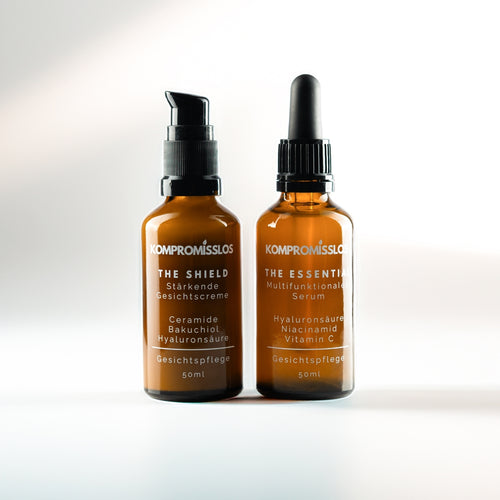
In most cases, sensitive skin is not a skin type you are born with but a condition that develops when the skin barrier becomes more permeable than it should be. This barrier is made up of horny cells and a lipid layer of ceramides, fatty acids and cholesterol. When it is intact, it keeps water in the skin and irritants out. When it is weakened, more water evaporates, and substances that previously had no effect reach deeper layers and cause burning, tightness or redness. The most common triggers are everyday ones: water that is too hot, cleansing too often, products high in surfactants, exfoliating too frequently, dry air from central heating, cold and wind. On top of that come hormonal changes and stress. This distinction is crucial for your skincare, because a condition can be changed and a type cannot. That is exactly why, for our Duo of serum and cream, we work with a few carefully matched active ingredients rather than the longest possible list. Incidentally, skin is often not sensitive from the outset but has become sensitive through over-care – and that is the case that can be turned around most quickly.
What skincare does sensitive skin need?
Sensitive skin needs fewer products, not more. A routine that works consists of four steps: gentle cleansing with lukewarm water, moisture, lipids and, in the morning, sun protection. Moisture comes from hyaluronic acid, which binds water in the upper layers of the skin. Ceramides and squalane take care of the lipid side, replacing what the barrier lacks. Barrier-supporting ingredients such as niacinamide and panthenol help the skin rebuild its protective function itself. Everything else is optional to begin with. With us, it is exactly two products: morning and evening, 3 to 6 drops of serum, followed by 3 to 6 pumps of cream on your still slightly damp face – that is all it takes. How to apply both, and in which order, is explained on the how-to-use page. In the end, more important than any individual product is keeping your routine consistent for six to eight weeks before you judge it.
Only ever introduce one new product at a time and give it two weeks. If you start with three at once, you won’t know afterwards which one was the trigger. A test along the angle of your jaw for two to three days costs little and can save you a week of irritated skin.
Fragrance and sensitive skin: what to look for on the label
For sensitive skin, fragrances are the most common avoidable irritant, whether they are synthetic or natural. Essential oils are no exception here but part of the problem, because they contain components known to be contact allergens. In Switzerland, you don’t have to guess. Under the Swiss Ordinance on Cosmetic Products (VKos) issued by the Federal Department of Home Affairs, allergenic fragrance substances in leave-on products must be listed individually in the list of ingredients, in addition to the collective term Parfum, from a concentration of 0.001%. For you, that means: if you find names such as Limonene, Linalool or Citronellol at the end of the ingredient list, you know the product contains fragrance, even if the front of the pack says natural skincare. You can check which substances our products contain, and in what amounts, in the ingredients overview.
Which active ingredients suit sensitive skin, and which need caution?
With sensitive skin, the individual active ingredient matters less than the dose and how often you use it. Ingredients that bind moisture and support the barrier are almost always unproblematic, because they give the skin something rather than taking something away. Things get critical with anything that dissolves or strongly renews the horny layer: fruit acids, high-dose retinol and frequent exfoliation. These substances aren’t bad; they are just poorly suited while the barrier is compromised. Our Duo as a whole contains 2% hyaluronic acid, 5% niacinamide and 0.3% bakuchiol, plus ceramides, squalane and panthenol. We chose bakuchiol for the combination of The Essential serum and The Shield cream because it is considerably calmer in use than retinol. We have written separately about what gentian root extract does in skincare. The overview below assesses the active ingredients people ask about most often in relation to sensitive skin.
| Active ingredient | For sensitive skin | What to watch out for |
|---|---|---|
| Aloe vera | Usually well tolerated | Pure gels off the shelf often contain fragrance or alcohol. |
| Coenzyme Q10 | Generally unproblematic | Acts as an antioxidant and doesn’t rebuild the barrier. |
| Peptides | Well tolerated | A sensible option if retinol is too much. |
| Niacinamide | Well tolerated at moderate doses | Very high concentrations can cause redness and tingling. |
| Bakuchiol | Calmer alternative to retinol | Still introduce it slowly and watch how your skin reacts. |
| AHAs and fruit acids | Only occasionally and on specific areas | Can put additional strain on an already weakened barrier. |
| Salicylic acid and BHAs | Only in a targeted way for a restless complexion | Don’t apply over large areas of irritated or flaking skin. |
Why sensitive skin gets worse in winter and when the foehn blows
Cold air holds less water than warm air, and heated indoor air draws additional moisture from your skin. Taken together, this means that in winter your skin loses more water through its surface than it can replenish. Add moving from outdoors to indoors several times a day, and the barrier is under constant strain. Foehn conditions work in the same way, only much faster. Warm, very dry air and wind dry out the skin’s surface within hours, and many people notice this as tight cheeks and red patches on exactly those days. What helps is unspectacular: more lipids rather than more active ingredients, shorter and less hot showers, no exfoliation at all during this time, and a slightly more generous layer of cream, especially in the evening. If your skin is also prone to blemishes in winter, you’ll find guidance in our article on the causes of blemish-prone skin and how to care for it.
When to see a professional about sensitive skin
Cosmetics care for the skin; they don’t make a diagnosis, nor do they replace one. There comes a point where a good routine is no longer the right tool. See a dermatologist if redness stays and no longer fades, if blisters, weeping patches or severe itching appear, if a reaction to a single product is sudden and severe, or if your skin gets worse over several weeks despite gentle care. Persistently sensitive skin can be a sign of skin conditions that need medical assessment and treatment, and that is not a question of finding the right cream. Gentle skincare can be a sensible accompaniment in such cases, but the order is only right if the medical assessment comes first. And if you are unsure about individual active ingredients, the comparison of vitamin C and niacinamide will help you weigh them up.
I deliberately decided against a routine of eight products. With sensitive skin, every additional product is an additional risk, and at some point you no longer know what you are reacting to. That is why Kompromisslos has only two products, and why we state the concentrations openly. I want you to be able to judge before you buy whether something suits your skin, rather than having to rely on a promise on the front of the pack. If, after reading this, you conclude that a simple cleanser and a basic cream are enough for you, I count that as a good outcome. Not every skin needs a serum.
Dominic Bertschin
Frequently asked questions
Can I use aloe vera on sensitive skin?
Yes, aloe vera is usually well tolerated by sensitive skin and has a cooling, moisturising effect. Do check the ingredient list, though: many pure aloe gels contain alcohol, fragrance or preservatives that cancel out the soothing effect. In a finished formulation, the dose is more predictable than with a leaf straight from the plant.
Can I use coenzyme Q10 on sensitive skin?
Yes, coenzyme Q10 is considered low in irritation and is generally unproblematic for sensitive skin too. It works as an antioxidant and protects against oxidative stress, but it doesn’t rebuild the skin barrier. If your skin feels tight or burns, ceramides, squalane and moisture will do more for you in the short term than an antioxidant.
Can I use peptides on sensitive skin?
Yes, peptides are well tolerated by sensitive skin and don’t strip away the horny layer. That makes them a calmer option if retinol or fruit acids are too much for you. Don’t expect quick results: peptides work over weeks and are suitable as an addition, not as a replacement for moisture and lipids.
Can I use salicylic acid or BHAs on sensitive skin?
Only in a targeted way and rarely. Salicylic acid is a BHA and loosens build-up of dead skin cells, which can be useful for a restless complexion but puts additional strain on a compromised barrier. Apply it to specific spots, never over large areas of red or flaking skin, and leave it out while your skin is burning or feels tight.
Can I use AHAs on sensitive skin?
Carefully and at long intervals. AHAs such as glycolic acid or lactic acid loosen dead skin cells and can make the skin’s surface look smoother, but they act on precisely the layer that is already weakened in sensitive skin. Rebuild the barrier over several weeks first before introducing an exfoliant.
Do I need both a serum and a cream for sensitive skin?
Not necessarily. If your skin is simply dry and feels comfortable with a cream, the cream is enough. A serum mainly adds moisture and active ingredients in a lighter texture, while the cream supplies the lipids and seals everything in. The combination makes sense when tightness and redness occur together.
How long does it take for sensitive skin to calm down?
Allow four to eight weeks if you consistently cut back on the triggers. The first improvements in tightness often show after a few days, but rebuilding the skin barrier takes several of the skin’s renewal cycles. So don’t judge a new routine after one week.