Damaged skin barrier: how to recognise it and what it really needs
SKIN CONDITION
The skin barrier is the outermost layer of your skin, made of surface skin cells and lipids. It keeps moisture in the body and irritants out. When you have a damaged skin barrier, your skin feels tight, reddens more quickly and suddenly reacts to products it used to tolerate. What it needs is lipids, humectants and much less irritation.
What exactly is the skin barrier?
The skin barrier is the outermost layer of your epidermis, known technically as the stratum corneum, and it works like a wall. Dead skin cells form the bricks, and a mixture of ceramides, cholesterol and free fatty acids forms the mortar between them. On top sits a slightly acidic film, the acid mantle. According to a multicentre measurement published in the International Journal of Cosmetic Science, the natural pH of the skin’s surface averages 4.7, below 5. This acidic range keeps the skin’s own flora in balance and keeps active the enzymes that continuously rebuild the mortar. As long as bricks, mortar and pH work together, your skin loses little water to the outside and lets little in from outside. If one part fails, you notice straight away, because all three depend on each other. You can see which lipids and humectants we use for this in the full list of our ingredients.
What causes a damaged skin barrier?
A damaged skin barrier is almost always the result of too much, not too little. Hot water, alkaline soaps and foaming cleansers strip the lipids from between the skin cells and push the pH up. Then there are exfoliants with acids or grains, retinoids at too high a dose, too many active products at once and the reflex of cleansing irritated skin even more thoroughly. Cold, dry heated air, unprotected sun exposure and long showers also play a part. On top of that come factors you cannot control: the skin barrier becomes thinner and lower in lipids over the years, and some people naturally have fewer ceramides. We see the damage particularly often in people who are fighting blemish-prone skin and have been using oil-stripping products for months. It also includes washing your face with shower gel in the shower, which many people do not even think of as cleansing.
How do you recognise a damaged skin barrier?
You recognise a damaged skin barrier by the fact that your skin reacts to things that used to cause no trouble. The typical picture is tightness shortly after washing, a brief stinging when you apply serum or cream, redness that lingers longer than it used to, and rough patches on the cheeks or around the nostrils. Many people also describe their skin as shiny and dry at the same time. That is not a contradiction but a sign that moisture is lacking, not that there is too much oil. The timing matters: a damaged barrier develops over weeks and improves over weeks. A single bad skin day after a short night is something different. Another sign is make-up that suddenly sits patchily or rolls off in small flakes, even though nothing about the product itself has changed. The table below sorts the most common signs.
| Sign | What is behind it | What helps first |
|---|---|---|
| Tightness after washing | The mortar between the skin cells has thinned. | Cleanse more gently and moisturise straight afterwards. |
| Stinging with familiar products | The barrier lets active ingredients through too quickly. | Pause acids and retinoids for the time being. |
| Redness with a feeling of warmth | External irritants hit the skin unchecked. | Switch to calming, lipid-rich skincare. |
| Rough or flaky patches | The skin loses more water than it holds. | Bind moisture and seal it in with lipids. |
| Shiny yet dry | Lipids are missing, not just moisture. | Do not strip oil; build up the barrier instead. |
Which active ingredients help a damaged skin barrier?
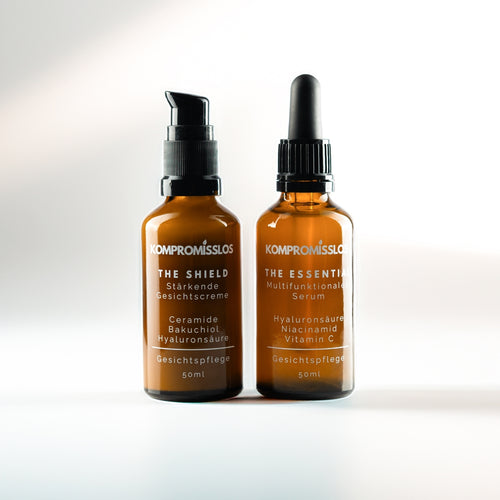
With a damaged skin barrier, the helpful active ingredients are those that either supply building blocks or hold water – not those that strip away. Ceramides, squalane and jojoba oil replace the lipids missing from the spaces between the cells. Hyaluronic acid and panthenol bind water in the upper layers. Niacinamide plays a special role: according to a study in the British Journal of Dermatology, nicotinamide increases the synthesis of ceramides in keratinocytes and reduces water loss in dry skin. In the Duo, niacinamide is at 5% and hyaluronic acid at 2%, alongside ceramides, squalane, panthenol and aloe vera, for which no percentage is given. Plant extracts such as edelweiss and gentian root, at 2% each, also have a calming effect, and we have written separately about what gentian root extract does in skincare. That is exactly what our Duo of serum and cream is designed for. All percentages apply to the Duo as a whole, never to a single product.
Two active ingredients call for more care in this phase. Vitamin C as 3-O-Ethyl Ascorbic Acid and bakuchiol are present in the Duo at 2% and 0.3% respectively, and are deliberately kept low. If you are interested in the order, read whether vitamin C or niacinamide should come first.
What skincare does a damaged skin barrier need?
A damaged skin barrier needs shorter routines, not longer ones. The most effective step is leaving things out: exfoliants, cleansing brushes, toners with alcohol, masks and anything that strips the skin several times a week are banished from the bathroom for a few weeks. What remains is a gentle cleanse with lukewarm water, followed by a serum that binds water and, on top, a cream that seals it in. This order is crucial, because a humectant without anything sealing it in tends to dry out in dry indoor air. With us, that means 3 to 6 drops of serum and 3 to 6 pumps of cream morning and evening, applied to slightly damp skin. The exact sequence is on the how-to-use page, and why we stick to two products follows from exactly this logic. What you do not need is an extra repair serum on top, because every additional product brings new fragrances and preservatives with it.
Sunscreen belongs in your morning routine even when your skin is irritated. We do not sell one, so this is an honest recommendation that points elsewhere: choose a fragrance-free mineral product that your skin tolerates well.
When to see a professional
Skincare supports the skin barrier, but it does not replace a medical assessment. If nothing changes after several weeks of consistent, pared-back skincare, if redness has sharp edges, weeps, flakes or itches badly, if blisters or open areas appear, or if the problem started after a change of medication, it belongs in the hands of a dermatologist. The same applies if you already have a diagnosed skin condition: then your doctor decides what else you can put on your skin. This boundary matters to us, because a lot of advertising blurs it and people then lose months with creams instead of getting checked. You can read how others have got on with our skincare in the reviews from our customers, but they do not replace a diagnosis. A useful rule of thumb: anything that really hurts should be checked; anything that is merely uncomfortable you can first observe with less skincare.
I deliberately left exfoliants and acids out of our routine, even though both sell well. If you have a damaged skin barrier, you need less stripping, not more. That is why niacinamide in the Duo is at 5% and no higher, and bakuchiol at 0.3% instead of a harsher retinoid alternative. I wanted skincare you can apply twice a day even on a bad skin day, without wondering whether you should skip it today. That costs some perceived effect, because for many people a tingle after application looks like it is working. The calmer option mattered more to me.
Frequently asked questions
How long does it take for the skin barrier to recover?
Think in weeks rather than days. How long it takes depends on how severely and for how long the skin was irritated. The tightness usually eases first; redness and roughness take longer. What matters is not trying anything new during this time.
Can I keep using vitamin C with a damaged skin barrier?
At a low concentration and in a well-buffered formulation, usually yes. In the Duo, vitamin C as 3-O-Ethyl Ascorbic Acid is at 2%, so deliberately low. If your skin stings when you apply it, stop for a few days and start with a purely moisturising routine.
Is hyaluronic acid alone enough for a damaged skin barrier?
No. Hyaluronic acid binds water but does not replace lipids, and without anything sealing it in, the water even evaporates faster. The sensible approach is to combine them: first the humectant, then a cream with ceramides and squalane that keeps the bound water in the skin. Only this combination brings noticeable calm.
Is bakuchiol too strong for a damaged barrier?
Bakuchiol is considered a gentler alternative to retinol and is at 0.3% in the Duo. At this level, most people tolerate it even in a sensitive phase. If your skin still reacts, leave it out until the tightness has settled. Bakuchiol is not essential in this phase anyway.
Do I need more products for a damaged skin barrier?
Usually the opposite. The more active ingredients hit irritated skin at once, the harder it becomes to identify the cause. Two steps, the same morning and evening, are the more reliable route in this phase than a routine of six products. Fewer variables mean you can see more quickly what does your skin good.
How can I tell that my skin barrier is recovering?
The first sign is that the tightness after washing stops. Then the brief stinging on application disappears, redness fades more quickly and rough patches feel smooth again. Make-up also sits more evenly, because the surface is intact. Use this sequence to track your progress.
Is a damaged skin barrier the same as dry skin?
No. Dry skin mainly describes a lack of moisture or oil. A damaged barrier also means that the protective function itself is weakening: the skin reacts more sensitively, loses more water and tolerates products less well than before. Dry skin can be a precursor to it, but does not have to be.
Sources
- Tanno O, Ota Y, Kitamura N, Katsube T, Inoue S, British Journal of Dermatology, Nicotinamide increases biosynthesis of ceramides as well as other stratum corneum lipids to improve the epidermal permeability barrier, 2000. Source
- Lambers H, Piessens S, Bloem A, Pronk H, Finkel P, International Journal of Cosmetic Science, Natural skin surface pH is on average below 5, which is beneficial for its resident flora, 2006. Source