Skincare overload: signs you use too many products and how your skin recovers
SKIN CONDITION
The signs you use too many skincare products are skin that feels tight, stings, turns red or breaks out in small blemishes despite all that care, often while looking shiny and flaky at the same time. The cause is rarely a single product but the sum of them: too many active ingredients at once, fragrance, heavy layers and cleansing or exfoliating too often. Your skin can recover if you cut your routine down to a few well-tolerated steps and add nothing new for a few weeks.
What are the signs you are using too many skincare products?
The clearest sign of skincare overload is a contradiction: you put a lot of care into your skin, yet it feels worse than before. Typically, products you have tolerated well for a long time suddenly sting or burn. Your skin feels tight again shortly after you moisturise, looks red on the cheeks and, at the same time, shiny on the forehead or chin. On top of that, small skin-coloured bumps or blemishes often appear in places where you do not usually get them. None of these signs is conclusive on its own. The picture only becomes meaningful when several of them occur together and coincide with a change in your routine, such as a new serum, a second acid product or a richer night cream.
- Tightness or a dry feeling even though you have just moisturised
- Burning or stinging from products that used to be fine
- Redness on the cheeks, nose or chin that gets worse after you apply your skincare
- Shine and fine flakes at the same time, so oily and dry on the same patch of skin
- Small bumps or blemishes that are new
- Skincare that no longer sinks in properly and sits on the skin as a film
Which skincare habits overload your skin?
Four habits overload the skin most often: too many active ingredients at once, fragrance, heavy occlusion from several rich layers, and cleansing and exfoliating too often. What matters is how they add up. In an experiment published in Acta Dermato-Venereologica, researchers applied two irritants one after the other to the same patch of skin in 20 volunteers. The combination triggered stronger reactions than either substance on its own, applied twice a day. The test used model substances rather than skincare products, but the principle behind it applies to your routine too: each acid, each retinoid and each exfoliant may be justifiable on its own, but together the irritation adds up. Fragrance brings a second mechanism into play. According to a review in the American Journal of Clinical Dermatology, fragrance ingredients are among the most common triggers of allergic contact reactions, and 1.7 to 4.1 per cent of the general population are sensitised to ingredients of the fragrance mix, a standard blend used in allergy testing.
When it comes to cleansing, frequency and strength are what count. A review in Dermatologic Therapy describes how harsh surfactants damage the skin’s proteins and lipids and can cause tightness, dryness, barrier damage, irritation and even itching. And heavy layers on top of one another are not harmless just because they sound nourishing. In an Australian case-control study in the Australasian Journal of Dermatology, the combination of foundation, moisturiser and night cream was associated with a 13-fold increased risk of perioral dermatitis, whereas moisturiser alone showed no increased risk. The authors suspect an occlusive mechanism.
| Habit | What happens | Calmer alternative |
|---|---|---|
| Several active serums and acids at the same time | Irritation adds up and the skin never settles | One serum with a clear list of active ingredients |
| Fragranced products in several steps | More contact with potential allergens | Fragrance-free skincare on your face |
| Several rich layers on top of one another | Heavy occlusion; pores and skin look congested | One cream, with a little more of it if needed |
| Foaming cleanser twice a day, plus exfoliants | Lipids are lost and the skin feels tight | Water, plus a mild cleanser in the evening if you wear make-up |
Behind these habits there is usually the same expectation, which we call the biggest lie in skincare: that a routine is only good once it has lots of steps. Transitional periods are particularly risky. If you try to rescue your skin after summer with new products, for example, you often add more at exactly the moment it needs a rest. In her review on Judge.me, Barbara F. describes this pattern as follows: “I did that Korean 7-step routine for years. My skin was well looked after, but always a little overwhelmed.” (review translated from German). Our guide to a minimalist skincare routine covers which products you can drop first and how many your skin really needs.
Is it skincare overload or a damaged skin barrier?
Usually it is both, but they are not the same thing: overload describes the cause, and a damaged skin barrier is a common consequence of it. Overload means that your routine as a whole irritates or burdens your skin more than it can compensate for. If this goes on for long enough, the top layer of the skin loses lipids and moisture, and the barrier lets more irritants through. This creates a vicious circle: your skin feels tight, so another cream goes on; your skin reacts, so a soothing serum follows. But overload can also happen without an obvious barrier problem, for example when it is mainly too many heavy layers weighing down the pores and the skin tends to shine and form bumps rather than feel tight. Conversely, a damaged barrier is not always down to skincare. Cold, dry air from central heating, sun or skin diseases can trigger it just as easily.
One simple question helps you tell the two apart: did the symptoms start after a change in your routine, or after a change in the weather, your health or your everyday life? In the first case, overload is the obvious suspect. How to recognise a damaged skin barrier is explained in a separate article. The symptoms overlap a great deal, so it is worth looking at both sides.
What helps overloaded skin recover?
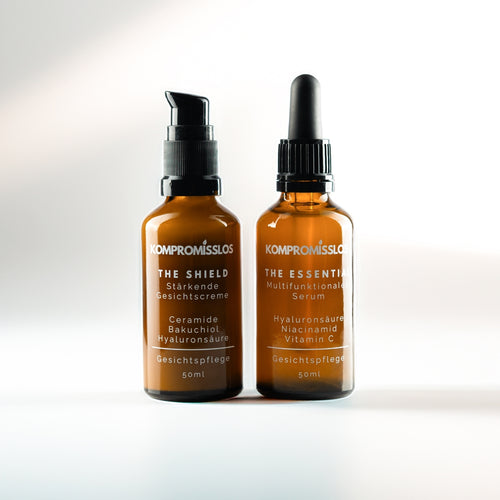
What helps overloaded skin most is reducing the irritation and focusing the skincare you keep on a few well-tolerated steps. Reducing does not mean leaving everything out. Skin that feels tight and burns still needs moisture and lipids, just not in seven layers and not together with three active ingredients that are irritating it right now. The aim is a base so calm that you can see again how your skin actually behaves. Such a base consists of a mild cleanser or just water, a serum, a cream and, during the day, a separate sunscreen. That is exactly the principle behind The Duo of serum and cream, and it works with other products too, as long as the number of steps stays small.
- Cleanse with water, and only use a mild, fragrance-free cleanser in the evening if you have been wearing make-up or sunscreen.
- Pause acids, exfoliants, retinoids and other potent products for the time being.
- Use just one serum and one cream, both without fragrance.
- Apply a separate sunscreen during the day so that UV exposure does not add to the strain.
- Introduce nothing new for several weeks and observe your skin during that time.
How long recovery takes depends on how badly the barrier has been affected; what is known about this is covered in the article on how a damaged skin barrier recovers. Think in weeks rather than days.
Do not test individual products while your skin is recovering. If you bring back an old serum after a few days, you cannot tell whether a new reaction comes from the serum or is still left over from the overload before it.
When is it something other than too much skincare?
It is probably something else if your symptoms persist for several weeks or get worse despite a significantly reduced routine. At that point it is no longer about skincare habits but about getting your skin checked by a dermatologist. Common culprits include contact allergy, rosacea, atopic eczema, acne and perioral dermatitis. The latter typically shows up as small red bumps and flakes around the mouth and nose, often with a narrow clear margin right next to the lip. A separate article explains in detail how to tell it apart from ordinary dry skin around the mouth. With all of these conditions, it is important to remember that cosmetics can only play a supporting role. A cortisone cream should only go on your face after you have talked to a doctor, not on your own initiative.
A second warning sign is how quickly it comes on and how severe it is. Blisters, weeping patches, severe swelling or itching that wakes you at night are not signs of too much cream. If, on the other hand, your skin reacts to almost every product with burning and you cannot find a clear cause, the article on what to do when your skin suddenly reacts to everything will help you narrow it down.
I deliberately built Kompromisslos with two products instead of eight, and we sell neither a toner nor an exfoliant. The reason fits this topic exactly: the answer to skincare overload is leaving things out, not adding another product – not even one of mine. That is why the serum and the cream are fragrance-free, and why I disclose the concentrations, so you know what you are putting on your skin. To be honest, even the Duo cannot calm overwhelmed skin overnight. If your skin is burning right now, the first step is to cut down the number of products. How the two products are used morning and evening is deliberately kept simple: water, serum, cream, nothing more.
Frequently asked questions
Can using too many skincare products cause breakouts?
Yes, it can. Several rich layers on top of one another can congest the pores, and irritated skin is quicker to react with small blemishes. If the spots appear shortly after you start a new active ingredient, it is worth asking whether it is skin purging or a reaction. If your acne is persistent, have it checked by a dermatologist.
Should I stop using skincare altogether if my skin is overloaded?
No, cutting back makes more sense than stopping. Overloaded skin has often already lost moisture and lipids, and it still needs a base that supports the skin barrier. With a few well-tolerated products, such as a mild cleanser, a serum and a cream without fragrance, you take out the irritation without leaving your skin completely unprotected.
Can mature skin be overloaded too?
Yes, mature skin can be overloaded just as easily. Over the years it usually produces less sebum, and it is often given several anti-ageing active ingredients at once – a retinoid, an acid and vitamin C, for example – plus several rich creams. This combination of more sensitive skin and lots of irritants is a typical route into overload. Fewer active ingredients, sensibly dosed, are usually better tolerated.
Which active ingredients overload the skin most often?
Most often it is exfoliating acids such as AHAs and BHAs, retinoids and high-strength active ingredients, especially when several of them are used together. Then there is fragrance, which is not an active ingredient but is one of the most common triggers of allergic contact reactions. Usually the problem is not the individual substance but the combination.
How often should I moisturise overloaded skin?
Morning and evening is usually enough. Extra rounds during the day do not speed up recovery; they only mean more contact with products. If your skin feels tight, use a little more cream when you normally moisturise rather than applying a second layer or another product at lunchtime.
When can I start using active ingredients again?
When your skin has been calm for several weeks, meaning it no longer burns, feels tight or turns red. Then reintroduce one active ingredient at a time, leaving a few weeks between each, so you can tell what is causing any reaction. Before you combine them, it is worth checking which skincare ingredients work together.
Is The Duo suitable for skin that has been overloaded?
Yes, it can work as a calm base once you have cut back, because it consists of just a serum and a cream and is fragrance-free. To be honest, though, it does contain active ingredients such as 5% niacinamide and 2% vitamin C. If your skin is burning right now, wait until it has settled and consider starting with one application a day. You can see exactly what it contains on the product page for The Duo.
Sources
- Wigger-Alberti W, Spoo J, Schliemann-Willers S, Klotz A, Elsner P. The tandem repeated irritation test: a new method to assess prevention of irritant combination damage to the skin. Acta Dermato-Venereologica, 2002. Source
- Johansen JD. Fragrance contact allergy: a clinical review. American Journal of Clinical Dermatology, 2003. Source
- Ananthapadmanabhan KP, Moore DJ, Subramanyan K, Misra M, Meyer F. Cleansing without compromise: the impact of cleansers on the skin barrier and the technology of mild cleansing. Dermatologic Therapy, 2004. Source
- Malik R, Quirk CJ. Topical applications and perioral dermatitis. Australasian Journal of Dermatology, 2000. Source