Skin purging vs breakout: how to tell if your new skincare can stay
SKIN CONCERNS
Skin purging is the name for new breakouts in the first few weeks after you start using an active ingredient that speeds up skin renewal – mainly retinoids and exfoliating acids such as glycolic or salicylic acid. The spots appear where you tend to break out anyway and clear up within a few weeks. Spots after a cream without such ingredients, or itching, burning, swelling or a rash in new places, point instead to an intolerance or to skincare that simply does not suit your skin. In that case the rule is: stop rather than push through.
What is skin purging and how is it different from a skin reaction?
Skin purging is a temporary worsening of your complexion that happens because an active ingredient speeds up the renewal of the skin’s outer layer and brings existing blockages to the surface faster. The idea behind it: beneath the surface sit microcomedones, tiny blockages you cannot see yet. A retinoid or an acid makes them mature in less time. No new problems are created; the existing ones simply become visible. An intolerance is something fundamentally different. Here your skin reacts to an ingredient in the product, either as irritation or as a genuine contact allergy. This typically shows up as redness, itching, burning, flaking, swelling or small blisters, and sometimes as bumps that look like spots.
To be honest, purging is less well documented than the many guides would have you believe. A literature review in the Journal of Drugs in Dermatology looked specifically for study data on initial flare-ups caused by retinoids and found none. The available data tended to show improvement within the first few weeks. The authors put isolated flare-ups in the first or second week down to the natural ups and downs of acne. For you, this means that purging is an exception with narrow limits, not an excuse for every reaction.
Which active ingredients can actually cause purging?
Purging can only happen with active ingredients that measurably speed up skin cell turnover – in other words, retinoids and exfoliating acids. Retinoids include retinol, retinal and prescription forms such as tretinoin or adapalene. Among the acids, the main ones are glycolic acid, lactic acid and salicylic acid, as found in exfoliants, acid toners and serums. A small study in Acta Dermato-Venereologica measured this mechanism in six healthy volunteers: both 12% glycolic acid and 0.1% retinoic acid significantly shortened the renewal time of the outer skin layer compared with the control. Both substances also caused redness. That is exactly what makes it hard to tell the two apart in everyday life, because the same ingredient can both speed things up and irritate. How deeply each acid works is explained in the overview of AHA, BHA and PHA. Redness, flaking and tightness caused by retinol are a separate topic, covered in detail in the article on retinol side effects.
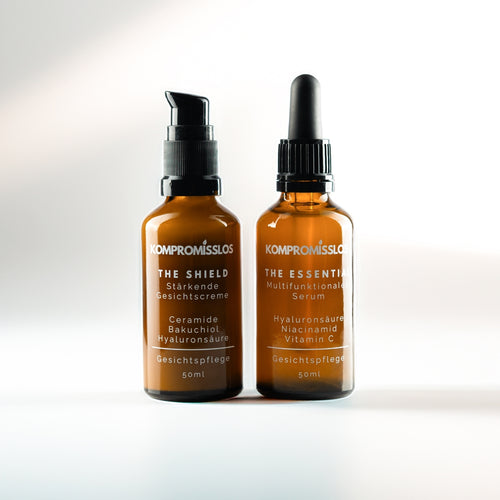
Nothing else causes purging. A moisturiser, a hyaluronic serum, niacinamide, zinc, ceramides or plant oils do not speed up the renewal of the outer skin layer. If a product like that brings new spots, something is not right – be it the texture, an ingredient or the amount you use. The Duo contains neither a retinoid nor an exfoliating acid; the cream uses bakuchiol instead of retinol. Even so, nobody can guarantee that every skin will stay calm with it.
How can you tell purging from a breakout by location, type and duration?
You can recognise purging by the fact that the blemishes appear in your usual problem areas, tend to be small and come and go faster than your usual spots. If you normally get blackheads and small papules on your chin or forehead, purging brings them out in exactly the same places, just more densely. New spots where you have never had any, such as on your cheeks or neck, argue against purging. The same goes for anything that itches, weeps, flakes or turns red over a wider area. The distribution can also be a clue. A review in Clinical Reviews in Allergy and Immunology describes how a suspected contact allergy to cosmetics is first identified from the patient’s history and the pattern of the skin changes. Reactions in the centre of the face tend to point to creams and make-up, while those on the sides of the face and the neck often point to shampoo and conditioner, which run down there as they are rinsed out.
| Feature | Purging | Intolerance | Unsuitable skincare |
|---|---|---|---|
| Trigger | Retinoid or exfoliating acid | Any ingredient, often fragrances and preservatives | A texture that is too rich or clogs pores |
| Location | Your usual problem areas | Anywhere the product goes, including new areas | Often where the skin is oilier anyway |
| Type | Small blackheads and papules | Redness, itching, burning, flaking, blisters | Blackheads and spots that stay |
| Course | Improves after a few weeks | Stays or gets worse as long as you carry on | Stays as long as you use the product |
| What to do | Keep the dose the same or reduce it, and observe | Stop using it | Stop using it and switch to a different texture |
The third column is often overlooked. Not every spot after a new cream is purging or an allergy. Sometimes the skincare is simply too heavy for your skin. The guide to comedogenic ingredients explains what the term really means and why the finished formula matters more than individual raw materials.
How long does skin purging last?
There is no reliable figure for how long skin purging lasts, because the phenomenon has never been properly captured in studies. The logic behind it serves as a guide instead: if an active ingredient only brings existing blockages up faster, your complexion has to calm down after a few weeks, because at some point the supply runs out. As a rule of thumb rather than a study figure: if things are not clearly better after four to six weeks, it is no longer purging but a sign that the product, the concentration or the frequency does not suit your skin. The same applies if it starts again straight after a short break, as soon as you reapply the product. It is also worth knowing what makes it last longer: daily use of a high concentration from the start, several acids and retinoids at once, or an extra exfoliant on top. If you start like that, you will end up unable to tell whether your skin is purging or simply overwhelmed.
Terms such as ‘healing crisis’ or ‘your skin just needs to adjust’ do not belong here. They come from the detox narrative and are readily applied to products that contain no accelerating active ingredients at all. A cream without a retinoid or an acid does not detox anything. If new spots appear when you change your skincare, the article on switching to natural skincare explains what to look out for.
When should you stop using new skincare?
Stop using the new skincare as soon as the reaction no longer fits the narrow picture of purging. That sounds strict, but it is the safe interpretation, because a contact allergy can get stronger with every further application. A review in Actas Dermo-Sifiliográficas names contact dermatitis caused by cosmetics as the reason for 2 to 4 per cent of all dermatology visits, around 60 per cent of which are allergic. Fragrances are the most common cause, followed by preservatives. However, the authors also stress that every ingredient, natural ones included, can be a possible trigger.
- Itching, swelling, weeping patches or small blisters, even if they are only mild.
- Burning that does not ease off after a few minutes. What lies behind that sensation is explained in detail in the article on face cream stinging.
- New spots after a product without a retinoid or acid.
- A rash in places where you have never had spots, or reactions on the eyelids.
- No clear improvement after four to six weeks.
After you stop, your skin above all needs rest: gentle cleansing, a simple product you know you tolerate, and no new experiments. If your skin is currently flaring up at almost everything, the article on what to do when your skin is suddenly reacting to everything will help. Severe swelling, a widespread rash or reactions that do not subside after stopping should be checked by a dermatologist. A clinical patch test there can also establish which substance is responsible.
How do you trace a reaction back to the right product?
The most reliable way to trace a reaction back to its source is to change only one product at a time and keep a short skin diary. If a serum, a cream and a cleanser all join your routine in the same week, you will later have no way of telling which product triggered the spots or the redness. How to introduce new skincare step by step and test it beforehand is covered in the article on how to patch test skincare. This section is about what comes afterwards: how do you read what has happened? Four notes a day are enough.
- What: which product is new, with its active ingredient and how often you use it, and what else has changed, such as laundry detergent, shampoo, make-up or sunscreen.
- When: on which day the first changes appeared and whether they get stronger after each application.
- Where: in your usual areas or new ones, widespread or isolated, in the centre of your face or at the sides.
- How long: whether it is weaker, the same or stronger after a week.
A photo taken in the same light every few days beats any memory. Many spots also have causes that have nothing to do with the new product: your cycle, stress, or friction from a face mask or your phone. If your skin is generally prone to blemishes, the diary matters all the more, because normal fluctuations can otherwise look like a reaction. How cautiously some people go about it is shown by a review on Judge.me in which Meret S. writes: ‘I came across the Kompromisslos products by chance and tried them out individually and cautiously at first’ (review translated from German).
I deliberately used bakuchiol instead of retinol in The Shield, and there is no exfoliant and no toner in our range. That means The Duo does not contain the active ingredients classically associated with purging. But it does not mean that every skin will tolerate The Duo. Any ingredient can trigger a reaction, including a plant-based one. That is why we offer a 100-day return policy. You cannot fairly judge whether a skincare product suits your skin after two days, but you can after a few weeks. If you realise during that time that it does not suit you, you should not keep applying it out of a guilty conscience. Exactly which ingredients are in it, and at what concentration, is set out openly on the page about our active ingredients.
Frequently asked questions
Can a moisturiser cause purging?
No, a plain moisturiser does not cause purging, because it does not speed up skin renewal. If you get spots after starting a new cream, it is too rich for your skin, contains something you do not tolerate, or you are using too much. Stopping and observing then makes more sense than pushing through.
Can vitamin C cause purging?
As a rule, no, because vitamin C does not speed up cell turnover the way a retinoid or a fruit acid does. New spots after a vitamin C serum usually have other causes, such as the base formula, an additional acid in the product or irritation. If an acid such as glycolic acid is also on the ingredient list, purging becomes possible again.
Does it help to introduce new skincare more slowly?
Yes, with retinoids and acids, a slow start with just a few applications a week usually makes the reaction milder and easier to read. What such an introduction schedule looks like in practice is explained in the article on testing a new face product at home.
Can niacinamide cause purging?
No, niacinamide does not speed up skin renewal and is therefore not a purging ingredient. Spots, redness or burning after using it have other causes, which are explained in more detail in the article on niacinamide side effects.
Can I squeeze spots while my skin is purging?
No, even during purging you should leave spots alone. Squeezing pushes inflammatory material deeper into the tissue, which can leave marks that last longer than the purging itself. Why that is and what helps instead is covered in the article on squeezing spots and why you should leave them alone.
What should I do if I am not sure?
If you are not sure, stop the product you added most recently and watch your skin for one to two weeks. If it becomes noticeably calmer, you have your answer. If the reaction persists, or itching, swelling or blisters appear, have it checked by a dermatologist and take the ingredient list with you.
What should I do if I get spots after starting The Duo?
Take it seriously and do not write it off as purging, because The Duo contains neither a retinoid nor an exfoliating acid – none of the classic purging triggers. First check what else has changed, then test the serum and the cream separately to find the product responsible. If the spots persist, stop using it and get in touch. That is what the 100-day return policy is for.
Sources
- Yentzer BA, McClain RW, Feldman SR. Do topical retinoids cause acne to “flare”? Journal of Drugs in Dermatology, 2009. Source
- Effendy I, Kwangsukstith C, Lee JY, Maibach HI. Functional changes in human stratum corneum induced by topical glycolic acid: comparison with all-trans retinoic acid. Acta Dermato-Venereologica, 1995. Source
- Zirwas MJ. Contact Dermatitis to Cosmetics. Clinical Reviews in Allergy and Immunology, 2019. Source
- González-Muñoz P, Conde-Salazar L, Vañó-Galván S. Allergic contact dermatitis caused by cosmetic products. Actas Dermo-Sifiliográficas, 2014. Source